中文 (中国)
 Tiếng Việt
 한국어
한국어
In the era of smart manufacturing, ensuring flawless adhesion quality on polymers, metals, and composite materials has become more stringent than ever before. Plasma cleaning technology has rapidly emerged as the ultimate “golden” solution, effectively replacing traditional, highly toxic chemical treatment methods. By fundamentally intervening at the nanometer scale through advanced processes like activation, coating, and plasma surface modification, this equipment does more than just clean—it completely redefines material surface enhancement for the Industry 4.0 landscape.
1. What is the fundamental nature of plasma cleaning technology?
1.1. Atomic-level purification and ionization mechanics
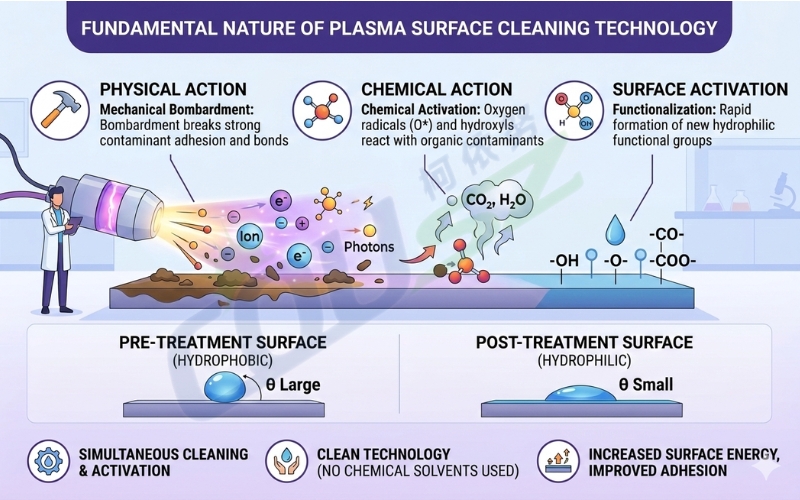
At its core, plasma cleaning technology utilizes the fourth state of matter—an ionized gas—to thoroughly eradicate organic impurities and chemically activate the surface of a material. When highly energetic particles, including positive ions, free electrons, and highly reactive free radicals, violently collide with a substrate, they physically and chemically break the strong hydrocarbon bonds of deeply embedded dirt, machining oils, and microscopic grease.
During this intense interaction, these fractured organic contaminants are rapidly oxidized and converted into completely harmless, volatile gas molecules, primarily Carbon Dioxide (CO2) and Water Vapor (H2O), which are then exhausted from the system. This specific mechanism is what allows a standard plasma surface treatment machine to achieve unparalleled purity without relying on harmful liquid solvents.
1.2. Why atomic cleaning outpaces traditional solvents
The most outstanding advantage of this advanced methodology is its capacity for “atomic cleaning.” Unlike liquid solvents that rely on macroscopic fluid dynamics, ionized plasma gas can seamlessly penetrate into microscopic, nanoscale crevices and deep blind holes that liquids physically cannot reach due to surface tension. This guarantees an absolutely pristine, microscopically clean canvas that flawlessly prepares the substrate for subsequent manufacturing stages.
2. How does plasma improve interfacial bonding mechanisms?
2.1. Micro-etching and barrier layer elimination
One of the most profound core values of plasma cleaning technology is its phenomenal ability to drastically improve Interfacial Bonding. Interfacial bonding refers strictly to the intermolecular interactive forces that occur at the exact contact boundary between two dissimilar materials (for example, between a smooth plastic polymer and a liquid structural adhesive).
A plasma cleaner chemically and physically amplifies this critical bonding force through two simultaneous, highly aggressive actions:
- Micro-etching (increasing nanoscale roughness): The kinetic bombardment of heavy plasma ions actively excavates billions of microscopic cavities into the substrate. This drastically multiplies the actual physical contact area, allowing liquid adhesives to flow into these pores and create a permanent “mechanical interlocking” effect once cured.
- Eliminating weak boundary layers: Surfaces are naturally plagued by weak oxide scales or Low Molecular Weight Layers (LMWL) of loose plastic molecules. Plasma completely annihilates these weak structural barriers, ensuring that the applied coating bonds directly to the robust, solid bulk structure of the base material.
2.2. Empirical data on adhesion strength
The scientific community heavily backs these industrial claims. According to extensive peer-reviewed research conducted by materials engineering experts at the prestigious Fraunhofer Institute, properly executing plasma surface cleaning can aggressively amplify the sheer tensile bond strength by an astonishing 3 to 5 times when directly compared to an untreated, virgin surface.
| Treatment Method | Surface Cleaning Level | Interfacial Bond Strength | Environmental Impact |
|---|---|---|---|
| Plasma Cleaning Technology | Nanoscale (Atomic) | Excellent (3x-5x Increase) | Zero VOCs (Eco-Friendly) |
| Chemical Solvents | Macroscopic | Moderate | High VOCs (Toxic waste) |
| Mechanical Sanding | Visible roughness only | Poor to Moderate | Generates airborne dust |
3. What is plasma activation and how does it boost surface energy?
3.1. Converting hydrophobic polymers to hydrophilic states
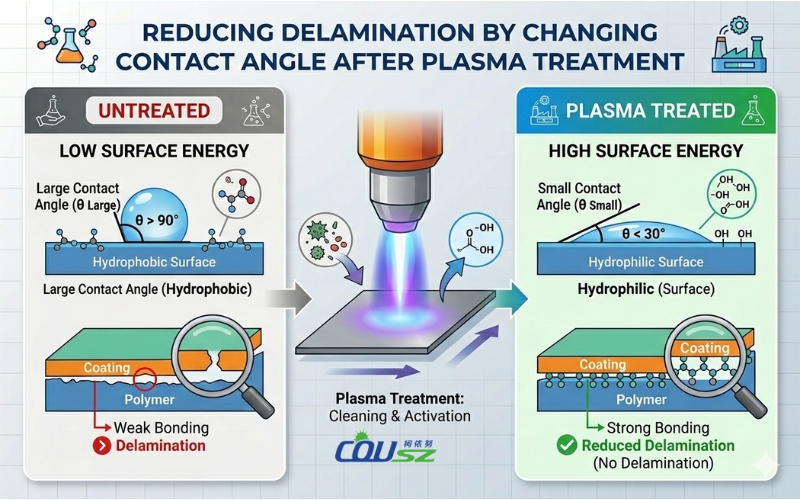
Plasma Activation is the precise, calculated process of chemically transforming a material’s surface characteristics from a highly “inert” state into a highly “reactive” state. The vast majority of standard industrial plastics—such as PP, PE, and PTFE (Teflon)—naturally possess critically low surface energy. This low energy state renders them highly hydrophobic, causing industrial printing inks, paints, or structural glues to bead up and shrink away (commonly known as the lotus leaf effect).
During the intense plasma activation process, the highly energetic free radicals present within the plasma plume violently react with the polymer chains. This reaction forcefully breaks inert Carbon-Carbon bonds and systematically grafts highly polar chemical functional groups, specifically Hydroxyl (-OH) and Carboxyl (-COOH), directly onto the substrate’s surface.
3.2. Measuring the success of surface property improvement
The ultimate result of this chemical transformation is massive. The material’s surface energy spikes dramatically, frequently soaring past the critical 72 dyne/cm threshold required for optimal industrial bonding.
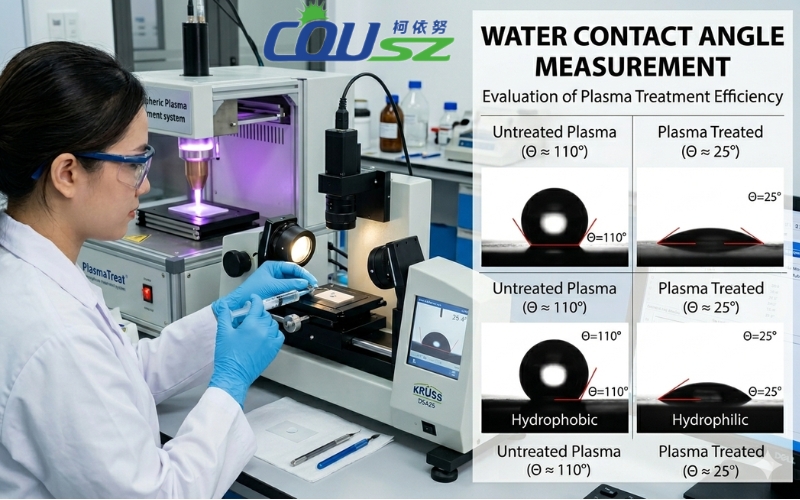
To accurately measure this surface property improvement in a factory setting, engineers utilize Contact Angle measurement goniometers. Before treatment, a water droplet on raw plastic typically exhibits a contact angle of 90 degrees or higher. Immediately after plasma exposure, this angle plummets to below 20 degrees, serving as absolute, irrefutable scientific proof of perfect, uniform wettability.
4. Why is plasma surface modification crucial for smart materials?
4.1. Tailoring specific chemical functionalities
While standard plasma activation is generally designed to be a temporary, short-term boost for immediate gluing or printing, plasma surface modification focuses entirely on altering the surface structure in a highly stable, long-term, and permanent manner. This highly advanced procedure is essentially the act of “tailor-making” exact surface properties strictly according to specialized manufacturing demands.
Through precise gas modulation, a plasma surface treatment machine can engineer specific functionalities:
- Hydrophilic (Water-attracting): Extensively utilized for critical medical devices, such as diagnostic microfluidic chips and catheters, to drastically increase biocompatibility and biological fluid flow dynamics.
- Hydrophobic (Water-repelling): Engineered to create ultra-durable, waterproof barrier shields for sensitive outdoor electronics and high-end consumer wearables.
- Anti-static properties: Permanently modifying the surface of synthetic packaging plastics to completely prevent the dangerous accumulation of electrostatic discharge (ESD) that can fry delicate microchips.
4.2. Preserving the bulk properties of the product
Applying advanced plasma surface modification allows high-tech enterprises to innovate and create intelligent, functional materials without ever altering the internal, mechanical Bulk Properties of the original product. The tensile strength, visual clarity, and core flexibility remain 100% pristine and untouched.
5. How does nanoscale plasma coating protect industrial products?
5.1. Polymerizing ultra-thin functional films
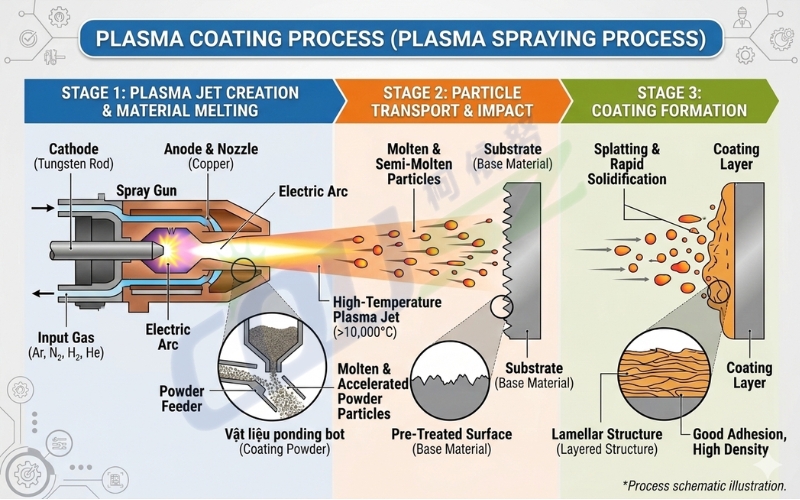
Plasma Coating (often referred to as Plasma Enhanced Chemical Vapor Deposition or PECVD) represents the absolute pinnacle of modern surface engineering. Instead of solely relying on standard inert gases like Argon or Nitrogen, specialized vaporized precursor gases (monomers) are intentionally introduced directly into the highly energetic plasma zone.
The intense plasma energy shatters these monomers, causing them to rapidly cross-link and polymerize, ultimately depositing an incredibly dense, ultra-thin polymer film—typically measuring only 10 to 500 nanometers thick—that covalently bonds directly to the substrate.
5.2. Core industrial benefits of plasma polymerization
The industrial benefits of integrating this specific plasma cleaning technology are immense and highly lucrative:
- Absolute Barrier Protection: Creates flawless, impermeable barriers against oxygen and moisture transmission, massively extending the shelf life of premium pharmaceutical and food packaging.
- Advanced Anti-Corrosion: Shields sensitive industrial metals and aerospace alloys from aggressive degradation in harsh, high-salinity marine environments.
- Antibacterial Surfaces: Highly critical for sterilizing surgical instruments, orthopedic implants, and modern biometric smartwatches.
Furthermore, because this is a 100% “green”, completely solvent-free process that generates zero toxic liquid discharge, it is actively defining the new global standard for sustainable manufacturing in 2026.
6. What are the key application trends in core industries?
6.1. Transforming automotive, electronics, and medical sectors
Today, advanced plasma cleaning technology is absolutely no longer a theoretical concept confined to university research laboratories; it has been aggressively integrated into high-speed, mass-production assembly lines worldwide. The most prominent material surface enhancement trends include:
- Automotive & Electric Vehicles (EV): Utilizing atmospheric plasma to meticulously treat EV battery casings, intricate headlight housings, and interior plastic dashboards to guarantee that expensive polyurethane paints and sealants never peel or delaminate under extreme temperature fluctuations.
- High-Tech Electronics: Deploying vacuum plasma systems to flawlessly activate the surface of high-density PCB boards, premium wireless earbuds, and smartphone chassis prior to dispensing highly sensitive protective potting compounds and conformal coatings.
- Medical & Pharmaceuticals: Leveraging plasma surface modification on delicate surgical catheters and diagnostic assay trays to drastically increase clinical testing sensitivity and ensure perfect biocompatibility inside the human body.
- Technical Textiles: Depositing specialized nano-coatings to engineer premium athletic fabrics that are 100% waterproof yet retain total microscopic breathability for the wearer.
7. Contact a plasma surface treatment expert at COUSZ
Is your enterprise actively searching for definitive, data-driven solutions for material surface enhancement, or do you require free, hands-on plasma sample testing in a controlled laboratory environment? Connect with our elite engineering team today to secure your factory’s future:
- 👤 Ms. Yuna – Senior Plasma & Surface Treatment Solutions Expert
- 📱 Tel/Zalo/Whatsapp/Wechat: (84) 965 535 348
- 📧 Email: sales03@cousz.com
- 🌐 Website: www.cousz-vn.com
8. Frequently asked questions about plasma technology
8.1. Does plasma cleaning technology damage delicate substrates?
No. When properly calibrated by a professional, the plasma beam strictly interacts with the outermost molecular layers (a few nanometers deep). Especially when utilizing cold plasma technology, the thermal impact is virtually non-existent, ensuring that delicate substrates like ultra-thin polymer films or sensitive microchips never warp, melt, or suffer any bulk structural damage.
8.2. How long does the surface property improvement last?
The longevity of the activation depends on the material and the specific plasma process used. Standard plasma activation on plastics typically remains highly effective for 24 to 72 hours before natural polymer chain relaxation (the aging effect) occurs. However, if true plasma surface modification or plasma coating is applied, the chemical changes and nano-barrier effects are permanently bonded to the substrate and can last for decades.
8.3. Can it replace toxic chemical primers entirely?
Absolutely. One of the primary financial and environmental drivers for adopting a plasma surface treatment machine is the complete elimination of hazardous, high-VOC chemical primers and liquid adhesion promoters. Plasma creates stronger, covalent chemical bonds naturally, rendering expensive and toxic chemical pre-treatments entirely obsolete.