中文 (中国)
 Tiếng Việt
 한국어
한국어
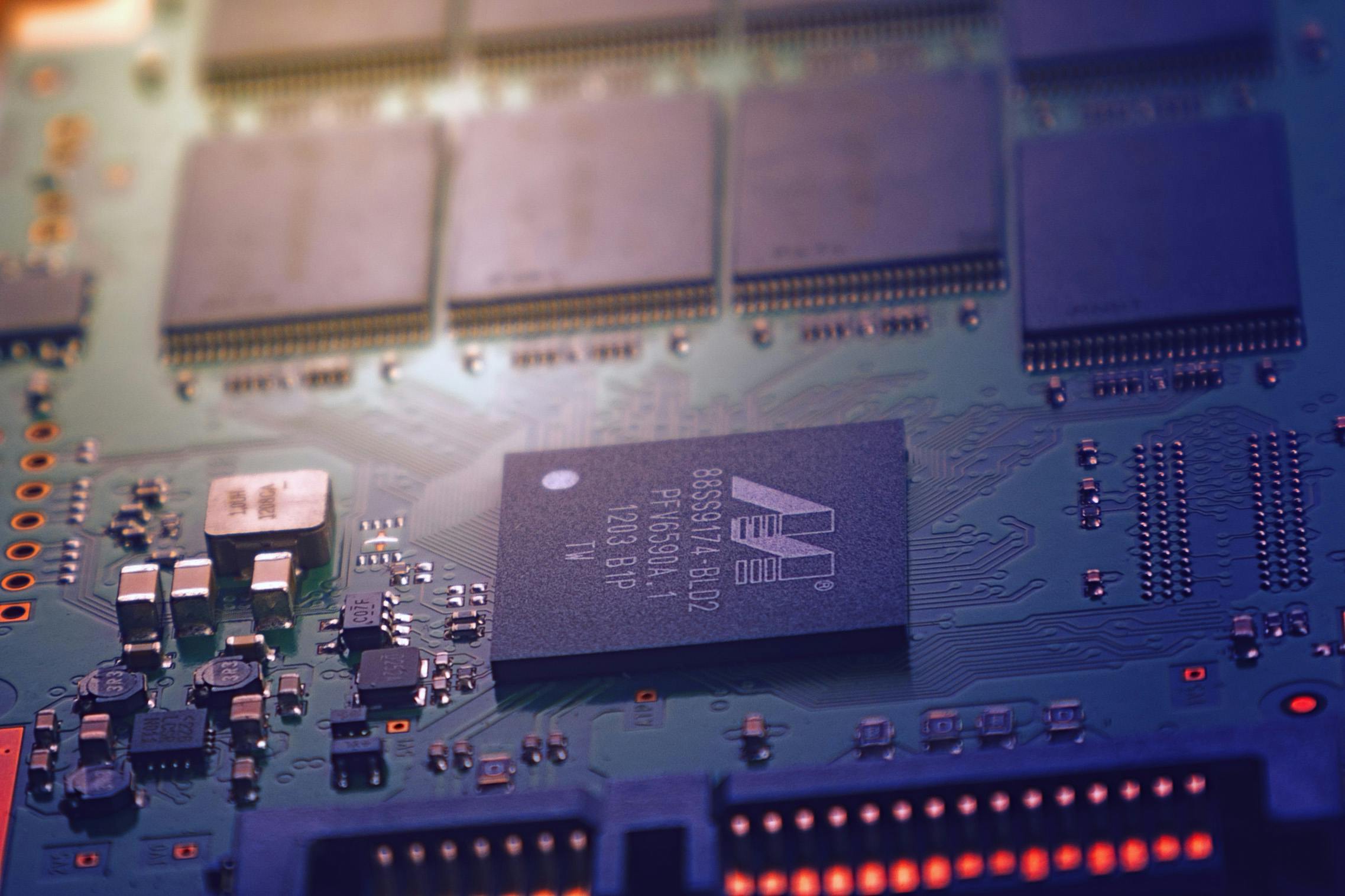
In the new era of advanced material manufacturing, guaranteeing absolute adhesion on notoriously inert polymer or high-purity metal surfaces is a colossal industrial challenge. Utilizing plasma surface cleaning technology—specifically through the process of Plasma Activation—has emerged as a pivotal, core technology. It effortlessly alters surface characteristics at the atomic level without ever damaging the underlying bulk structure of the material. By radically driving up surface energy and grafting highly reactive chemical functional groups, plasma activation establishes an unbreakable, rock-solid foundation for all subsequent industrial gluing, high-resolution printing, and nanoscale coating processes.
1. What exactly is Plasma Activation?
1.1. The science of ionized gas treatment
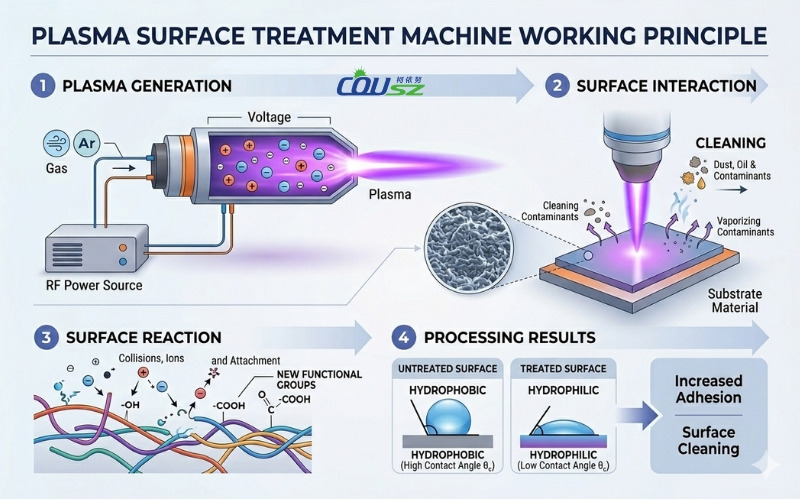
Plasma Activation is a highly specialized engineering process that leverages the fourth state of matter—an ionized gas or plasma—to fundamentally transform the physical and chemical topography of a material’s surface. When a raw substrate is exposed directly to this intense plasma field, an extremely dense cloud of high-energy particles (including heavy positive ions, fast-moving electrons, and highly reactive free radicals) violently bombards the outermost molecular layer.
1.2. From hydrophobic to hydrophilic
This intense bombardment process accomplishes far more than just executing a microscopic “atomic cleaning” to obliterate trace organic impurities. More importantly, advanced plasma technology systematically replaces weak, naturally occurring chemical bonds with highly active, polar functional groups (such as -OH and -COOH). This precise chemical shift miraculously transforms a slick, highly hydrophobic (water-repelling) surface into a perfectly hydrophilic (water-attracting) one, making it completely primed for permanent, durable bonding.
2. What is the scientific mechanism behind Plasma Activation?
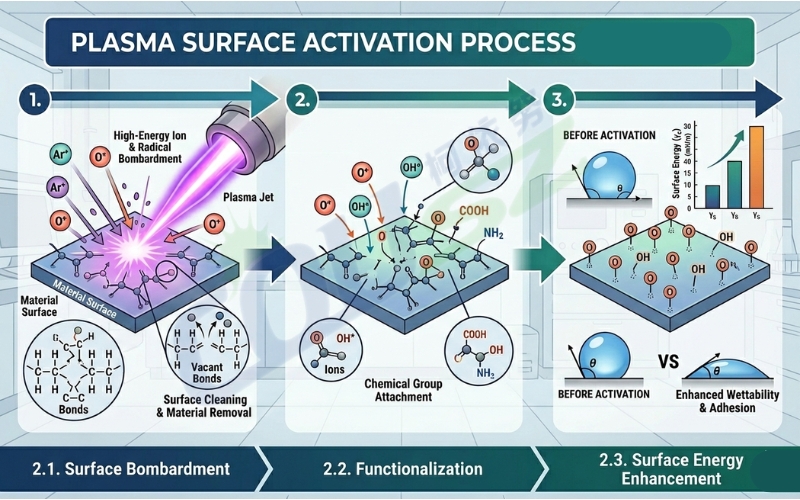
According to extensive, peer-reviewed research published in the globally respected Surface and Coatings Technology journal, the complex process of Plasma Activation unfolds through three distinct, core scientific stages:
2.1. Surface Bombardment (Breaking chemical bonds)
The highly energetic electrons and heavy ions present within the plasma stream possess more than enough kinetic and thermal energy to forcibly shatter stable Carbon-Carbon (C-C) or Carbon-Hydrogen (C-H) bonds on the surface of dense plastics and polymers. This violent fracturing process instantly creates millions of localized “free radical” sites on the substrate—sites that are incredibly unstable and highly eager to form new chemical bonds.
2.2. Functionalization (Grafting chemical groups)
Depending entirely on the specific process gas injected into the plasma surface treatment machine (such as Oxygen, Nitrogen, or standard compressed air), these exposed free radicals will rapidly combine with the highly reactive atoms suspended in the plasma plume to form new, polar functional groups:
- When using Oxygen gas: The process predominantly generates Hydroxyl (-OH) and Carbonyl (C=O) groups, which drastically and instantly increase the material’s wettability.
- When using Nitrogen gas: The process specifically engineers Amine (-NH2) groups onto the surface, which is absolutely vital for dramatically improving chemical covalent bonding with industrial Epoxy-based structural adhesives.
2.3. Surface Energy Enhancement (Increasing dyne levels)
The direct, measurable result of this aggressive plasma surface technology is a massive, sudden spike in the material’s surface energy (scientifically measured in mN/m or Dyne/cm). For context, a standard, untreated sheet of PP plastic typically holds a critically low surface energy of around 28-30 Dyne/cm. However, immediately after plasma activation, this measurement can skyrocket to well over 72 Dyne/cm—the exact mathematical threshold considered ideal for liquids, inks, and glues to wet out perfectly and adhere flawlessly.
3. Why does Plasma Activation deliver superior manufacturing benefits?
3.1. Shifting away from toxic chemical processes
Why are modern, forward-thinking factories rapidly discarding outdated, highly toxic chemical primer treatments in favor of plasma surface cleaning technology? The answers lie in four distinct operational advantages:
- Nanoscale precision: The intense activation process strictly impacts a microscopic depth of merely a few nanometers. Consequently, the core physical shape, tensile hardness, and bulk properties of the final product remain 100% unaltered and undamaged.
- Environmental sustainability: The process operates completely solvent-free. It generates absolutely zero toxic chemical discharge and emits no VOCs, perfectly aligning with the strict, global “green manufacturing” trends projected for 2026.
- Massive economic efficiency: The actual processing speed is incredibly fast (often calculated in milliseconds per localized area). This allows the equipment to be effortlessly integrated onto the end of high-speed, 6-axis robotic arms running on fully automated assembly lines.
- Broad material compatibility: A single high-end machine can seamlessly treat an enormous variety of substrates, ranging from notoriously difficult plastics (PP, PE, ABS) and rigid metals (Aluminum, Stainless Steel) to delicate glass and technical ceramics.
4. What are the practical applications of Plasma Activation technology?
Today, advanced plasma technology is deeply embedded in the manufacturing lifecycle of almost all premium, high-reliability products that surround us daily:
4.1. Core industrial sectors
- Electronics industry: Aggressively activating the surface of complex PCB boards immediately prior to applying protective potting compounds or conformal coatings. This ensures a hermetic seal against severe moisture, dust, and mechanical vibration.
- Automotive industry: Meticulously treating interior plastic dashboards, EPDM door seals, and polycarbonate headlights before painting or applying heavy-duty 3M adhesive tapes. This absolutely guarantees the coating will never peel or flake, even under extreme UV exposure or harsh weather conditions.
- Medical sector: Safely activating the surface of delicate surgical catheters and biometric implant trays. This dramatically improves biological compatibility and provides the necessary chemical foundation for antimicrobial nano-coatings to bond permanently.
- Flexible packaging: Ensuring that high-resolution UV inks grip tenaciously onto notoriously slick PET plastic films and aluminum foils without ever resorting to the use of hazardous, ozone-producing chemical primers.
5. What factors determine the ultimate efficiency of Plasma Activation?
5.1. Controlling the critical engineering variables
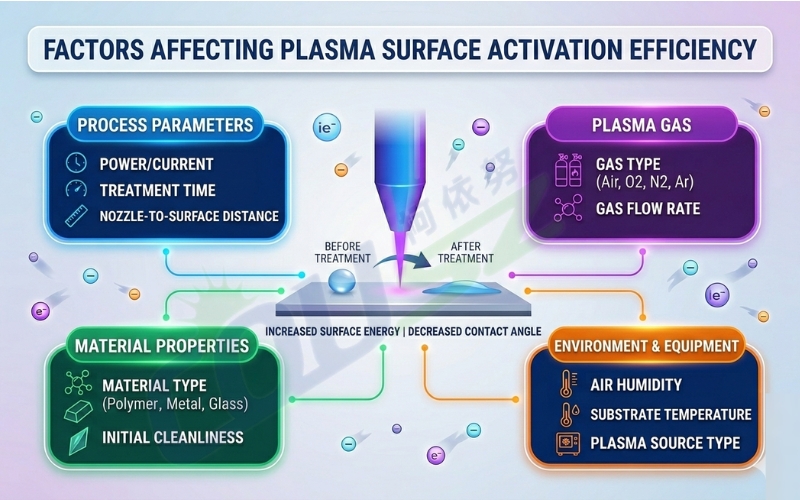
To successfully optimize the plasma activation process on a live factory floor, process engineers must rigorously control and monitor the following critical variables:
- Generator power output: If the electrical power is set too low, the plasma lacks the kinetic energy required to successfully break the stable carbon bonds on the substrate. Conversely, if the power is cranked too high, it will generate excessive heat, causing catastrophic thermal damage or melting to delicate polymers.
- Treatment exposure time: Plasma Activation typically reaches its absolute peak efficiency within just a few seconds. Subjecting the material to the plasma beam for too long does not increase the surface energy further; instead, it causes “over-treatment,” creating a brittle, oxidized crust that actively weakens adhesive bonds.
- Nozzle standoff distance: For atmospheric plasma systems, the mathematically ideal focal distance from the nozzle tip to the material surface generally fluctuates within a highly strict range of 5mm to 12mm to ensure maximum ion impact.
6. Conclusion on the future of surface engineering
Plasma Activation represents far more than a simple, macroscopic cleaning step; it is a highly sophisticated, atomic-level “surface engineering” process. It brilliantly unlocks the ability to form permanent, unbreakable chemical bonds on materials that the industry previously deemed “impossible to glue.” Backed by modern, fully automated plasma surface cleaning technology, enterprise leaders can aggressively elevate their product quality, drive their factory defect rates down to near zero, and optimize their long-term operational costs in a truly sustainable, eco-friendly manner.
7. Contact COUSZ for Plasma Activation solutions
If your manufacturing line is currently battling severe material adhesion failures, or if you wish to dive deeper into the science of plasma technology, contact the engineering experts at COUSZ today to schedule a free, comprehensive sample demonstration:
- 👤 Ms. Yuna – Senior Plasma Solutions Expert
- 📱 Tel/Zalo/Whatsapp: (84) 965 535 348
- 📧 Email: sales03@cousz.com
- 🌐 Website: www.cousz-vn.com