中文 (中国)
 Tiếng Việt
 한국어
한국어
In modern industrial manufacturing, significantly increasing the surface energy of a substrate is the ultimate key to guaranteeing the flawless adhesion of industrial glues, printing inks, and protective coatings. However, the critical choice between a plasma cleaner vs corona treatment frequently leaves enterprise engineers searching for definitive answers. This comprehensive technical article will deeply analyze the exact differences between these two surface activation methods. By evaluating their performance, efficiency, and industrial applicability, we aim to help you confidently select the most optimal and cost-effective solution for your automated production line.
1. What is plasma surface treatment technology?
1.1. Operating principles and nanometer precision
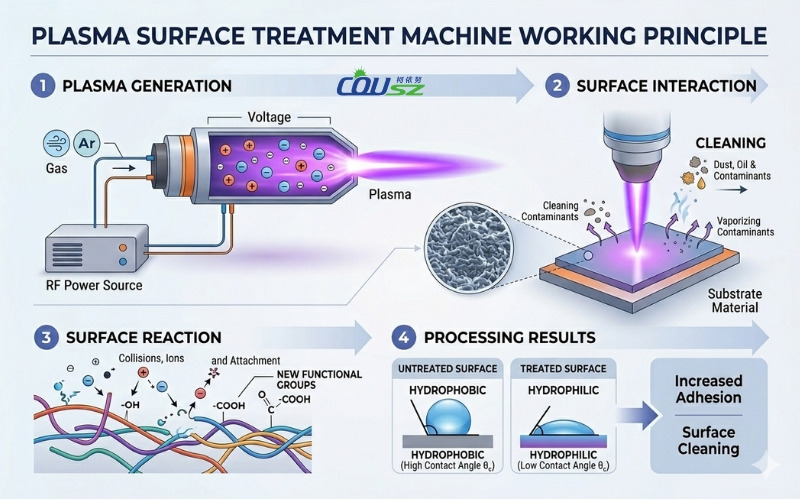
Plasma surface treatment technology harnesses the profound power of the fourth state of matter—an ionized gas—to fundamentally alter the physicochemical characteristics of a material at the nanometer scale. When a specific process gas (typically compressed air, high-purity Nitrogen, or Oxygen) is driven through a high-voltage electromagnetic field, electrons are forcibly stripped away. This intense reaction generates a highly active plasma plume, which is incredibly rich in energetic ions and free radicals.
The working principle: A plasma surface treatment machine blows this concentrated plasma stream directly onto the target surface through specialized nozzles. These highly energetic particles aggressively bombard the substrate, violently breaking inert carbon bonds and immediately replacing them with highly polar chemical functional groups, such as Hydroxyl (-OH).
1.2. Core advantages and industrial challenges
Opting for a plasma system offers several undeniable manufacturing advantages:
- Nanometer precision: The treatment is highly localized and only penetrates a few nanometers deep, guaranteeing zero thermal or structural damage to the bulk material.
- Deep atomic cleaning: It flawlessly eradicates microscopic organic dust, deeply embedded greases, and machining oils, performing a dual action of cleaning and activation.
- Long-lasting durability: The chemical activation achieved by plasma maintains its high surface energy for significantly longer periods compared to other legacy methods.
The challenge: The initial capital investment for a high-end plasma system is generally higher than traditional equipment, and it requires strict regulation of the input compressed air quality. However, when evaluating a plasma cleaner vs corona treatment, it becomes immediately apparent that plasma possesses vastly superior versatility across complex 3D material profiles.
2. What is traditional corona surface treatment?
2.1. The mechanics of electrical discharge on films
Corona surface treatment is a localized, high-voltage electrical discharge created between two specific electrodes, where at least one electrode is heavily insulated. This traditional method has been widely deployed across the globe since the 1950s, serving primarily as the standard for the thin plastic film manufacturing and packaging industries.
The working principle: The material (most commonly a continuous web of thin plastic film) is passed rapidly through a narrow air gap between the active discharge electrode and a grounded roller. The resulting corona electrical arc generates ozone and bombards the surface with ions, physically breaking the polymer chains on the outermost layer to temporarily increase wettability.
2.2. Strengths and critical limitations
Corona systems bring specific benefits to highly specialized applications:
- Low capital cost: The equipment is structurally simple, relatively inexpensive to procure, and highly straightforward to operate and maintain.
- Extreme processing speed: It is exceptionally efficient at continuously treating massive rolls of film running at speeds of hundreds of meters per minute.
The challenge: Corona is strictly limited to treating flat, two-dimensional, and highly thin materials. Its activation effect suffers from a rapid “aging effect,” meaning the surface energy degrades incredibly fast. Furthermore, the uncontrolled electrical arcs can easily cause “pinholing” (burning holes through the film) and will instantly destroy sensitive electronic components. Therefore, factory managers must carefully weigh the risks when looking to plasma vs corona treatment compare for their high-tech assembly lines.
3. How do you compare plasma vs corona treatment directly?
3.1. Technical comparison and surface energy metrics
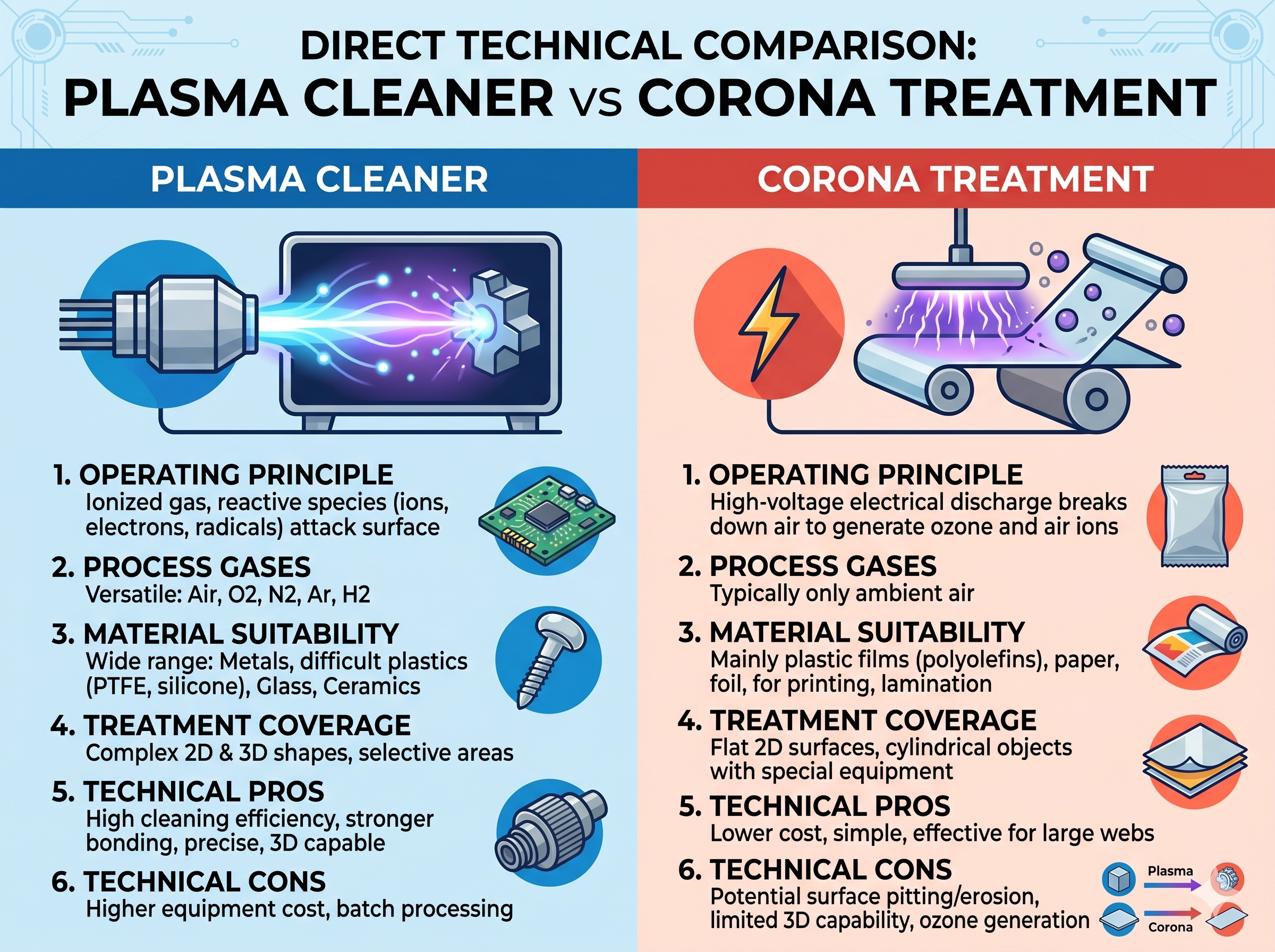
To acquire the most objective, data-driven perspective regarding the difference between plasma and corona treatment, we must meticulously analyze their capabilities based on practical, real-world technical criteria:
| Evaluation Criteria | Plasma Surface Treatment | Corona Surface Treatment |
|---|---|---|
| Nature of the energy beam | Highly focused, low-temperature plasma plume. | Wide, high-voltage electrical arc discharge. |
| Cleaning capabilities | Executes atomic nano-cleaning (removes oils/grease). | Only performs chemical activation; zero cleaning ability. |
| Compatible material shapes | Perfect for complex 3D parts, thick profiles, and narrow gaps. | Strictly limited to 2D flat, ultra-thin continuous films. |
| Required treatment distance | Highly flexible; treats effectively from 5mm to 15mm away. | Requires extremely close, dangerous proximity (< 3mm). |
| Durability of the effect | Highly stable and long-lasting (several days to weeks). | Degrades very rapidly (often within hours to a few days). |
According to extensive empirical studies published in the internationally acclaimed Surface and Coatings Technology journal, when placing corona vs plasma surface treatment side by side, there is a massive disparity in the final achieved surface energy. While a standard corona system typically maxes out at a moderate 38-48 dyne/cm, an industrial plasma cleaner can effortlessly push the surface energy well past the critical 72 dyne/cm threshold, even on notoriously hydrophobic plastics like PP or PTFE.
4. When should you choose corona vs plasma surface treatment?
4.1. Selecting the right system for your specific application
Making the final executive decision between a plasma cleaner vs corona treatment depends entirely on the specific geometric, operational, and budgetary requirements of your manufacturing facility:
You should choose Corona Treatment when: Your factory exclusively manufactures continuous rolls of PE or PP plastic films, or flat, thin plastic packaging. It is the ideal choice when you require extremely high-speed web processing and are working within a very tight, low capital expenditure budget.
You must choose a Plasma Surface Treatment Machine when:
- Your products feature complex, three-dimensional geometries (such as intricate automotive parts, smartphone chassis, or precision medical devices).
- You are required to treat highly heat-sensitive materials or delicate, expensive printed circuit boards (PCBs) that corona arcs would destroy.
- Your assembly process demands exceptionally high adhesion strength for specialized structural epoxies, UV inks, or advanced nano-coatings.
- The raw material is microscopically contaminated with machining oils and demands simultaneous atomic cleaning alongside chemical activation.
Practical manufacturing data continuously proves that while combining both methods is occasionally useful for heavy web lines, plasma technology is aggressively replacing corona across all high-quality, precision manufacturing sectors. Deeply understanding the contrast between a plasma cleaner vs corona treatment ensures your enterprise avoids wasteful investments and successfully skyrockets its product pass rates. Ultimately, this choice is a strategic balance between immediate initial costs and long-term, sustainable quality.
5. Contact a plasma solutions expert today
If your manufacturing enterprise is still struggling to definitively choose between a plasma cleaner vs corona treatment, connect with the elite engineering team at COUSZ for deep technical consultation and completely free, hands-on sample testing:
- 👤 Ms. Yuna – Senior Plasma & Surface Treatment Solutions Expert
- 📱 Tel/Whatsapp/Wechat/Zalo: (84) 965 535 348
- 📧 Email: sales03@cousz.com
- 🌐 Website: www.cousz-vn.com

6. FAQs – Frequently asked questions about treatment methods
6.1. Why is corona treatment mostly seen in the plastic film printing industry?
Corona treatment strictly requires an incredibly narrow electrode gap and mandates that the material be perfectly flat to ensure an even electrical discharge. The roll-to-roll plastic packaging industry, which utilizes continuous rotating web rollers, perfectly matches these physical constraints. However, when you compare corona vs plasma surface treatment, corona is entirely incapable of safely processing thick, rigid objects or complex 3D shapes without causing severe electrical arcing.
6.2. Is plasma treatment truly more durable than corona?
Yes, absolutely. In detailed engineering analyses of a plasma cleaner vs corona treatment, it is proven that the polar chemical functional groups generated by plasma penetrate deeper and form significantly more stable covalent bonds. The activation effect from a corona system frequently vanishes rapidly due to the natural reorientation of polymer chains (the aging effect), whereas plasma maintains its peak activation levels for considerably longer.
6.3. Why is plasma considered “stronger” than corona for surface activation?
Plasma is universally considered stronger because it delivers a vastly higher density of reactive ions and free radicals directly to the surface. When placing plasma vs corona treatment compare models side-by-side, plasma not only chemically activates but also executes “micro-etching.” This nanoscale physical roughening drastically increases the actual contact surface area—a critical mechanical interlocking advantage that a corona system simply cannot replicate. This dual-action mechanism is exactly why the debate over plasma cleaner vs corona treatment is of such paramount importance to process engineers.