中文 (中国)
 Tiếng Việt
 한국어
한국어
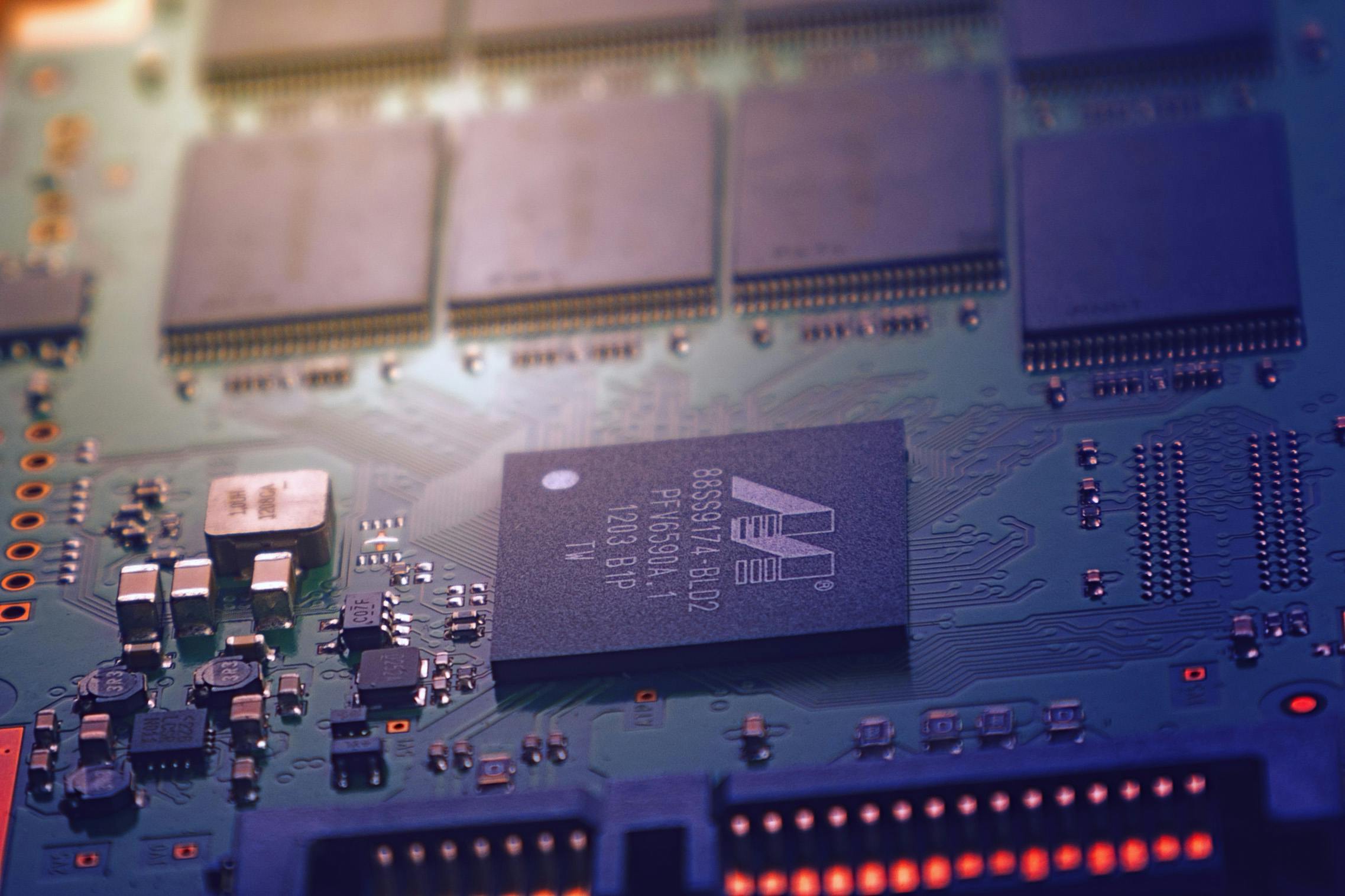
In the highly demanding landscape of modern industrial manufacturing, optimizing surface adhesion is a critical factor for ensuring long-lasting product quality. Plasma coating technology has rapidly emerged as the perfect, high-tech alternative to outdated, traditional methods such as applying chemical primers, mechanical sanding, or thermal flame treatment. This comprehensive article will deeply analyze the fundamental differences between various industrial surface treatment methods, empowering enterprise engineers to select the most optimal and sustainable solution for their assembly lines.
1. Introduction to plasma coating technology
1.1. The mechanism of ionized gas treatment
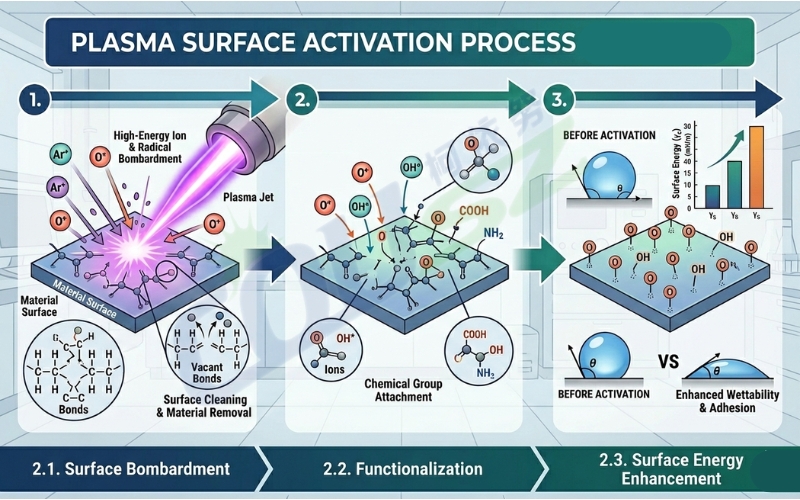
Fundamentally, plasma technology is an advanced surface treatment method that utilizes an ionized gas to generate a highly active cloud of particles, including heavy ions, free electrons, and reactive radicals. When this energetic plasma plume comes into direct contact with a substrate material, it executes a flawless atomic cleaning process, violently removing microscopic organic impurities while simultaneously altering the micro-structure of the surface. Consequently, the surface energy is drastically increased, which massively improves the adhesion capabilities of industrial printing inks, protective coatings, and structural adhesives.
At its core, plasma coating technology is a high-energy surface modification process. Depending strictly on the operational conditions and ambient pressure, the technology is divided into three primary branches:
- Atmospheric plasma surface treatment: Operates at standard atmospheric pressure, typically utilizing ionized compressed air or nitrogen. This is the most widely deployed form of plasma coating technology integrated directly into high-speed, automated robotic assembly lines.
- Vacuum plasma surface treatment: Executed inside a hermetically sealed vacuum chamber at extremely low pressures (ranging from 10^{-1} to 10^{-3} mbar). This specific technology allows for the flawless, 100% uniform treatment of highly complex, 3D geometric parts and deep blind holes.
- Low-pressure plasma treatment: An intermediate technological phase that is exceptionally effective at synthesizing and depositing ultra-dense, highly functional thin-film coatings onto substrates.
| Evaluation Criteria | Atmospheric Plasma | Vacuum Plasma | Low-Pressure Plasma |
|---|---|---|---|
| Primary Application | Continuous inline processing (Conveyor/Robot) | Batch processing (Large quantities inside a chamber) | Thin-film functional nano-coating deposition |
| Treatment Uniformity | High (Excellent for flat surfaces and localized areas) | Absolute (Penetrates all crevices and 3D shapes) | Extremely High |
| Capital Investment | Moderate | High | Very High |
Implementing plasma coating technology across any of these branches helps manufacturing enterprises completely resolve surface energy deficits, easily pushing the dyne level well above the critical 72 dyne/cm threshold.
1.2. The difference between plasma surface treatment and corona treatment
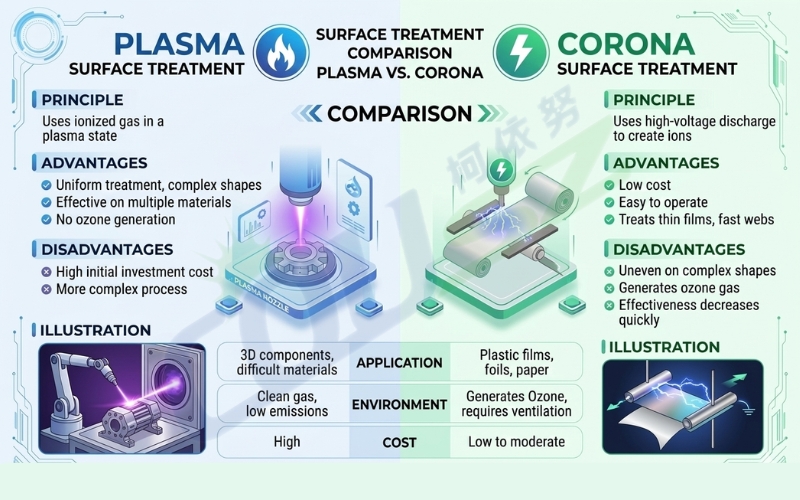
When upgrading factory lines, process engineers frequently debate the difference between plasma surface treatment and corona treatment. While both utilize electrical discharge to treat surfaces, they are fundamentally distinct. Corona treatment relies on a high-voltage electrical arc that generally only treats flat, two-dimensional surfaces. It operates at a lower density, meaning the activation effect degrades rapidly. Furthermore, corona arcs can easily cause “pinholing” or burn through thin polymer films, and they notoriously generate toxic ozone gas.
In the direct comparison of corona vs plasma surface treatment, plasma is vastly superior. When evaluating plasma vs corona treatment, a modern plasma surface treatment machine produces a dense, focused ion stream that can effortlessly treat complex 3D shapes. It creates a much stronger, longer-lasting chemical bond and, crucially, generates zero toxic ozone, making it the superior, environmentally safe choice for modern adhesion improvement techniques.
2. Surface treatment using chemical primers
2.1. Environmental and stability limitations
While applying liquid chemical primers has historically been the traditional method for improving adhesion, it has increasingly exposed severe, critical limitations when directly compared to modern plasma coating technology.
- Severe environmental pollution: Chemical primers heavily contain Volatile Organic Compounds (VOCs). These toxic chemicals not only emit highly offensive odors but directly endanger the respiratory health of factory workers and flagrantly violate modern green manufacturing and ISO 14001 environmental standards.
- Low quality stability: The adhesion effectiveness of a liquid primer relies almost entirely on the manual skill of the operator, the precise thickness of the applied layer, and strict drying times. This inevitably leads to a massive lack of uniformity and wildly inconsistent product quality across different manufacturing batches.
- Hidden operational costs: Enterprises must absorb immense hidden fees associated with the safe storage of hazardous chemicals, the expensive disposal of toxic liquid waste, and the massive allocation of factory floor space required for long drying and curing ovens.
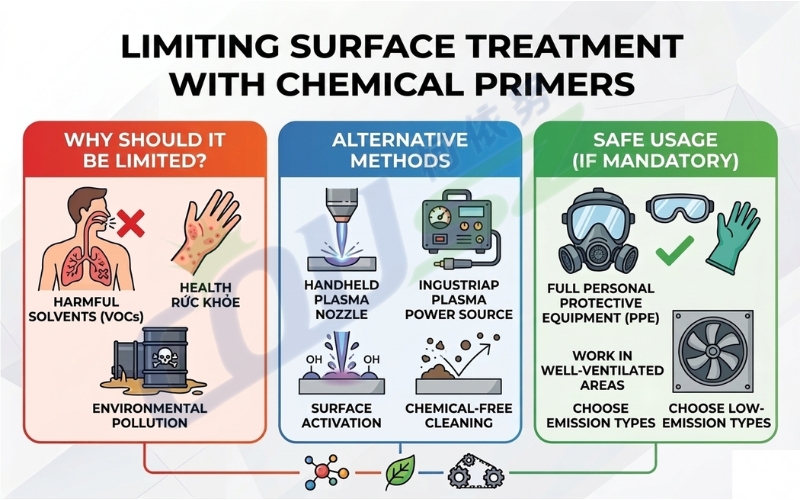
When analyzing plasma treatment vs chemical primer, rigorous empirical studies conducted by professors at the prestigious Fraunhofer Institute in Germany have conclusively proven that utilizing plasma coating technology multiplies the interfacial bond strength by a factor of 3 compared to chemical primers—especially on notoriously low-surface-energy plastics like PP or PE. Transitioning to a plasma cleaner not only guarantees a 100% dry, clean process but also ensures absolute bond durability and perfect consistency for every single production lot.
3. The flame treatment method
3.1. Thermal risks and safety concerns
Flame treatment is a legacy methodology that utilizes extreme, direct heat to thermally oxidize the surface of plastics. Although the initial capital investment for gas burners is relatively low, this method presents severe, often catastrophic risks when compared to modern plasma coating technology.
The most glaring weakness of flame treatment is the massive thermal distortion it inflicts. The uncontrollable heat can easily warp, melt, or completely destroy thin-walled components or highly heat-sensitive polymers. Additionally, operating open, combustible flames within a busy factory environment introduces extreme fire and explosion hazards. Furthermore, it is virtually impossible to maintain uniform treatment consistency across complex, 3D geometric surfaces using a rigid flame.
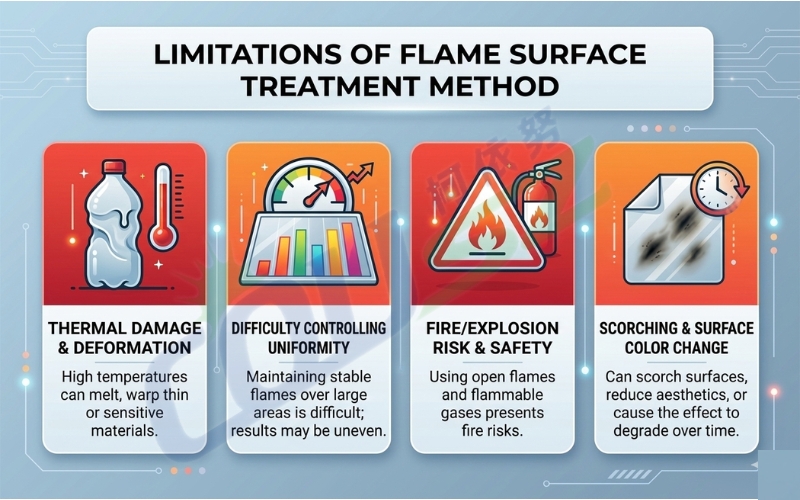
In stark contrast, plasma coating technology (specifically non-equilibrium cold plasma) operates at remarkably low temperatures, perfectly preserving the physical bulk structure of the product. The high-energy ion stream emitted by a plasma surface treatment machine guarantees absolute factory safety while delivering nanoscale precision, engineering a uniformly activated surface without inflicting any thermal damage to the base material.
4. Mechanical sanding and physical abrasion
4.1. Temporary mechanical locking vs chemical bonding
The traditional mechanical sanding method relies entirely on physically gouging microscopic craters into the substrate to give liquid adhesives a rough texture to grip onto. However, in the high-speed industrial manufacturing landscape of 2026, this rudimentary technique exposes fatal flaws when compared to plasma surface modification.
Firstly, mechanical abrasion generates massive amounts of airborne micro-dust and dangerous static electricity, severely contaminating the surface—a catastrophic risk for highly sensitive microelectronics and PCB boards. Secondly, the physical sanding process is incredibly labor-intensive, painfully slow, and notoriously difficult to integrate into high-speed, automated robotic production lines.
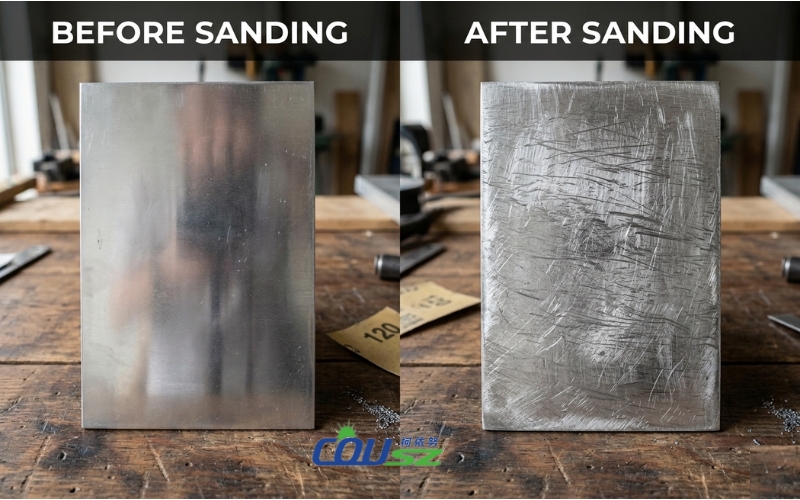
Fundamentally, sanding only creates a temporary, weak “mechanical interlock.” Conversely, plasma coating technology intervenes deeply at the nanoscale structure to synthesize permanent, unbreakable chemical bonds. The plasma activation phase generates highly polar functional groups, such as Hydroxyl (-OH) and Carboxyl (-COOH). These active groups allow the base material to form direct, covalent chemical bonds with the applied coating or structural glue. This profound shift from weak physical locking to permanent chemical bonding is the exact reason why a plasma cleaner delivers eternal durability and absolute surface purity.
5. CO2 dry ice cleaning method
5.1. Physical cleaning without chemical activation
CO2 dry ice blasting is a modern, highly effective method for rapidly blasting away macroscopic contaminants, heavy dust, and thick layers of industrial grease from material surfaces. However, from a strict engineering perspective, CO2 blasting is exclusively a physical cleaning mechanism; it possesses absolutely zero capability to chemically “activate” or modify the surface energy like plasma coating technology does.
To achieve the ultimate peak adhesion performance, many advanced enterprises now utilize a hybrid approach. They deploy CO2 blasting to remove massive, heavy dirt deposits, and immediately follow it with a plasma surface treatment machine to unlock the nanoscale chemical bonds. This powerful synergy ensures that the polar functional groups are perfectly formed, allowing UV inks and structural adhesives to penetrate deeply and create a flawless, permanent interfacial bond that CO2 alone could never achieve.
6. Comparing plasma vs traditional technologies
6.1. Comprehensive technical data table
The following analytical table consolidates empirical data sourced from leading technical reports within the global surface engineering industry:
| Surface Treatment Technology | Purity & Cleanliness | Adhesion Strength | Operational Safety | Automation Integration |
|---|---|---|---|---|
| Plasma Coating Technology | Absolute (Atomic Level) | Extremely High | Extremely High | Seamless / Easy |
| Chemical Primer | Moderate (Leaves residue) | High | Low (Toxic VOCs) | Difficult |
| Thermal Flame | Low | Moderate | Very Low (Fire hazard) | Moderate |
| Mechanical Sanding | Low (Generates dust) | Moderate | Moderate | Difficult |
It is unequivocally clear that plasma coating technology vastly outperforms all legacy methods, particularly regarding digital quality control and environmental compliance. With continuous advancements in plasma technology, enterprises can now easily integrate inline surface energy sensors to monitor and guarantee absolute treatment quality in real-time.
7. Contact our plasma surface treatment experts
If your manufacturing enterprise is actively seeking an advanced solution to upgrade your assembly line with state-of-the-art plasma coating technology, connect with the elite engineering team at COUSZ today:
- 👤 Ms. Yuna – Senior Plasma & Surface Treatment Solutions Expert
- 📱 Tel/Whatsapp/Wechat/Zalo: (84) 965 535 348
- 📧 Email: sales03@cousz.com
- 🌐 Website: www.cousz-vn.com