中文 (中国)
 Tiếng Việt
 한국어
한국어
In the modern industrial manufacturing sector, optimizing material surface energy is the deciding factor for the adhesion quality of structural adhesives, printing inks, and protective coatings. To achieve maximum processing efficiency, engineers and machine operators must master the correct plasma cleaner operation workflow. This sophisticated process requires not only a deep understanding of complex physical parameters but also the precision skills to control equipment at the nanometer scale.
This comprehensive, expert-level guide—curated by the engineers at COUSZ—will help your factory master plasma surface treatment technology, drastically increasing throughput while entirely eliminating costly material peeling defects.
1. How to execute plasma cleaner operation according to technical standards?
1.1. Essential parameter setup and startup sequences
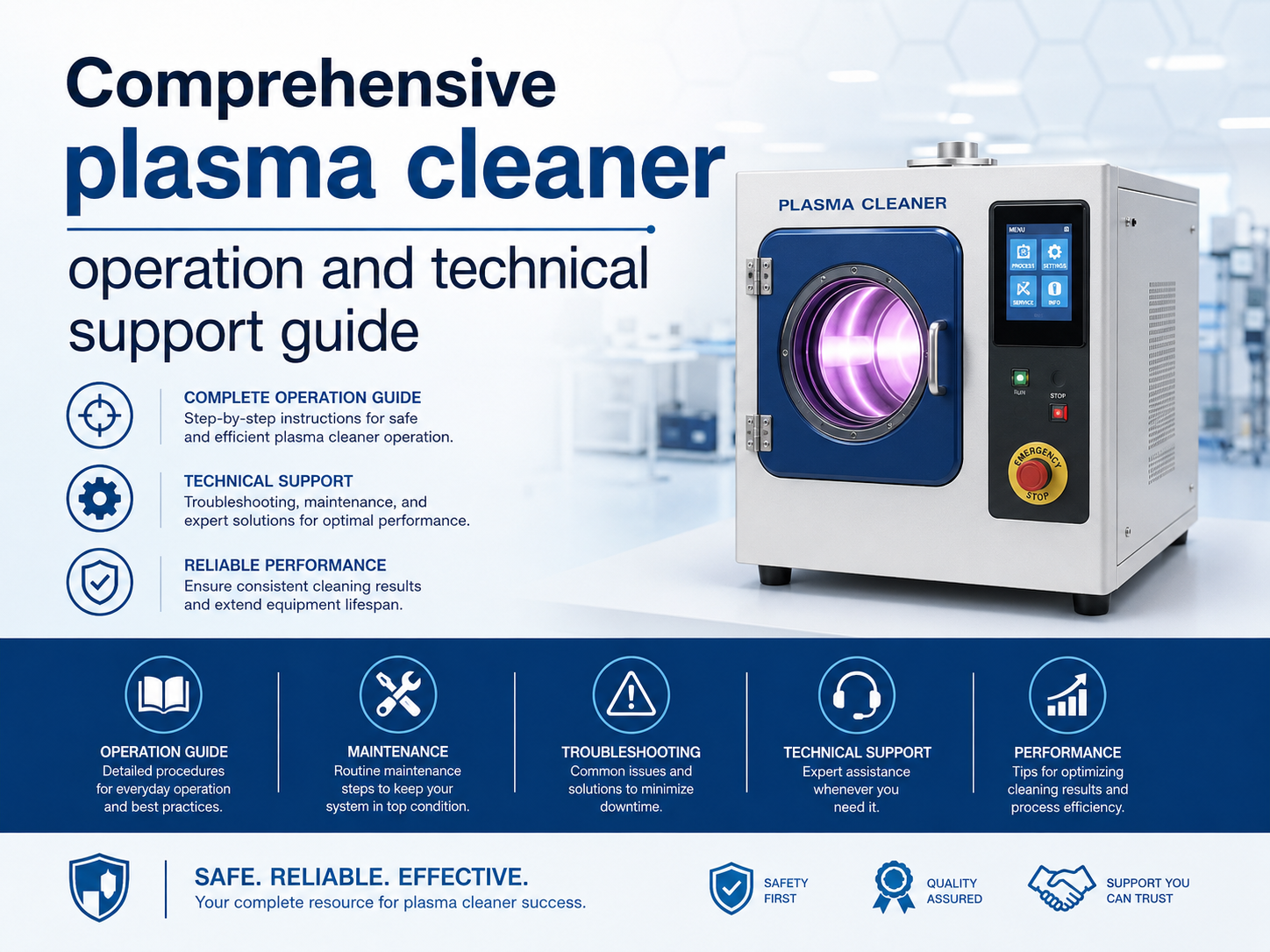
Before initiating the plasma surface treatment machine operation, operators must conduct a comprehensive inspection of the industrial compressed air (CDA) supply or high-purity process gases such as Argon or Nitrogen. The input gas pressure must be maintained at a stable range of 0.4 – 0.6 MPa to ensure the ionized flame exiting the nozzle remains consistent and pressure-loss free.
Unlike legacy systems, modern plasma cleaner operation is highly automated via intelligent PLC control systems. You only need to precisely configure the RF (Radio Frequency) power output and the gas flow rate via the Mass Flow Controller (MFC) directly on the integrated HMI touch screen.
1.2. Optimizing working distance and scanning speed
According to technical research published in Surface & Coatings Technology, the ideal working distance from the nozzle tip to the product surface ranges strictly from 5mm to 15mm. During plasma cleaner operation, if the nozzle is positioned beyond this threshold, high-energy free radicals are neutralized by the ambient air before they can interact with the substrate.
Beyond working distance, successful plasma surface treatment machine operation requires tight synchronization with automated conveyor speeds. Moving the belt too slowly may cause heat accumulation that warps delicate polymer films. Conversely, excessive scanning speeds prevent the ionized particle stream from having enough residence time to fully break inert carbon-carbon bonds.
Master Your Machine
Download our comprehensive plasma cleaning machine manual to master your production workflow.
2. What technical support and maintenance services does COUSZ provide?
2.1. Periodic maintenance for core equipment modules
Even if you perform your plasma cleaner operation flawlessly, physical wear and tear are inevitable. Professional technical services provide a standardized maintenance protocol, including utilizing precision measurement equipment to check for voltage leakage and performing deep nozzle cleaning.
For high-volume production lines requiring plasma surface treatment machine operation across three shifts daily, inspecting and replacing heat-resistant O-rings every 500 operating hours is mandatory to prevent pneumatic pressure loss.
2.2. Genuine spare parts and personnel training programs
Machinery only reaches its maximum potential when operated by personnel who understand its internal mechanics. COUSZ not only supplies genuine spare parts but also organizes specialized re-training sessions on plasma cleaner operation for our clients’ technical teams.
| Essential Component | Avg. Operational Lifespan | Signs of Required Maintenance |
|---|---|---|
| Central Electrode | 1,000 – 1,500 hrs | Beveled wear, blackened oxidation layer |
| Nozzle Head | 2,000 – 3,000 hrs | Micro-clogging, misaligned plasma plume |
| High-Voltage Cable | Over 3 years | Cracked insulation, arcing sounds |
| Air Filter | 6 months | Water saturation, ISO 8573-1 failure |
Optimize Performance
Explore our expert-approved accessories and technical support services to maximize your equipment’s longevity.
3. What are the common issues during plasma cleaner operation and how to fix them?
3.1. Flickering or non-existent plasma discharge
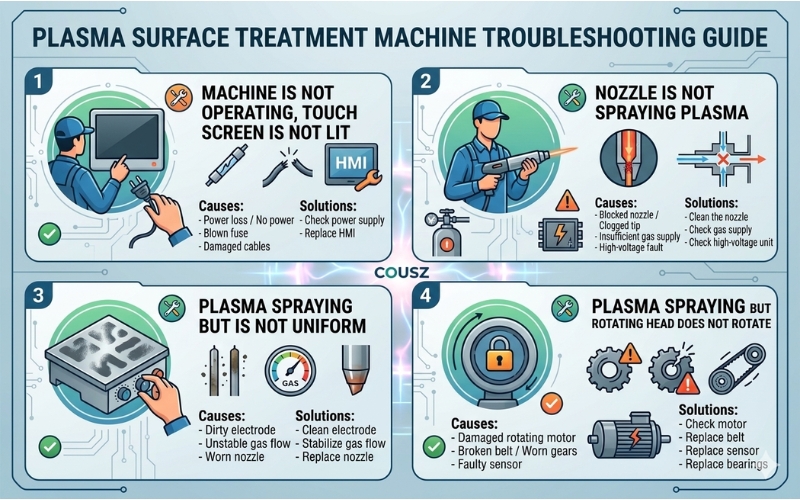
A frequent error during plasma cleaner operation is the failure of the generator to produce a stable, deep-violet plasma plume. This is rarely an electrical failure; it is usually caused by excessive humidity or compressor oil in the factory air supply. Furthermore, if the air pressure exceeds the mechanical limits of the ionizer, the plume will be “mechanically blown out” before the gases can ionize within the reaction chamber.
3.2. PLC temperature overload alerts
If you perform plasma surface treatment machine operation continuously in a high-temperature factory floor while the cooling fan is clogged with dust, the internal temperature sensor will immediately trigger an emergency stop. Never hard-power down the machine. Allow the system to remain in “Standby” mode to let the ventilation fans cool the Inverter motherboard below 45°C before resetting the HMI alarm.
Fix Issues Faster
Resolve production interruptions instantly with our expert-backed plasma cleaner repair and troubleshooting guide.
4. What safety factors are vital during plasma cleaner operation?
4.1. High voltage and electrostatic protection
Systems generating high-energy particle streams rely on high-frequency transformers capable of amplifying voltage to tens of kilovolts (kV). Therefore, the number one rule during plasma cleaner operation is to verify the grounding system (ground resistance must remain below 4 Ohms) periodically.
Technicians must wear specialized anti-static protective gear. Removing all metallic jewelry—watches, rings, and bracelets—is mandatory to completely eliminate the risk of secondary arc discharges, which can be life-threatening.
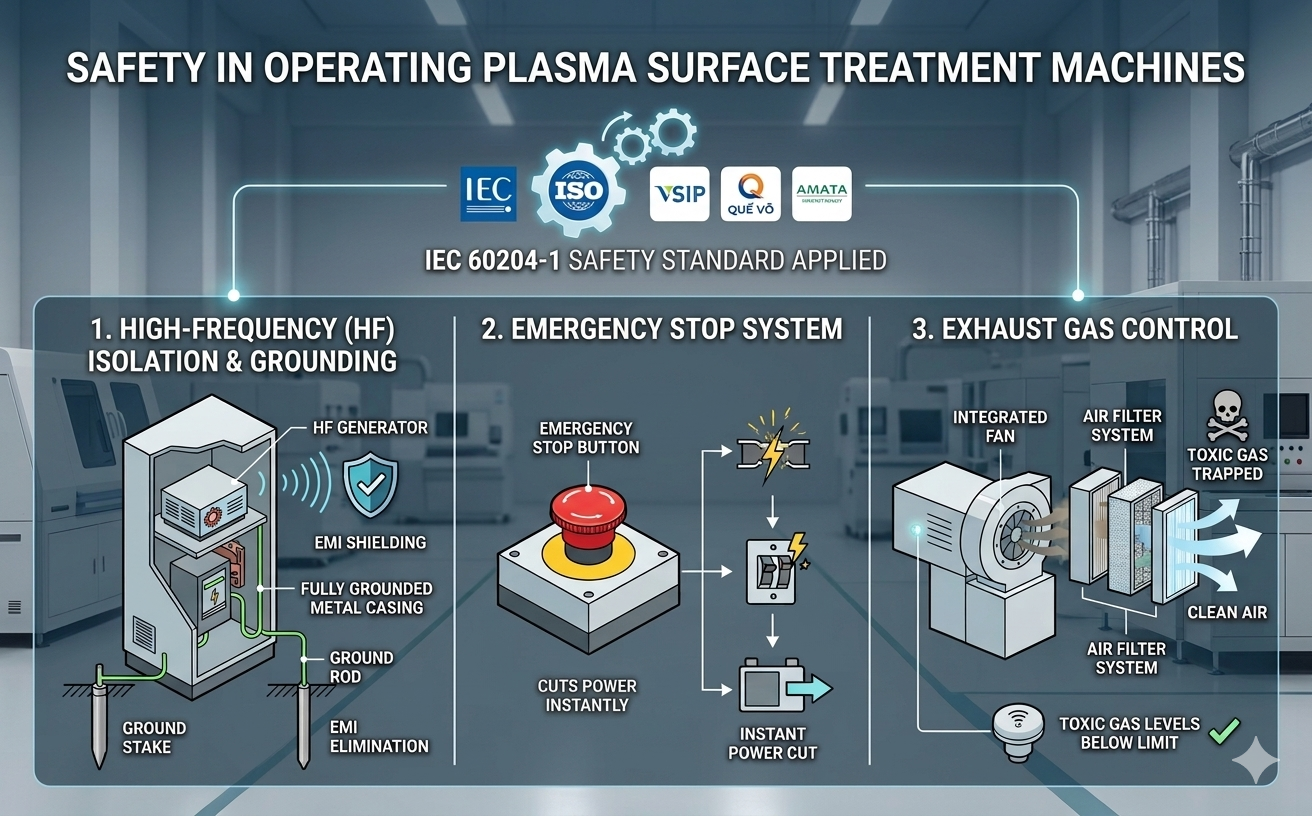
4.2. Exhaust and respiratory protection
Although plasma is a “green” technology that avoids toxic chemical usage, plasma surface treatment machine operation in open factory environments can produce trace amounts of Ozone ($O_3$) via the recombination of oxygen radicals. Installing a local exhaust hood directly above the nozzle area is necessary to comply with international ISO 45001 safety standards, ensuring the respiratory health of all factory workers.
Ensure Safety First
Prioritize workplace safety and efficiency by downloading our essential guide to industrial plasma operation standards.
5. Contact our experts for technical training
Mastering the plasma cleaner operation workflow is the “golden key” to achieving a massive competitive advantage in quality. This technology will permanently eliminate ink adhesion failures, reduce toxic chemical consumption, and elevate the competitive capacity of your automated production line.
To receive the official plasma cleaner operation manual and get expert advice on the most appropriate UV/Plasma solutions for your enterprise, connect with our specialists today:
- 👤 Ms. Yuna – Technical Specialist, COUSZ Vietnam
- 📞 Tel/Whatsapp/Wechat/Zalo: (84) 965 535 348
- 📧 Email: sales03@cousz.com
- 🌐 Website: www.cousz-vn.com