中文 (中国)
 Tiếng Việt
 한국어
한국어
1. General overview of the f358 measurement device
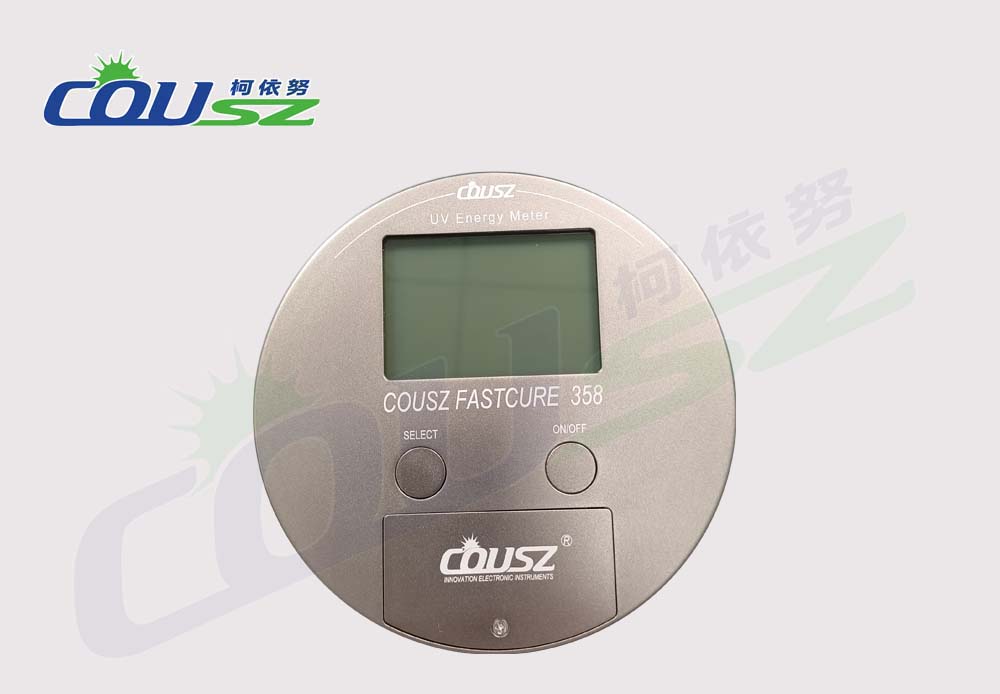
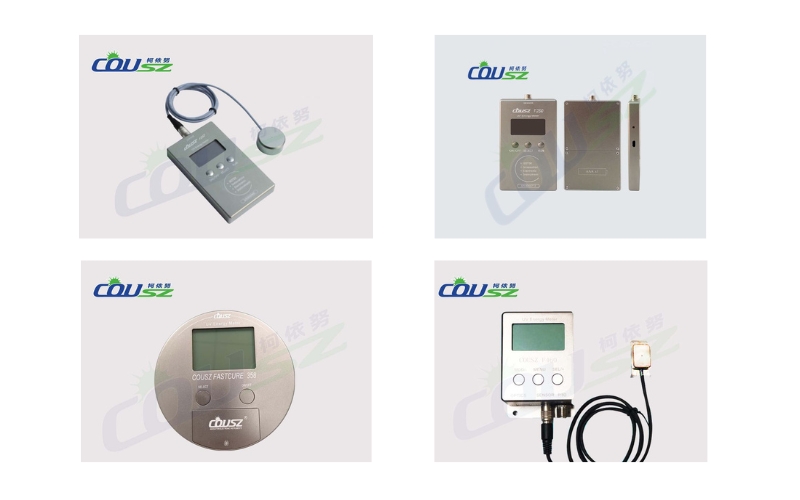
The F358 represents a massive technological leap forward in the field of industrial optical radiation measurement. Unlike traditional single-channel devices that only capture a fraction of the emitted light, this advanced multi-channel UV radiometer allows technicians to simultaneously measure UV energy and the instantaneous optical power across four critically important wavebands: UVA, UVB, UVC, and UVV.
The primary application of this robust instrument is to rigorously inspect the intensity and stability of LED and high-pressure mercury light sources. With an ultra-high sampling frequency reaching up to 2000Hz, the F358 UV light meter guarantees that absolutely no micro-fluctuations in light intensity are missed, even in the most demanding, high-speed production environments. Correctly applying the operational procedures not only secures highly accurate numerical data but also allows engineers to analyze complex power curve graphs—a foundational element in evaluating the true performance and degradation rate of an LED array.
2. Detailed technical specifications of the f358 model
To effectively utilize any advanced optical tool, the very first step is to thoroughly memorize its technical limits and capabilities. Attempting to measure UV energy without understanding these boundaries often leads to catastrophic sensor failure. Below is the detailed specification table for the device:
| Technical Parameter | Detailed Value and Range |
|---|---|
| Measured Spectral Bands | UVA (320-380nm), UVB (280-320nm), UVC (220-280nm), UVV (380-440nm) |
| Power Measurement Range | 0 — 40,000 mW/cm² |
| Energy Measurement Range | 0 — 999,999 mJ/cm² |
| Resolution | 1 mW/cm² |
| Measurement Accuracy | ± 10% |
| Temperature Range | -55°C — 125°C |
| Data Sampling Frequency | 2000Hz |
| Internal Storage Memory | Up to 30 minutes of continuous data recording |
| Dimensions & Weight | Diameter 118mm * Thickness 13mm |
| Power Supply | 2 standard AAA batteries |
A profound understanding of these exact specifications empowers users to confidently execute the operational procedures of the F358 UV light meter, preventing the dangerous mistake of deploying the machine into thermal environments that exceed its maximum allowable limits.
3. Outstanding features that make the f358 unique
Why do highly experienced process engineers consistently demand a specific operational manual for the F358 UV light meter rather than relying on generic tools? The answer lies in its heavily optimized, industry-leading features:
- Fast-response temperature sensor: This multi-channel UV radiometer does not merely measure radiation; it actively records the dynamic, real-time temperature inside the drying chamber. This is exceptionally critical because excessive heat can permanently damage expensive LED chips or cause the thermal warping of sensitive printing substrates.
- Peak thermal resistance design: Integrated with specialized aerospace-grade thermal insulation shielding, the machine can operate continuously in 100°C environments without compromising the delicate internal electronic microprocessors.
- Massive internal memory: The device is capable of logging power and temperature data for up to 30 continuous minutes. Even if the power is suddenly turned off, this logged data remains safely stored and will automatically display upon rebooting.
- 2000Hz sampling frequency: According to rigorous optical standards set by NIST, a high sampling frequency is an absolute prerequisite for accurately measuring the intensity of LED lamps, which inherently possess a high-frequency flickering characteristic.
4. Step-by-step operation guide for precise results
To achieve the most accurate and repeatable measurement results possible, operators must strictly adhere to the following procedural steps when handling the F358 UV light meter.
4.1. Power operations and automatic modes
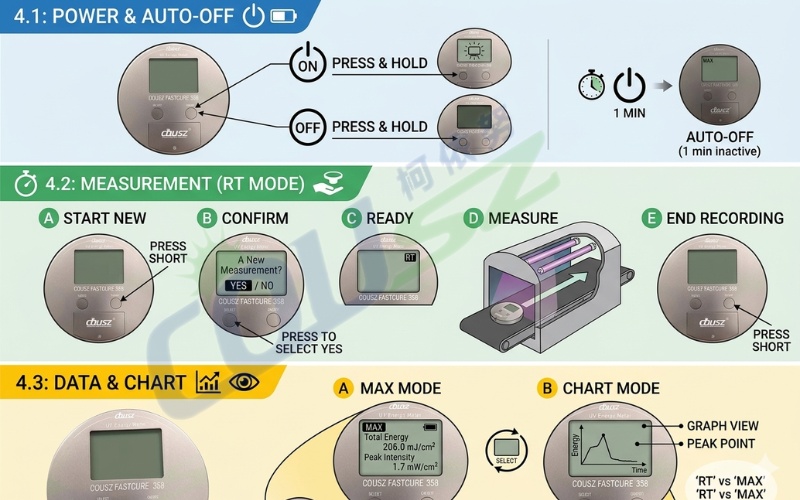
Powering On: Press and hold the “ON/OFF” button firmly until the LCD screen illuminates.
Powering Off: Press and hold the “ON/OFF” button while the machine is currently active.
Smart Auto-Sleep Feature: To proactively conserve battery life, the instrument will automatically shut down if left on the main screen (MAX state) without any user interaction for a duration of 1 minute.
4.2. Executing the real-time measurement (rt mode)
This is the fundamental core of operating the F358 UV light meter. To accurately measure UV energy on a brand new sample, execute the following:
- While on the MAX screen, quickly press the ON/OFF button once.
- The screen will prompt: “A New Measurement? YES/NO”. Press the SELECT button to choose YES.
- When the letters “RT” appear in the bottom left corner, the device is officially ready to measure, and all previous data has been securely wiped from the active buffer.
- Place the radiometer carefully onto the conveyor belt heading into the curing chamber. Crucially, ensure the optical sensor window (located on the back) is facing directly toward the light source at a 90-degree angle to avoid cosine errors.
- Immediately after the device exits the oven, quickly press ON/OFF to terminate the recording process and lock in the data.
4.3. Viewing and analyzing the data graph
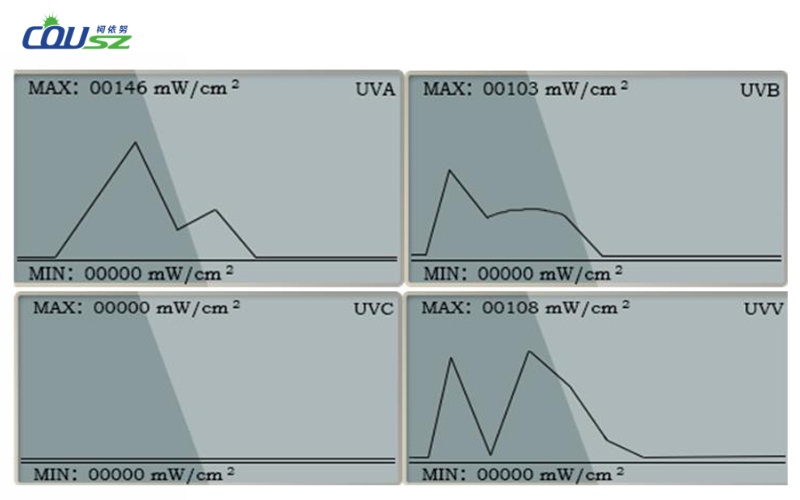
An exceptionally powerful feature of the F358 UV light meter is its built-in capability to render visual data graphs directly on the screen. When the device is in the MAX state, simply press the SELECT button.
At this point, you can toggle between viewing the maximum peak value (Max), the minimum value (Min), and the detailed power curve graphs for all four wavebands (UVA, UVB, UVC, UVV) simultaneously, displayed in mW/cm². Analyzing these specific graphical curves is the most effective way to identify optical “dead spots” or uneven light distribution across your industrial UV curing systems.
5. Instructions for calibration and multiplier adjustment (ch/rate)
During prolonged industrial use, optical sensors inevitably suffer from solarization and material aging. This comprehensive guide also provides the specific methodology for you to proactively calibrate the machine using its internal software coefficients:
- While turning on the machine, press and hold the SELECT button to forcibly enter the hidden calibration interface.
- Here, you will observe the precise CH/rate parameters for UVA, UVB, UVC, and UVV.
- Use the SELECT button to navigate to the specific value you need to amend, and use the ON/OFF button to increment or decrement the numerical value.
- Press and hold SELECT to permanently save the new coefficient changes.
Important Note: This multiplier calibration should only be performed while cross-referencing against a highly protected, standardized master light source. COUSZ highly recommends utilizing our professional annual calibration services to ensure your multi-channel UV radiometer continuously maintains its highest possible accuracy rating.
6. Crucial maintenance tips to protect your device
To avoid constantly searching for troubleshooting manuals because your F358 UV light meter has malfunctioned, you must strictly adhere to these fundamental preventative maintenance principles:
- Signal Reception Direction: The optical probe window on the rear must always be kept immaculately clean and aimed directly at the UV lamp. Any microscopic dust or ink smudges on the quartz filter will violently scatter the incoming light, severely skewing the measurement results.
- Storage Environment: Ultraviolet probes are exceptionally sensitive to ambient humidity. According to degradation studies by RadTech, high humidity can physically erode the delicate optical coatings of the semiconductor sensor. Always store the device inside its specialized carrying case alongside active silica gel desiccants when not in use.
- Avoid Harsh Chemicals: Absolutely never allow the instrument to come into direct contact with corrosive industrial cleaning agents or strong solvents present on the factory floor.
- Calibration Cycle: COUSZ firmly recommends a strict 12-month calibration cycle. This is the absolute best practice to guarantee the validity of every operational procedure applied by your quality control technicians.
7. Contact cousz technical team for expert support
If you encounter any difficulties while operating the F358 UV light meter, or if you require official NIST-traceable calibration support, please contact our engineering specialists immediately. We strongly recommend reading our Professional UV Meter Guide: Detailed Operation and Best Practices to further elevate your metrology expertise.
👤 Ms. Yuna
✨ Technical Specialist – COUSZ Vietnam
📞 Tel/Whatsapp/Wechat/Zalo: (84) 965 535 348
📧 Email: sales03@cousz.com
🌐 Website: www.cousz-vn.com
8. Faqs – common questions about the f358 model
8.1. Why doesn’t my f358 automatically delete old data when measuring?
The device features a secure data retention mechanism designed to prevent accidental data loss. You must quickly press the ON/OFF button and explicitly confirm “YES” at the “A New Measurement?” prompt. Only then will the machine wipe the old buffer and begin recording fresh data.
8.2. How long can i continuously measure inside a high-temperature oven?
Thanks to its premium thermal insulation design, the machine can operate for extended periods at 100°C. However, if the internal ambient temperature exceeds 125°C (the absolute maximum threshold of the thermal sensor), you must extract the device immediately to prevent melting the internal components. Always reference the thermal limits before deployment.
8.3. How do i view the measurement data from the previous 30 minutes?
The F358 UV light meter allows for a maximum storage capacity of 30 minutes. Simply press the SELECT button while in the MAX state to retrieve the graphical curves and peak values of the most recent recording session. Note that this historical data will be permanently erased if you confirm the start of a new measurement.
8.4. Why is the 2000hz sampling frequency so important?
For UV LED light sources, the emission is not continuous like a traditional mercury lamp; it operates via high-frequency pulsing. Utilizing an instrument with a 2000Hz sampling rate guarantees that the device perfectly captures the absolute highest pulse peaks, yielding the most accurate real-world power results for your industrial UV curing systems.
8.5. Does cousz provide battery replacement and maintenance services?
Yes. We not only provide comprehensive operational training but also fully support hardware part replacements, standard AAA battery servicing, and periodic light source calibration for all genuine ultraviolet radiometers in our ecosystem.