中文 (中国)
 Tiếng Việt
 한국어
한국어
In the modern era of advanced manufacturing, plasma technology has definitively become the master key to solving severe adhesion problems on notoriously difficult materials like PP and PE plastics or heavy metals. However, to achieve optimal efficiency, enterprise leaders must know exactly how to match equipment specifications to their exact production scale. This comprehensive plasma surface cleaning machine buying guide will provide you with deep, technical insights into the core plasma surface cleaner selection criteria. By following this guide, you will make a smart, sustainable investment that ensures flawless product quality and drastically reduces long-term operational costs.
1. Why is choosing a plasma surface treatment machine critical for your factory?
1.1. The direct impact on surface energy and adhesion
Plasma is an ionized gas stream containing highly active ions, free electrons, and radicals. When this energetic plume interacts with the surface of a material, it not only eradicates microscopic organic impurities but also fundamentally alters the surface structure at the atomic level. This highly controlled process drastically increases the material’s surface energy, ensuring that industrial printing inks, heavy-duty coatings, and structural adhesives bond with unbreakable strength.
Therefore, choosing a plasma surface treatment machine is not merely the act of purchasing standard industrial equipment; it is a direct, strategic investment into the core structural quality of your final product. A perfectly matched system will effortlessly boost a material’s surface energy from a critically low baseline of 28-30 dyne/cm to well over 72 dyne/cm, creating the perfect conditions for absolute adhesion.
1.2. The severe cost of incorrect equipment selection
Conversely, if a factory makes a mistake during the plasma surface treatment machine selection process, they face severe operational consequences. An mismatched machine can lead to highly uneven surface activation, thermal scorching of delicate plastics, or massive electrical waste. According to extensive peer-reviewed research published in the globally recognized journal Surface and Coatings Technology, utilizing incompatible plasma equipment can instantly degrade interfacial adhesion efficiency by up to 30%, leading to a catastrophic spike in product defect rates. Understanding how to choose a plasma surface treater is the absolute first step in protecting your brand’s global reputation.
2. What are the key factors to consider when buying a plasma cleaner?
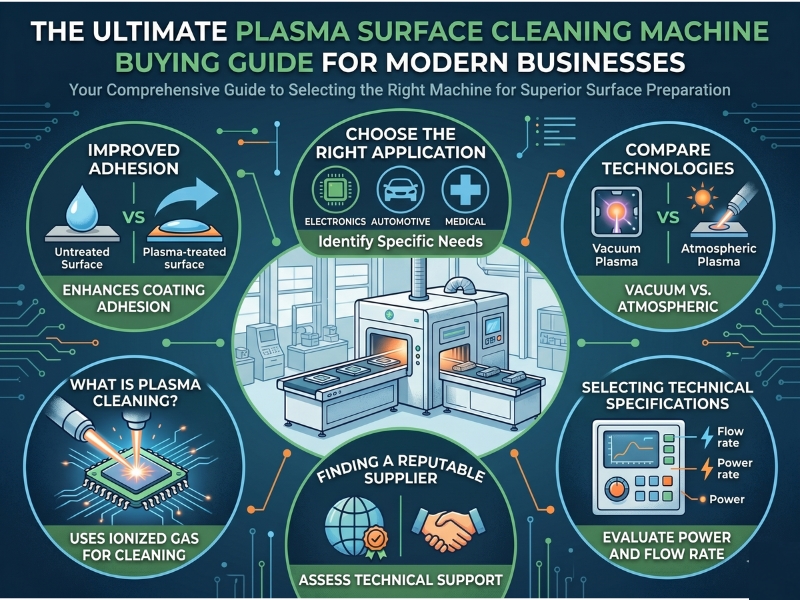
To successfully acquire equipment that delivers maximum ROI, manufacturing directors must conduct a multi-dimensional analysis ranging from specific material characteristics to daily operational workflows. Here are the most vital plasma surface cleaner selection criteria.
2.1. Defining your precise manufacturing requirements
Before finalizing any purchase in this plasma surface cleaning machine buying guide, you must clarify your primary objective. Do you strictly require atomic cleaning to remove nanoscale machine oils? Do you need functional groups activation to make hydrophobic plastics hydrophilic? Or are you aiming for advanced plasma coating (nano-deposition)? Each distinct need corresponds to a vastly different equipment class, dictating whether you should procure an Atmospheric Plasma jet or a deep Vacuum Plasma chamber.
2.2. Analyzing product applications and treatment area
The total surface area that requires treatment directly dictates the specific nozzle (jet head) you must select:
- For narrow areas or straight-line profiles: A Direct Jet nozzle is the optimal choice, delivering a highly concentrated, powerful stream into tight spaces or along glue lines.
- For wide surface areas or heat-sensitive materials: You must select a Rotary Jet nozzle. This spinning head evenly distributes the plasma plume, covering a much wider swath while actively minimizing the thermal impact on delicate substrates.
2.3. Integration and automation capabilities
This is one of the most critical factors to consider when buying a plasma cleaner. For small-scale, bespoke production, a handheld or manually operated standalone unit is sufficient. However, for massive, high-speed assembly lines, you must select a plasma system engineered for seamless integration. The machine must be capable of mounting onto a 6-axis robotic arm or a high-speed conveyor system to guarantee 100% processing uniformity across millions of units.
2.4. Evaluating the core machine configuration
The core configuration of the equipment includes the high-voltage RF Generator, the central control system, and the process gas delivery module. Prioritize next-generation digital generators that allow for incredibly smooth, micro-adjustments in power output and feature built-in self-diagnostic error protocols. Choosing the correct frequency (kHz) and voltage directly determines the penetration depth of the surface activation.
2.5. Budgeting for long-term operational costs
The true cost of the machine extends far beyond the initial purchase invoice. Enterprises must rigorously calculate the ongoing consumption of electrical power, compressed air, and the lifespan of consumable parts (such as ceramic nozzles and tungsten electrodes). A premium, high-quality plasma system may command a higher initial price, but its superior engineering can effortlessly save 15% to 20% in daily electrical consumption and drastically reduce factory downtime caused by unscheduled maintenance.
3. How to choose the right controller: Touch screen vs. standard?
3.1. Overview of controller interfaces
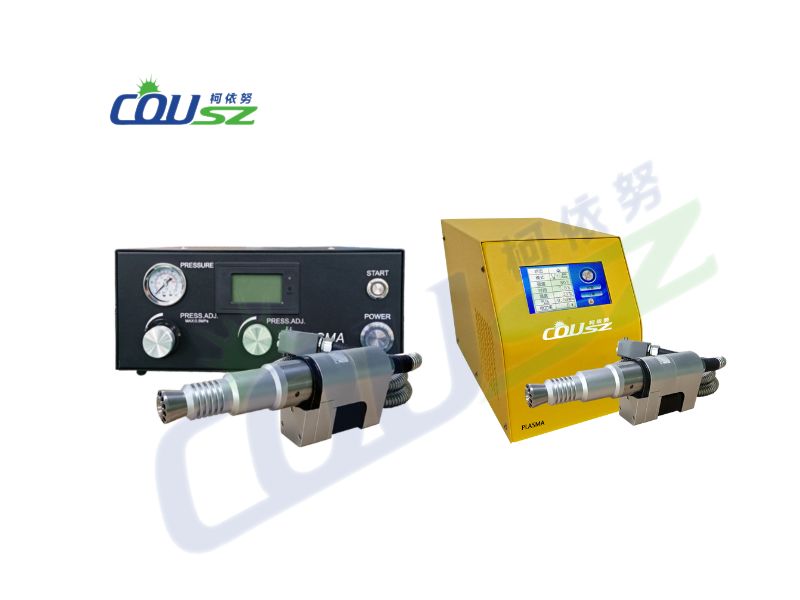
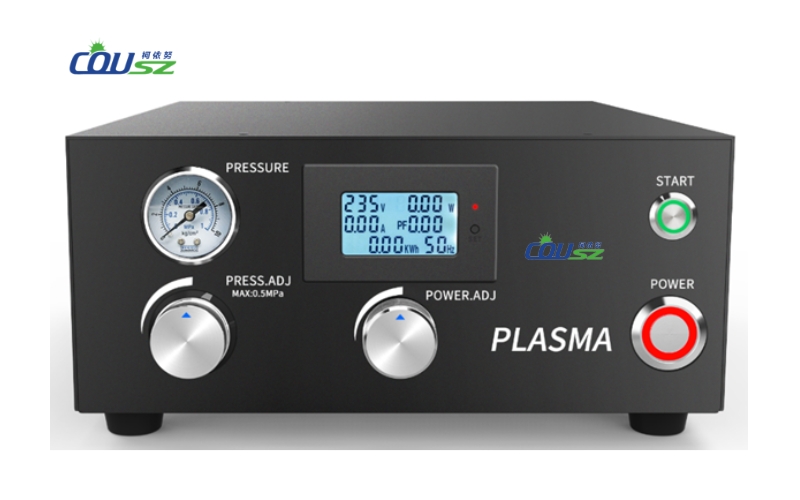
Modern plasma equipment from COUSZ offers multiple control interfaces to suit different factory environments. The advanced touch screen series includes two primary models: the DC-800 and the DC-500. The DC-800 is specifically paired with the powerful 1000W rotary gun head (R01), while the DC-500 is engineered for the 500W direct jet gun head (D01).
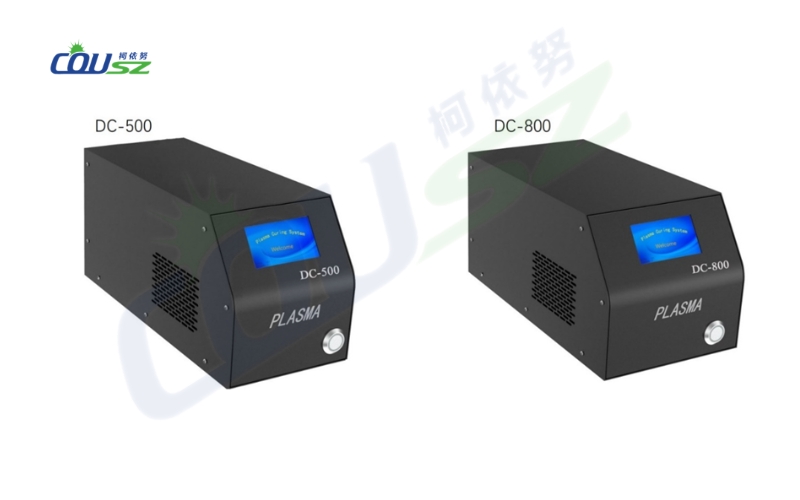
Alternatively, the highly robust standard knob-control series features the DC-800S and DC-500S models. The DC-800S operates the 1000W rotary gun (RS01), and the DC-500S controls the 500W direct jet gun (DS01).
3.2. Detailed technical comparison of controllers
Review the comprehensive specifications in the table below to assist your plasma surface treatment machine selection:
| Controller Specifications | DC500 | DC800 | DC500S | DC800S |
|---|---|---|---|---|
| Load Power | 300–500W | 600–1000W | 300–500W | 600–1000W |
| Terminal Control | ✓ | ✓ | ✓ | ✓ |
| Gas Pressure Alarm | ✓ | ✓ | ✓ | ✓ |
| Power Alarm | ✓ | ✓ | ✓ | ✓ |
| Touch Screen Interface | ✓ | ✓ | × | × |
| Digital Communication (PLC) | ✓ | ✓ | × | × |
| Manual Knob Adjustment | × | × | ✓ | ✓ |
| Dimensions (L×W×H mm) | 430×180×235 | 470×430×220 | 445×310×143 | 445×310×143 |
| Total Weight | 10 kg | 11 kg | 9.5 kg | 10 kg |
4. Which nozzle type is better: Rotary or direct jet?
4.1. Understanding nozzle architectures
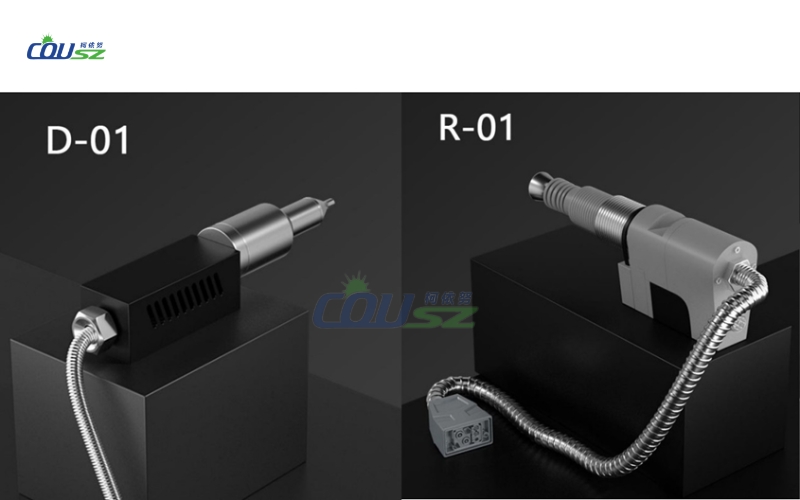
The physical nozzle head is the component that interacts directly with your product. The rotary gun version features two primary models: the R01 and RS01. The main internal structure of these two spray heads is identical; the only difference lies in the specific electrical connector module that links to the generator. The R01 is utilized exclusively with the digital DC800 controller, while the RS01 pairs with the analog DC800S controller.
Similarly, the direct jet gun version consists of the D01 and DS01 models. Again, their core architecture is identical save for the connector. The D01 is designed for the digital DC500 controller, and the DS01 connects to the standard DC500S controller.
4.2. Nozzle specification comparison
| Nozzle Specifications | R01 | D01 | RS01 | DS01 |
|---|---|---|---|---|
| Operating Power | 600–900W | 300–500W | 600–900W | 300–500W |
| Spray Pattern | Rotary Sweeping | Direct Jet | Rotary Sweeping | Direct Jet |
| Effective Treatment Diameter | 20–50 mm | 2–10 mm | 20–50 mm | 2–10 mm |
| Temp Increase in 1 Second | Max 30°C | Max 50°C | Max 30°C | Max 50°C |
| Electrode Lifespan | 2000 hours | 2000 hours | 2000 hours | 2000 hours |
| Unit Weight | 2.5 kg | 0.5 kg | 2.5 kg | 0.5 kg |
| Dimensions (L×W×H mm) | 330×65×110 | 249×50×58 | 330×65×110 | 249×50×58 |
5. How to determine the correct nozzle size for your plasma cleaner?
5.1. Matching the aperture to your product
Selecting the exact millimeter size of the nozzle aperture is absolutely critical to ensuring the plasma beam is perfectly focused on the treatment area without wasting energy.
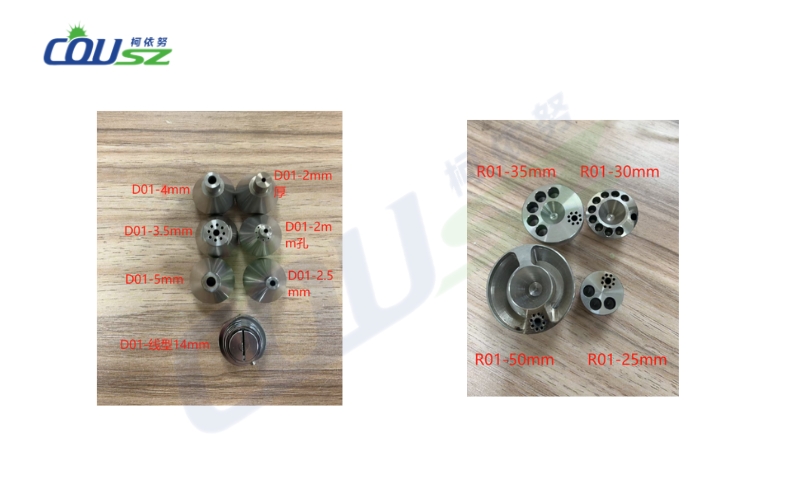
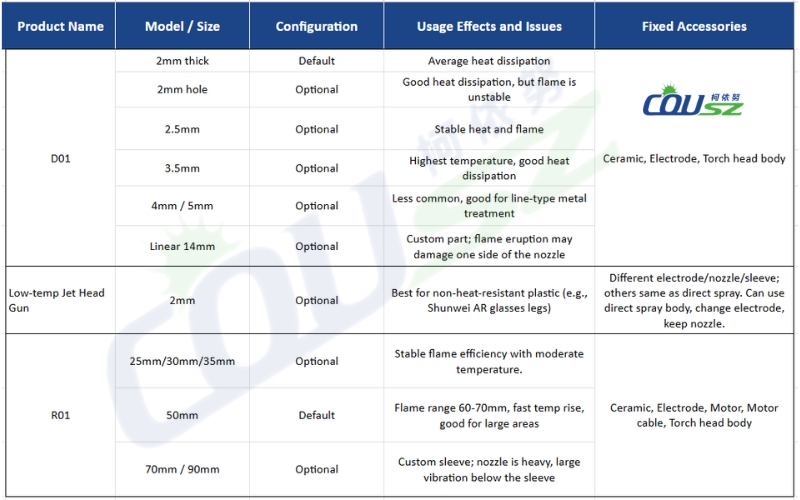
For high-precision applications requiring a direct jet (D01), the available compatible nozzle aperture sizes include:
- D01 – Fi 2.5mm (Ideal for intricate micro-electronics)
- D01 – Fi 2mm
- D01 – Fi 3.5mm
- D01 – Fi 4mm
- D01 – Fi 5mm
- D01 – Line 14mm (Specialized flat linear output)
For broad surface applications utilizing the rotary spray head (R01), the available compatible sweeping diameter sizes include:
- R01 – Fi 25mm
- R01 – Fi 30mm
- R01 – Fi 35mm
- R01 – Fi 50mm
- R01 – Fi 70mm (Ideal for large automotive panels and wide glass sheets)
6. What are the common mistakes in plasma surface treatment machine selection?
6.1. Avoiding costly procurement errors
Many manufacturing enterprises, when finalizing their plasma surface treatment machine selection, frequently fall into the following highly detrimental traps:
- Focusing solely on the cheapest price: Low-cost, generic machines typically generate a highly unstable, erratic plasma plume. This instability frequently causes dangerous electrical “pinholing” (burning straight through thin plastic films) or completely destroys highly sensitive, expensive microelectronic components.
- Skipping mandatory laboratory testing (Lab Test): Every specific polymer or alloy reacts entirely differently to plasma exposure. Failing to conduct rigorous Contact Angle measurements on your actual material samples prior to signing the purchase order is a fatal engineering mistake.
- Ignoring expert consultation: Attempting to select a machine without profoundly understanding the physics of process gases (such as when to use Nitrogen versus Oxygen or compressed air) will guarantee that the system completely fails to achieve the targeted surface energy.
Based on extensive data compiled by leading materials science professors, completely ignoring these fundamental technical plasma surface cleaner selection criteria is mathematically proven to increase a factory’s maintenance and scrap costs by an astonishing 2.5 times within just the first 2 years of automated operation.
7. Contact our plasma technology expert for technical support
If you are still struggling to determine exactly which equipment configuration is the perfect match for your automated factory line, contact us immediately. We will arrange comprehensive, free sample testing and provide deep technical consultation:
- 👤 Ms. Yuna – Senior Plasma Solutions Expert
- 📱 Tel/Whatsapp/Wechat/Zalo: (84) 965 535 348
- 📧 Email: sales03@cousz.com
- 🌐 Website: www.cousz-vn.com
8. FAQs – Frequently asked questions before buying
8.1. How does the plasma cleaner create a super-hydrophobic coating?
A super-hydrophobic (water-repelling) coating is the direct result of advanced surface modification that engineers a nanoscale structure, forcing water droplets to bead up and roll off (achieving a contact angle greater than 150°). To execute this, you must select a plasma machine capable of precisely metering specialized precursor gases (such as fluorocarbons). This process completely reverses the material’s surface energy characteristics, making it ideal for waterproofing outdoor sensors and sensitive mobile electronics.
8.2. What is a Barrier Coating and which plasma cleaner is required?
This specialized application is predominantly utilized in the food packaging and semiconductor industries to form an absolute barrier against oxygen and moisture transmission, drastically extending the product’s shelf life. To successfully apply this coating, the enterprise must invest in a specialized Vacuum Plasma system or an atmospheric unit fully integrated with a chemical precursor delivery system. This high-end equipment deposits an ultra-dense, pinhole-free physical barrier at the nanometer scale.
8.3. Why is a plasma cleaner the best choice for enhancing adhesion?
Adhesion enhancement is universally the most common and highly profitable application when a business purchases a plasma surface treatment machine. Through the rigorous process of activation, the intense plasma beam forcibly grafts highly polar chemical functional groups (such as hydroxyl -OH and carboxyl -COOH radicals) directly onto the material’s surface. These groups act exactly like microscopic chemical “anchors,” allowing plastics, bare metals, and glass to bond permanently with structural glues, paints, or UV inks, thereby completely and permanently eliminating the risk of delamination.