中文 (中国)
 Tiếng Việt
 한국어
한국어
During the critical process of researching, procuring, and operating advanced surface treatment equipment, manufacturing clients consistently raise numerous plasma cleaner FAQs to ensure they optimize their production lines. From comparing foundational technologies to verifying exact material compatibility, understanding every technical detail plays a vital role in guaranteeing perfect adhesion quality. This comprehensive article will aggregate and deeply analyze these common plasma coating machine FAQs, helping enterprise leaders fully grasp the transformative power of a modern plasma cleaning machine in the competitive Industry 4.0 manufacturing era.
1. What is the fundamental difference between cold plasma and thermal plasma?
1.1. Understanding thermal plasma properties
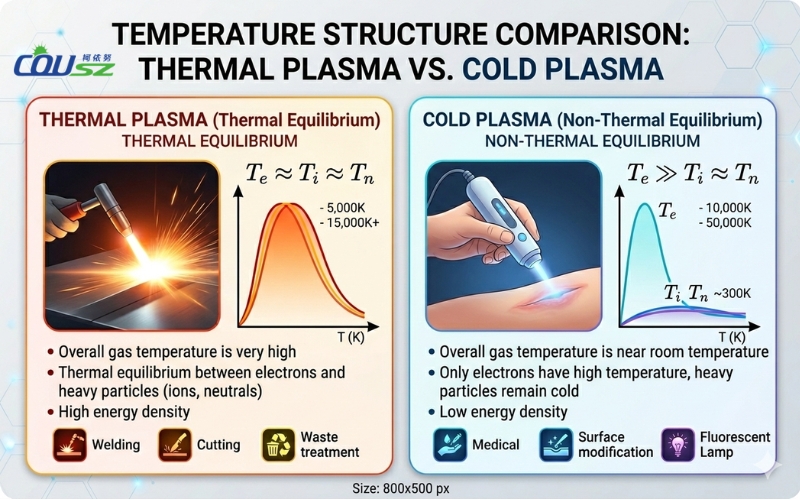
When reviewing our extensive list of plasma cleaner FAQs, the most frequently asked question revolves around distinguishing between cold plasma and thermal plasma technologies. Thermal plasma operates at an incredibly high temperature state, often reaching thousands of degrees Celsius. In this state, the kinetic energy of the electrons and the heavy ions are in complete thermal equilibrium. Because of this massive heat generation, thermal plasma is strictly utilized for heavy industrial applications such as metal cutting, destruction of hazardous waste, or heavy-duty arc welding. It is entirely unsuitable for delicate surface preparation.
1.2. The power of non-equilibrium cold plasma
Conversely, Non-equilibrium Plasma, widely known as Cold Plasma, is the core, revolutionary technology embedded within every COUSZ brand plasma surface cleaning machine. In this highly specialized state, the lightweight electrons possess extremely high temperatures (energy), while the heavier ions and neutral particles remain remarkably close to ambient room temperature.
According to empirical evidence and fundamental research established by Professor Alexander Fridman (author of the definitive text Plasma Chemistry), this unique temperature disparity allows cold plasma to effectively treat highly heat-sensitive materials. It can aggressively clean and activate delicate polymers, thin plastic films, and complex microelectronics without inflicting any thermal warping or structural damage. This perfectly explains why the cold plasma surface cleaner has become the undisputed, preferred choice in the global electronics and medical device manufacturing sectors.
2. Can a plasma surface cleaning machine completely replace corona treatment?
2.1. The physical limitations of traditional corona
This is one of the most critical plasma cleaner FAQs frequently raised by executives in the high-speed printing and flexible packaging industries. The definitive answer is: A plasma cleaning machine does not merely replace Corona treatment; it serves as a vastly superior, next-generation technological upgrade.
Traditional Corona treatment relies on a high-voltage electrical discharge that generally only impacts flat, two-dimensional surfaces. It operates at a relatively low energy density, meaning the surface activation effect degrades very quickly. Furthermore, Corona systems are notorious for generating significant volumes of toxic ozone gas, which poses severe respiratory health risks to factory workers. Additionally, the uncontrolled electrical arcs in Corona systems frequently cause “pinholing” or electrical breakdown on ultra-thin polymer substrates, resulting in scrapped materials.
2.2. The advanced capabilities of plasma technology
In stark contrast, a modern plasma surface cleaner provides a significantly higher, much more focused energy stream. It possesses the unique physical capability to effortlessly treat highly complex, three-dimensional topographies, blind holes, and deep grooves. According to technical reports published in the prestigious journal Surface and Coatings Technology, utilizing a plasma cleaning machine can consistently elevate the surface energy of a substrate to well over 72 mN/m.
This incredible dyne level ensures that industrial printing inks and structural adhesives bond exponentially better than they ever could following a standard Corona treatment. Transitioning to a COUSZ plasma system empowers businesses to permanently eliminate the costly nightmare of ink flaking and peeling on notoriously difficult-to-treat plastics like Polypropylene (PP), Polyethylene (PE), or PTFE.
| Comparison Criteria | Plasma Cleaning Machine | Traditional Corona Treatment |
|---|---|---|
| Surface Geometry | Complex 3D parts, deep crevices, narrow gaps | Strictly flat, 2D continuous webs |
| Treatment Lifespan | Long-lasting chemical activation (days to weeks) | Short-lived effect (hours to days) |
| Environmental Safety | Zero ozone emission, highly eco-friendly | Generates hazardous, toxic ozone gas |
| Material Safety | Safe for ultra-thin films, no electrical breakdown | High risk of pinholing and burning thin substrates |
3. Does plasma treatment alter the bulk physical structure of the material?
3.1. Precision at the nanoscale level
Many new clients naturally worry that exposing their premium products to a high-energy plasma beam will cause catastrophic physical deformation. However, this is a common misconception that we frequently address in our plasma coating machine FAQs.
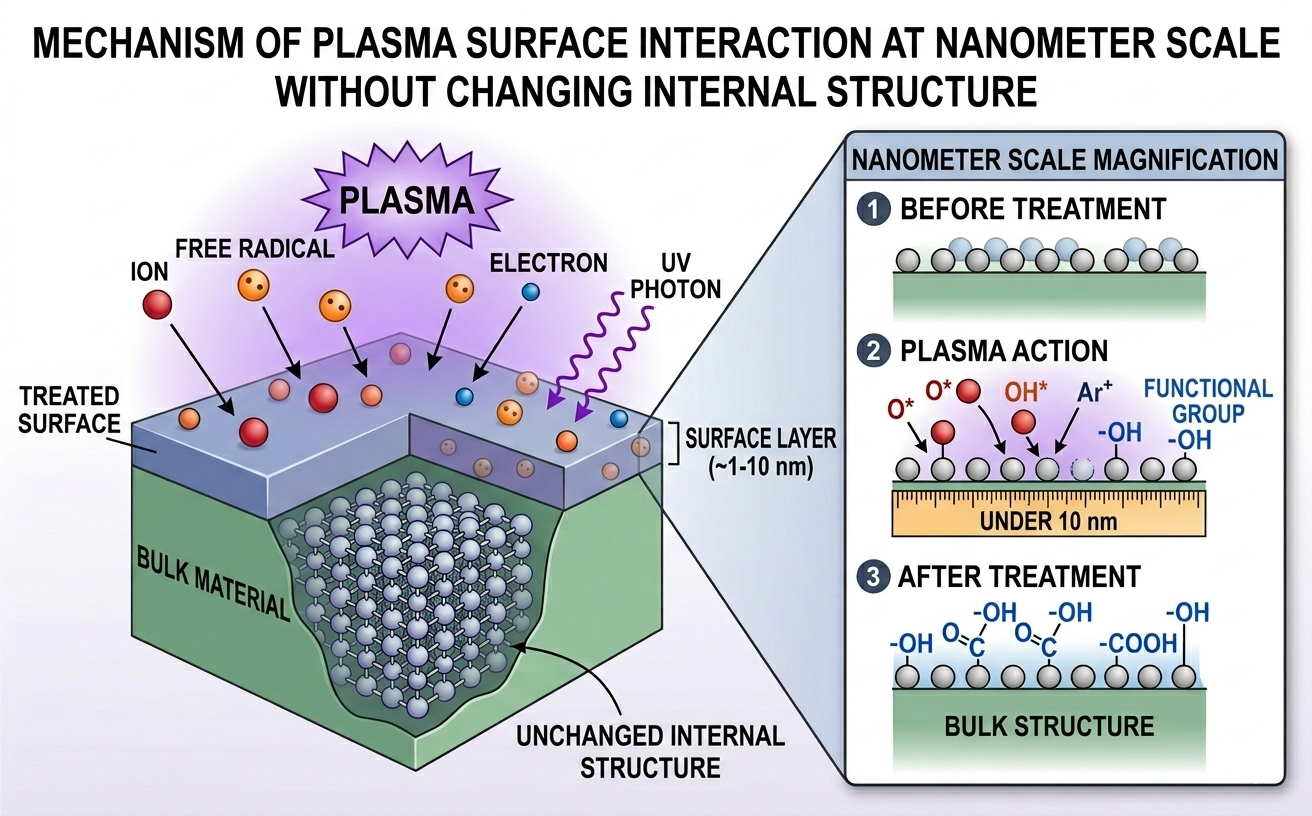
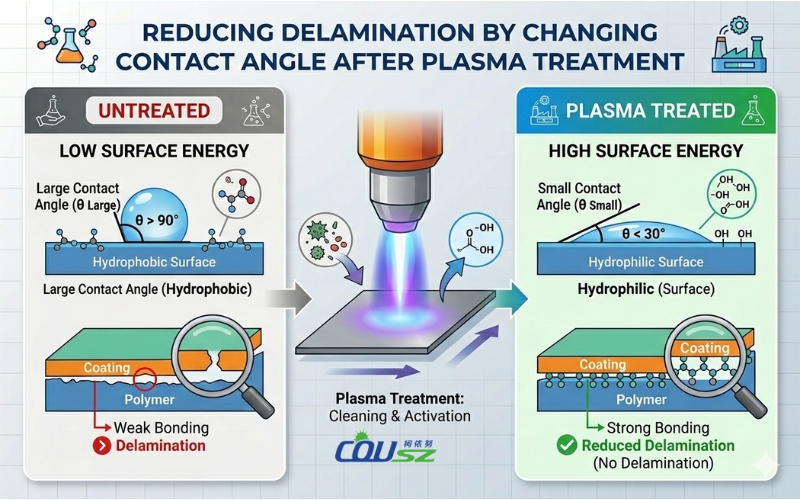
In reality, the active ion stream emitted by a plasma surface cleaner is meticulously engineered to interact exclusively with the outermost molecular layer of the substrate—penetrating to a microscopic depth of merely a few nanometers. This intense, localized process violently breaks the weak hydrocarbon bonds of dirt and oils, while simultaneously grafting highly polar chemical functional groups (such as hydroxyl -OH and carboxyl -COOH radicals) onto the surface.
Crucially, this entire chemical transformation occurs without penetrating or interfering with the bulk properties of the underlying material. Rigorous empirical testing conclusively proves that after processing with a plasma cleaning machine, the tensile strength, core hardness, color profile, and dimensional shape of the plastic or metal remain 100% intact and unchanged, while its wetting capability and chemical adhesion are dramatically improved.
4. What specific materials can a plasma surface cleaner process?
4.1. Universal compatibility across manufacturing sectors
Providing a comprehensive list of compatible materials is an absolute necessity within our core plasma cleaner FAQs. Because the technology operates at an atomic level, its industrial applications are incredibly vast and highly versatile across multiple sectors:
- Industrial plastics and rubbers: It flawlessly treats PP, PE, PVC, PET, ABS, and EPDM. It is particularly renowned for its effectiveness on low-surface-energy plastics that typically reject glues and inks.
- Metals and specialized alloys: Excellent for Stainless Steel, Aluminum, Copper, and Gold. The plasma seamlessly vaporizes microscopic oxide layers, machining fluids, and anti-rust greases to prepare for flawless wire bonding or coating.
- Glass and technical ceramics: The system hyper-activates the surface before the application of anti-reflective (AR) nano-coatings or prior to the lamination of heavy-duty tempered safety glass.
- Advanced composite materials: Highly effective on aerospace-grade carbon fiber and fiberglass, ensuring that structural epoxy resins bind the layers together into an unbreakable, monolithic block.
Leading technical experts globally agree that virtually any solid material requiring perfect, long-lasting adhesion can significantly benefit from integrating a plasma surface cleaning machine to optimize the assembly process.
5. How does a plasma cleaning machine physically reduce layer delamination?
5.1. The mechanics of permanent chemical bonding
Product delamination (the peeling or separation of glued layers) is a total nightmare in mass manufacturing. To thoroughly answer this critical point in our plasma cleaner FAQs regarding defect reduction, we must deeply examine the underlying mechanics of molecular bonding:
- Absolute deep cleaning: The plasma surface cleaner completely vaporizes and removes “loose” organic molecules, dust, and microscopic release agents that create a physical barrier between the substrate and the adhesive.
- Creating chemical anchors: The surface activation phase generates billions of microscopic chemical “hooks.” These newly formed polar groups actively reach out and permanently bind with the chemical structure of the applied glue, UV ink, or nano-coating.
- Maximizing contact area: Plasma physically alters the micro-topography of the surface through a process called nano-etching. This allows liquid adhesives to flow smoothly into microscopic crevices and spread out completely flat, drastically increasing the physical contact area rather than beading up and shrinking.
According to verified performance data from COUSZ installations across Southeast Asia, manufacturing enterprises that properly deployed our plasma coating machine technology successfully slashed their severe delamination defect rates from a crippling 15% down to an astonishingly low 0.5%. This dramatic reduction is the clearest, most undeniable proof of the massive ROI a plasma cleaning machine brings to an industrial assembly line.
6. Operational readiness: How does plasma compare to legacy factory equipment?
6.1. Maximizing uptime with instant-on technology
When factory managers review plasma coating machine FAQs, they often inquire about integration and operational downtime. In modern assembly lines, curing equipment and surface preparation machines are frequently deployed side-by-side. It is vital to understand the operational readiness of these systems to maximize factory throughput.
For example, in traditional optical bonding or coating lines, legacy mercury UV curing lamps are still utilized. A major operational drawback of these older mercury UV lamps is their mandatory 5 to 10-minute startup and warm-up time just to reach their necessary operational intensity. If the line stops, the lamps must cool down and restart, causing massive delays.
In brilliant contrast, a modern solid-state plasma surface cleaning machine features instantaneous “instant-on/instant-off” capabilities. There is absolutely zero warm-up time required. The moment the PLC sends the ignition signal, the plasma beam is operating at 100% peak activation energy. This lightning-fast operational readiness ensures that your conveyor belts never have to pause and wait for surface preparation equipment, aggressively driving up your daily manufacturing yield and profitability.
7. Conclusion on mastering plasma surface treatment
Thoroughly understanding the foundational principles and technical nuances provided in these plasma cleaner FAQs empowers enterprise directors and process engineers to confidently apply cutting-edge technology to their automated production floors. Advanced plasma technology is not merely a tool for macroscopic cleaning; it is the ultimate master key to definitively solving the most complex, persistent challenges regarding material adhesion, long-term durability, and aesthetic product quality. If you still possess unanswered plasma coating machine FAQs or require highly specific technical data, do not hesitate to contact the dedicated engineering team at COUSZ for deep, specialized support tailored to your unique manufacturing environment.
8. Contact COUSZ for expert technical consultation
If you need to arrange rigorous sample testing or require expert consultation to select the perfect plasma cleaning machine for your business, connect with us immediately:
- 👤 Ms. Yuna – Senior Plasma Solutions Expert
- 📱 Tel/Whatsapp/Wechat/Zalo: (84) 965 535 348
- 📧 Email: sales03@cousz.com
- 🌐 Website: www.cousz-vn.com