中文 (中国)
 Tiếng Việt
 한국어
한국어
1. What makes an overview of uv meters essential for stable curing?
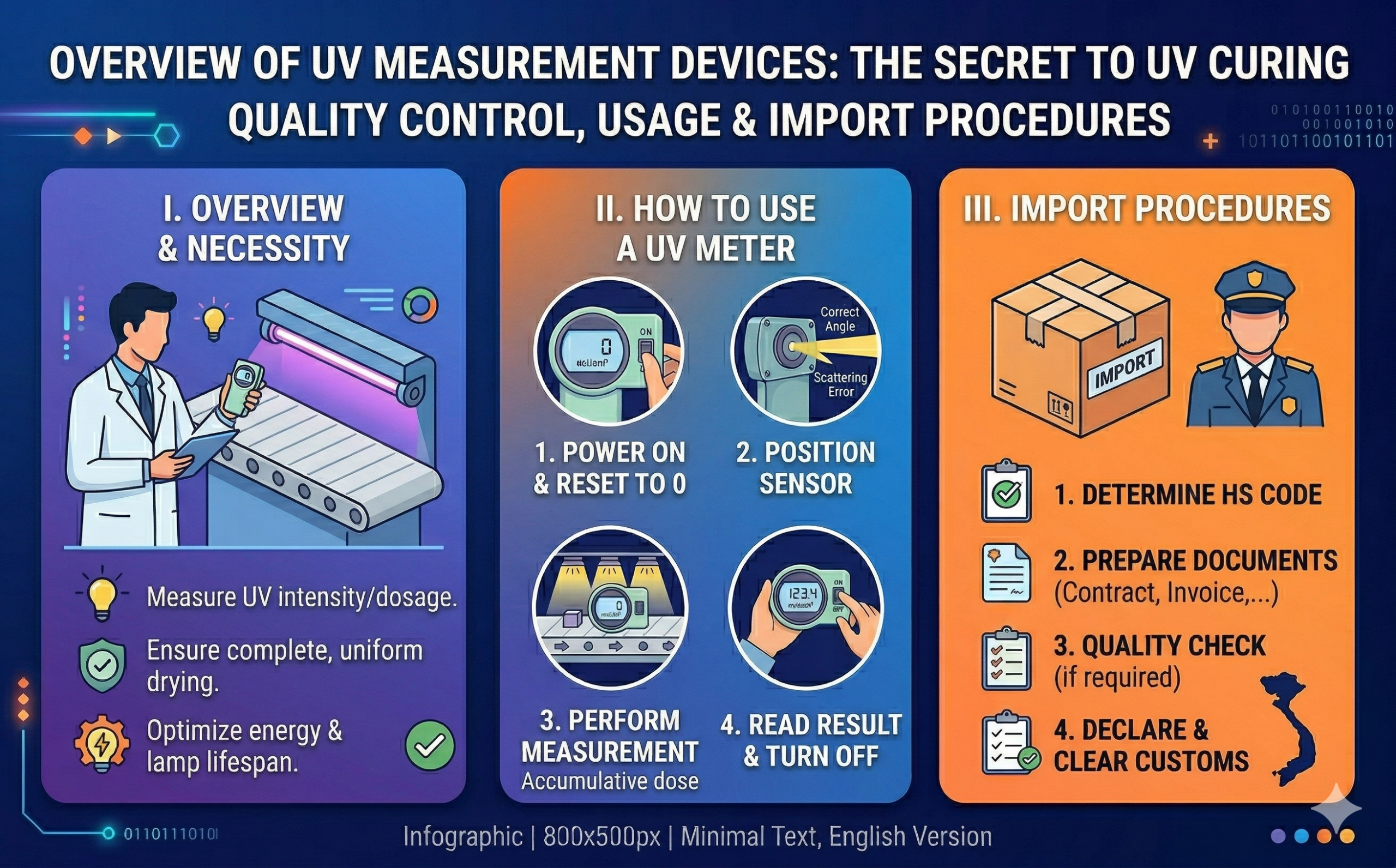
In high-speed production lines, the stability of your UV curing machine directly dictates the long-term durability, chemical resistance, and aesthetic appeal of the final product. However, ultraviolet light is entirely invisible to the human eye. Relying on visual intuition or guesswork to evaluate the strength of a lamp is the most common and costly mistake in the industry. This is exactly why technical managers urgently need a clear overview of UV meters, utilizing these tools as the “all-seeing eye” to accurately quantify invisible radiation.
The hidden mechanics of uv energy stability
A comprehensive study published by RadTech International revealed a startling fact: the output intensity of traditional high-pressure mercury curing lamps can plummet by up to 20% after merely 500 hours of continuous factory operation. Without utilizing proper UV measurement devices, floor technicians typically attempt to compensate for this degradation by blindly slowing down the conveyor belt or arbitrarily cranking up the power supply. These reactive measures often lead to thermal damage or inconsistent polymerization.
Conversely, when you possess a solid overview of UV meters, you can mathematically confirm that the target energy is being delivered. This ensures that the photopolymer adhesive or industrial ink cures perfectly from the top surface down to the base substrate, entirely eliminating massive manufacturing defects such as surface tackiness, delamination, or premature yellowing. For a deeper understanding of this foundational concept, please refer to our detailed guide: What is a UV meter: The secret behind stable curing performance.
2. How do uv measurement devices elevate quality control (qc)?
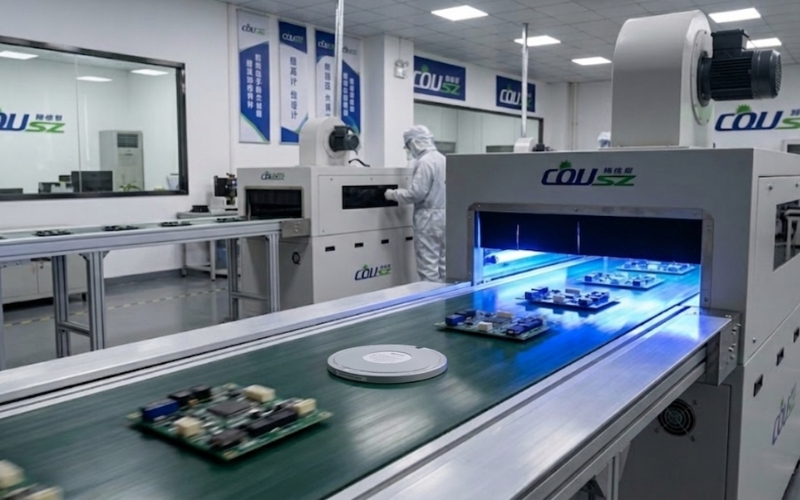
Effective Quality Control (QC) is not merely about inspecting and discarding defective products at the end of the line; true QC is about strictly preventing those defects from occurring in the first place. Within an industrial curing ecosystem, the role of high-precision UV measurement devices is absolutely critical.
Nist traceability and proactive defect prevention
According to metrology experts from the National Institute of Standards and Technology (NIST), numerical data extracted from calibrated radiometers provides undeniable, objective proof of manufacturing process compliance. A strategic overview of UV meters within your QC department focuses heavily on three practical, revenue-saving values:
- Validating lamp performance and lifespan: Empirical data helps your maintenance team know exactly when a bulb requires replacement based on actual optical degradation, rather than relying on inaccurate manufacturer estimates or arbitrary run-hour logs.
- Synchronizing multiple production lines: A proper overview of UV meters ensures that the curing machine in Factory A delivers the exact same energy profile as the machine in Factory B, guaranteeing uniform UV curing quality across your entire global supply chain.
- Supporting r&d for new materials: When formulating or testing new UV-curable adhesives, these instruments help scientists pinpoint the absolute minimum energy threshold required for a complete cure, thereby allowing engineers to optimize conveyor speeds and maximize daily throughput.
Consistently logging your UV light intensity is the ultimate way for an enterprise to definitively prove its technical professionalism to strict international partners, where audited drying reports are a non-negotiable component of the quality management dossier. To explore more about this, read: The role of UV meter in quality control (QC).
3. What do the parameters on uv meters actually mean?
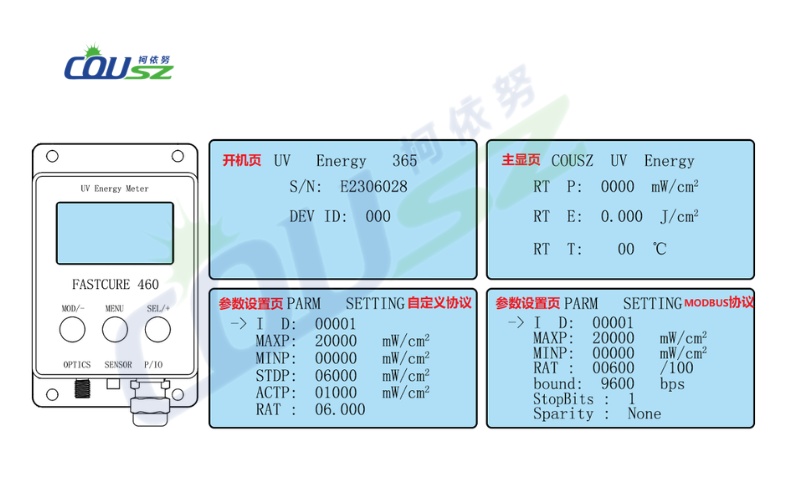
When initially studying the operational overview of UV meters, operators are frequently overwhelmed by complex optical physics terminology. However, to efficiently operate and troubleshoot a curing machine, you truly only need to focus on mastering two primary physical quantities.
Decoding irradiance and energy density in daily operations
| Optical Parameter | Physical Definition | Impact on UV Curing Quality |
|---|---|---|
| Irradiance / Intensity (mW/cm²) | The instantaneous peak optical power striking a surface area at a specific moment in time. | Represents the “penetration power” of the UV light intensity into thick layers of glue. If it is too low, the surface cures (skin-over) while the inside remains liquid. |
| Energy Density / Dose (mJ/cm²) | The total accumulated amount of photon energy the product receives during its entire exposure time under the lamp. | Determines the complete and thorough cross-linking of the polymer chains. It guarantees the structural integrity of the bond. |
Understanding this overview of UV meters is vital for practical troubleshooting on the factory floor. According to the foundational formula by Professor R.W. Stowe: Energy = Irradiance × Time. If your meter indicates that the peak irradiance (mW/cm²) is sufficient but the total energy (mJ/cm²) is too low, you simply need to reduce the conveyor belt speed. Conversely, if the accumulated energy is fine but the UV light intensity is severely lacking, you must either physically lower the lamp housing closer to the substrate or completely replace the aging UV bulb. Dive deeper into these metrics here: UV meter parameters reading practical guide.
4. What are the frequently asked questions about cousz uv meters?
At COUSZ, our engineering team regularly assists manufacturing clients in building a robust, practical overview of UV meters by directly addressing real-world technical challenges. Here are the most critical operational queries.
Troubleshooting common uv light intensity issues
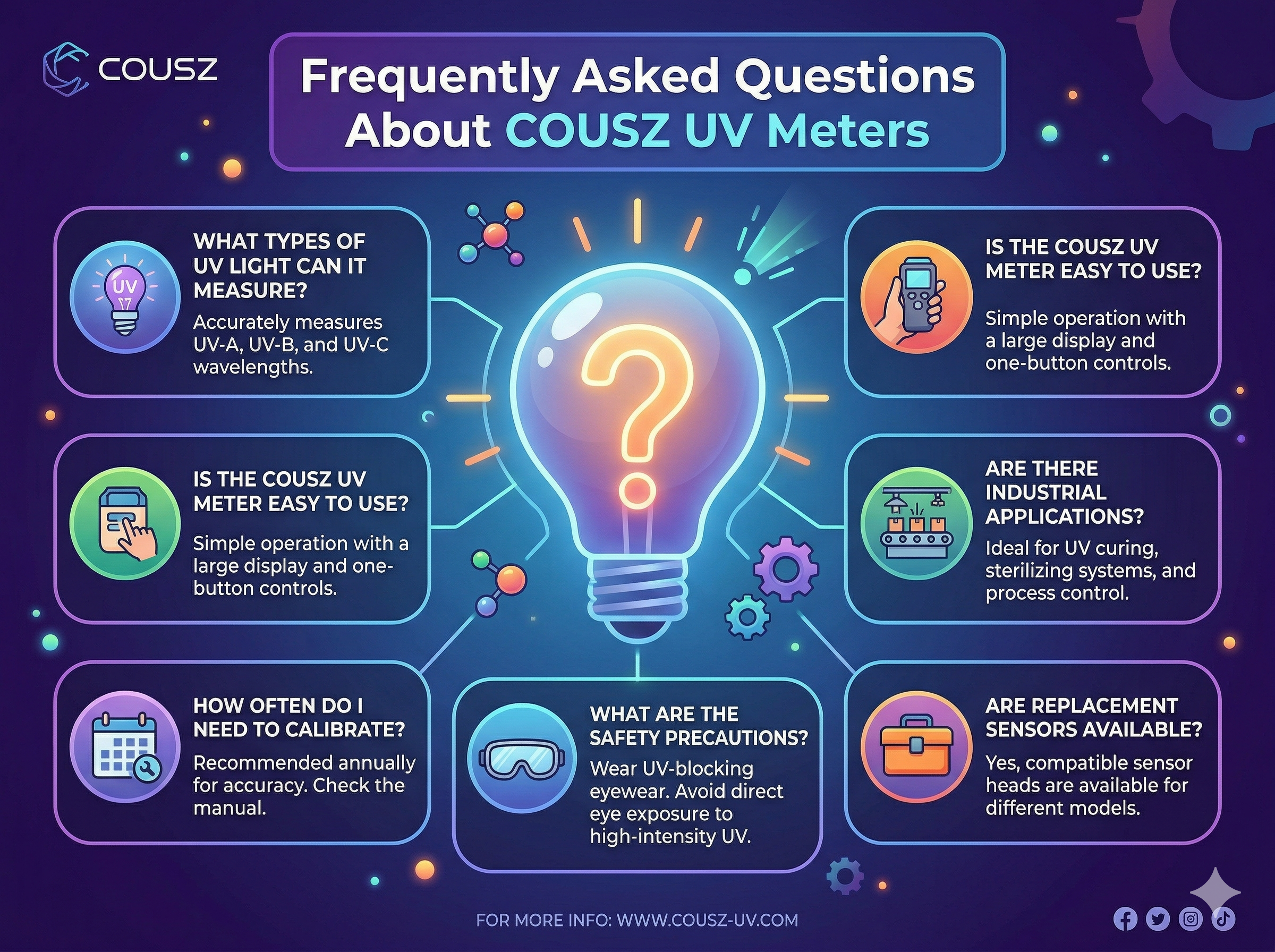
Question: Why does my radiometer show vastly different results when placed on different areas of the conveyor belt?
Answer: This is a completely normal physical phenomenon caused by the uneven optical distribution of the aluminum lamp reflectors. Utilizing high-quality UV measurement devices allows you to map the light footprint and adjust the focal point of the curing system so that the radiation covers the entire product surface as uniformly as possible.
Question: Can a meter designed for UV LED systems be used to measure traditional Mercury vapor lamps?
Answer: This is highly discouraged. LED lamps emit a very narrow, monochromatic spectral band (e.g., strictly 365nm or 395nm), whereas Mercury lamps emit a broad spectrum encompassing UVA, UVB, and UVC. If you use an improperly calibrated sensor, your UV curing quality will plummet due to reading errors that can easily exceed 30%.
Question: Will the extreme high temperatures inside an industrial drying oven damage the measurement device?
Answer: Premium COUSZ devices are engineered to withstand ambient temperatures up to 100°C for short bursts (typically 10 to 15 seconds). However, to definitively protect the delicate internal microprocessors and optical filters during slower conveyor runs, we strongly recommend utilizing our specialized thermal protection shields. For more expert answers, visit: Frequently asked questions about UV meters COUSZ.
5. How to handle customs procedures when importing uv meters?
Procuring advanced metrology equipment from overseas requires a precise understanding of international trade policies, taxation, and specialized sector management. When an enterprise decides to import these tools to safeguard their UV curing quality, having an administrative overview of UV meters and logistics is absolutely paramount.
Detailed import guide and hs code classification
To ensure a smooth, penalty-free customs clearance process, procurement officers must strictly adhere to the following procedural framework:
- Determining the HS Code and Applicable Taxes: The most highly recommended HS Code for this specific classification of optical equipment is 9027.50.00 (Instruments and apparatus using optical radiations). Under current trade agreements, the import tax is frequently reduced to 0% (provided you submit a valid preferential Certificate of Origin, such as Form E, Form D, or Form VK). The Value Added Tax (VAT) generally applies at 8% to 10%, contingent upon the latest governmental policy adjustments.
- Preparing the Commercial Dossier: A flawless documentation package is essential. You must prepare the Commercial Invoice, Packing List, Bill of Lading, and most importantly, the original Technical Catalog from the manufacturer.
- Electronic Customs Declaration: When filing through software systems like ECUS/VNACCS, the commodity description must be extremely precise. A standard accepted description is: “Ultraviolet light intensity measuring equipment, utilized in industrial drying processes, 100% brand new.”
- Physical Inspection and Labeling: Customs officials may request a physical inspection of the cargo. It is imperative that the physical labels on the machine perfectly match the submitted commercial documents regarding the Item Name, Country of Origin, Model Number, and Manufacturer details.
- Post-Import Calibration: Although formal domestic calibration is not legally mandated for customs clearance, highly professional enterprises should immediately send the imported equipment to a reputable domestic metrology center. This establishes a baseline overview of UV meters and guarantees absolute accuracy before deploying the tool onto the active production line.
To avoid costly demurrage fees at the port, please review our comprehensive breakdown: Guide to importing UV meters customs.

6. Where to find the best solutions for uv curing quality?
Understanding the complete overview of UV meters is just the first step. To truly integrate these insights and drastically reduce your factory’s scrap rate, you need a reliable technical partner who understands the intricate physics of photopolymerization.
Connect with the cousz vietnam engineering team
If you require further, customized consultation on how to select the perfect radiometer, need in-depth operational training, or are searching for the ultimate UV adhesive drying solution, please connect with our dedicated specialists today:
👤 Ms. Yuna
✨ Technical & Sales Representative – COUSZ Vietnam
📞 Tel/Whatsapp/Wechat/Zalo: (84) 965 535 348
📧 Email: sales03@cousz.com
🌐 Website: www.cousz-vn.com
7. Faqs about uv measurement and curing systems
Essential knowledge for production managers
1. What are the most common wavelengths used in industrial curing?
Typically, industrial drying systems utilize the 365nm wavelength (ideal for clear adhesives due to its high penetration capability) or the 395nm-405nm range (highly popular for curing dense printing inks and advanced LED applications). Possessing a solid overview of UV meters allows you to select the exact optical sensor calibrated for these specific wavelengths.
2. How do I know when my device requires formal recalibration?
According to stringent ISO quality management standards, the standard calibration cycle is exactly 12 months. However, if you observe that the measurement results on the exact same lamp are fluctuating wildly, or if the data deviates by more than 10% from your historical baseline logs, you must send the unit in for immediate recalibration to protect your UV curing quality.
3. What is the actual difference between a high-end industrial radiometer and a cheap handheld meter?
Professional industrial UV measurement devices (such as the COUSZ F150 or F250 models) are equipped with premium quartz interference filters and possess robust thermal resistance capabilities allowing them to survive inside blistering curing chambers. Conversely, cheap handheld meters are designed strictly for low-intensity civil environments; their plastic sensors will quickly burn out, resulting in catastrophic measurement errors when exposed to industrial-grade radiation.
4. Why is it important to measure the ambient temperature alongside ultraviolet radiation?
In addition to emitting intense ultraviolet rays, traditional lamps radiate a massive amount of infrared heat. If the internal temperature of the oven exceeds the physical tolerance threshold of the substrate material (such as thin plastic films or delicate electronic components), the product will permanently warp or melt. Therefore, advanced meters always provide concurrent temperature readings alongside optical data, ensuring you maintain a safe and highly controlled manufacturing environment.