中文 (中国)
 Tiếng Việt
 한국어
한국어
1. How do these devices work with mercury lamps?
Medium pressure mercury lamps are traditional light sources but still hold a crucial position in the printing and coating industries due to their broad spectral output. One of the frequent questions about UV meters is how the device can accurately measure such a multi-spectral emission source.
In principle, a mercury lamp emits energy across multiple wavelengths from 200nm to over 400nm (encompassing UVA, UVB, and UVC). An industrial UV radiometer designed for mercury lamps is equipped with special bandpass filters. When light passes through the optical window, this filter sifts the light, allowing only photons belonging to the target spectral band (usually UVA at 365nm) to impact the silicon sensor.
Integrating the spectral power distribution
According to research from RadTech International, the spectral power distribution (SPD) of a mercury lamp is highly complex. Therefore, our devices are designed to integrate energy across the entire spectrum to which the photoinitiator in the ink or adhesive is most sensitive. This allows the production department to determine the actual peak irradiance, ensuring that even with broad-spectrum emissions, we measure the most useful energy for the polymerization reaction.
2. Do you need to calibrate an industrial UV radiometer?
This is a core issue among questions about UV meters related to quality management. The short and definitive answer is: Absolutely mandatory.
These are extremely sensitive optical measurement instruments. The internal components, especially the semiconductor sensors and glass filters, will “age” over time due to direct exposure to high-intensity radiation and massive heat. This phenomenon is scientifically known as “Solarization” (the alteration of optical properties caused by ultraviolet rays).
The impact of solarization on data accuracy
If not calibrated, the equipment can display significantly skewed results. A report from the National Institute of Standards and Technology (NIST) indicates that an unmaintained UV sensor can have an error margin of up to 15-20% after just one year of high-intensity use. Calibration restores the device to its original accurate measurement state, ensuring that your UV intensity measurement today is perfectly consistent with the data from a year ago. This is the foundation for businesses to maintain ISO certifications and ensure continuous product reliability.
3. What is the standard calibration cycle?
Following the previous point, addressing further questions about UV meters, the calibration cycle is a common concern for factory managers. While every manufacturer might have specific recommendations, the golden standard in the industrial drying sector is once every 12 months.
Exceptions to the 12-month rule
However, we advise that this cycle should be shortened if any of the following conditions apply:
- The equipment operates in exceptionally harsh environments, frequently exceeding 60°C.
- Testing frequency is continuous (multiple production shifts per day).
- The device suffers physical impact or shows signs of chemical contamination on the optical window.
Adhering to the 12-month cycle is not just a technical issue but also a matter of legal compliance and quality insurance. Strict compliance ensures your UV intensity measurement stays within the allowable error margin (±5%). A properly calibrated device is the best insurance policy for your million-dollar production batches.
4. Are measurements affected by high temperatures?
Temperature is the silent enemy of all electronic components, and measurement sensors are no exception. Temperature resistance is often raised in questions about UV meters from technicians working with massive conveyor ovens.
The photodiodes inside the device have characteristics that fluctuate with heat. When the temperature rises, leakage current increases, leading to a phenomenon known as “zero drift,” which skews the actual intensity values. Furthermore, extreme heat inside the curing chamber can melt solder joints or warp the glass filters.
Protecting your device from heat
To overcome this, high-end COUSZ models are equipped with specialized thermal defenses:
| Thermal Defense Feature | Functionality and Benefit |
|---|---|
| Reflective Housing | Made of aerospace-grade aluminum alloy to bounce radiant heat away from the core. |
| Temperature Compensation | An internal algorithm that automatically adjusts the measurement results based on the ambient temperature. |
| External Heat Shields | Physical barriers used to protect the sensor when passing through high-power, slow-moving industrial ovens. |
Technicians must remember: Always let the device cool down to room temperature before performing the next reading to obtain the most accurate results.
5. Can they detect visible light?
The short answer is no, and this is an intentional design choice. Another one of the top questions about UV meters is whether the bright glare from the lamps artificially inflates the reading.
In reality, specialized devices are designed to be “blind” to visible light and infrared (IR) rays. This is achieved through specific glass filters that only allow wavelengths below 400nm to pass through. If the device were influenced by visible light, the accumulated energy value (Dose) would be artificially inflated, leading to misinterpretations about the actual UV curing quality.
Why blindness to visible light matters
Eliminating visible light allows the machine to focus entirely on the wavebands that cause the chemical reaction. This is the precise difference between a robust industrial tool and cheap ambient light sensors used in photography or basic consumer applications.
6. What is the difference between a radiometer and a uv meter?
Terminology confusion leads to many questions about UV meters. Technically speaking, there is a distinct hierarchy in these definitions:
- Radiometer: This is a broad term referring to any device that measures the energy of electromagnetic radiation. A radiometer can measure anything from X-rays and visible light to infrared and radio waves.
- UV Meter: This is a specific subset of radiometers, finely tuned and equipped with specialized filters exclusively to measure ultraviolet radiation (100nm – 400nm).
Specificity in UV intensity measurement
In industrial communication, these two terms are often used interchangeably. However, when purchasing equipment, you must clearly define the spectral band you need to measure. A generic device might not meet the strict requirements of an industrial UV radiometer if it lacks the precise spectral filters for UVA or specialized LED wavelengths.
7. Is pc software integration necessary?
In the digital transformation era, questions about UV meters regarding software connectivity are increasingly common.
Software connection is not mandatory simply to get a number on the screen, but it is absolutely essential for optimizing the drying process. When connected to a PC via USB or Bluetooth, specialized analysis software allows you to:
- Plot intensity distribution charts: Clearly visualize which specific bulb in an array is weakening.
- Compare historical data: Cross-reference today’s measurements with previously established “Golden Standards.”
- Export quality reports: Generate documents for QC archiving or to send directly to manufacturing partners.
Data-driven UV curing quality
If you only need to check if a lamp is “still bright,” you don’t need software. But if your goal is data-driven QC, software is an inseparable tool. It is crucial for optimizing overall UV curing quality. For a deeper dive into this software integration, refer to our Guide to using UV meters in UV curing systems for quality control.
8. Do these meters store historical data?
Most modern COUSZ models feature built-in internal memory. This built-in feature resolves many practical questions about UV meters for technicians who must perform checks across multiple different production lines.
On-board memory features
The device is capable of storing:
- Peak Value: The strongest intensity recorded during the pass.
- Total Dose: The total energy accumulated throughout the entire drying cycle.
- Timestamp: The exact date and time the measurement was taken.
This storage capability allows you to perform mass measurements on the factory floor and later bring the device back to the office to extract the data. This eliminates the need to carry logbooks or laptops into noisy, dusty production environments, building a reliable database for long-term UV curing quality.
9. Contact COUSZ for advanced solutions
We understand that every drying system has its own unique characteristics. If this list of questions about UV meters hasn’t addressed your specific issue, connect with our experts today for a free technical consultation:
👤 Ms. Yuna
✨ Technical Support & Sales Representative
📞 Tel/Whatsapp/Wechat/Zalo: (84) 965 535 348
📧 Email: sales03@cousz.com
🌐 Website: www.cousz-vn.com
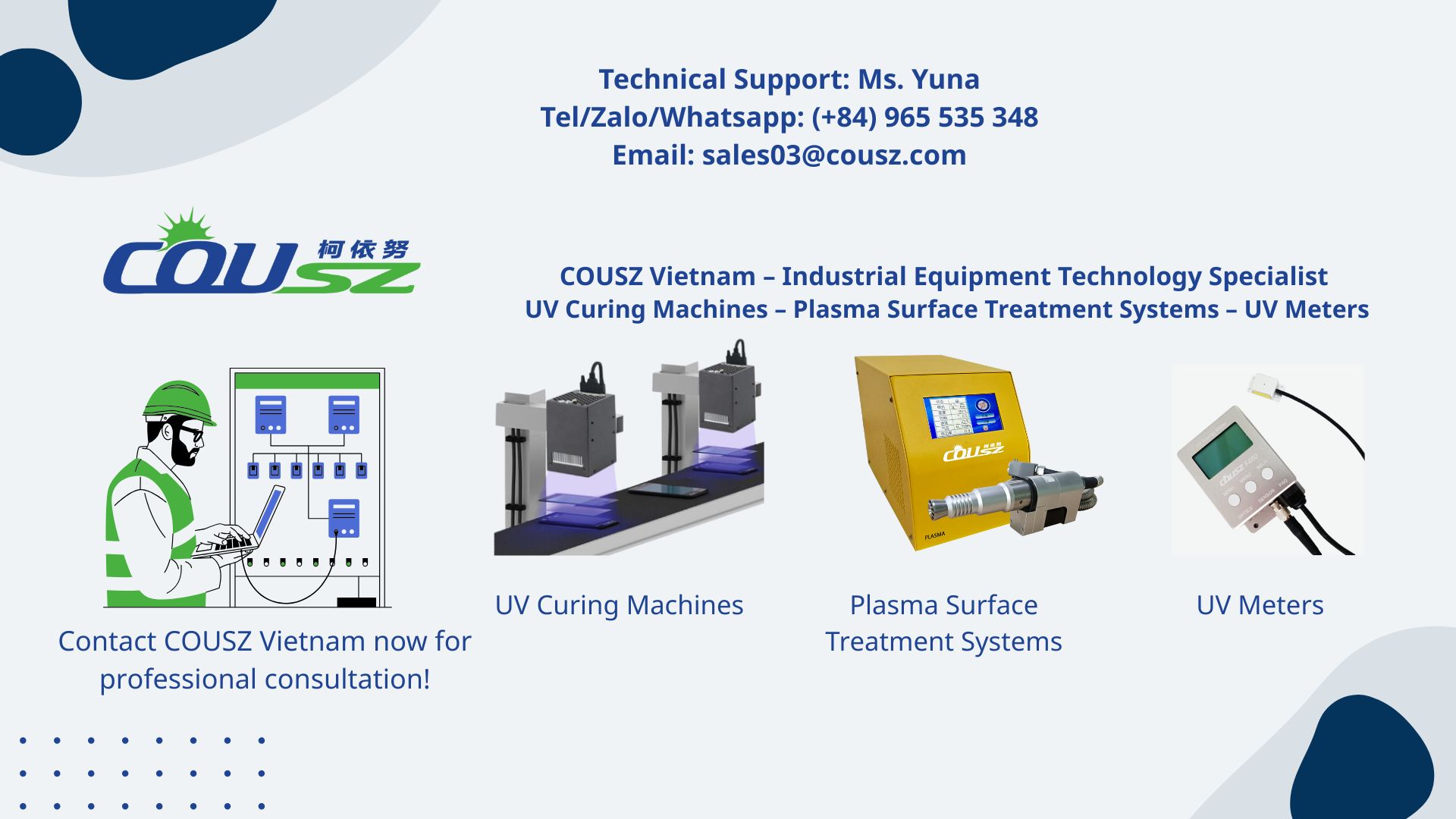
10. Summary FAQs on questions about UV meters
10.1. Can I use the same meter for both mercury and LED lamps?
Generally, no. Mercury lamps have broad spectrums, while LEDs have narrow peaks (e.g., 395nm). You must use a device whose optical filters match your specific light source.
10.2. What does “Solarization” mean for my device?
Solarization is the degradation of the device’s internal glass filters and sensors due to continuous exposure to intense ultraviolet light, which causes the readings to drift over time.
10.3. Why does my reading change when the conveyor speed changes?
While the Peak Irradiance (power) remains constant, the Total Dose (accumulated energy) is dependent on time. Faster conveyor speeds mean less exposure time, resulting in a lower mJ/cm² reading.