中文 (中国)
 Tiếng Việt
1. Why is a UV meter increasingly important in manufacturing?
The industrial UV Curing sector is witnessing a massive transition from traditional mercury lamps to LED technology. However, regardless of the technology used, ultraviolet radiation remains an invisible entity that the human eye cannot quantify. According to research by RadTech International, over 70% of defects in the UV curing process (such as uncured ink or brittle adhesives) stem from the degradation of lamp output over time without proper monitoring.
Routine inspection of your equipment prevents massive losses from rejected products. As a lamp ages, the UV intensity (measured in mW/cm²) it emits gradually decreases. Without a proper measuring device, technicians often compensate by instinctively increasing the lamp’s power, which leads to wasted electricity or overheated material surfaces. A reliable measurement tool eliminates this guesswork entirely.
The cost of unmonitored radiation
Failing to monitor light output doesn’t just impact product quality; it directly affects the bottom line. Running lamps at higher power than necessary shortens their lifespan exponentially, while under-curing leads to costly product recalls and loss of client trust.
2. What is a UV meter exactly?
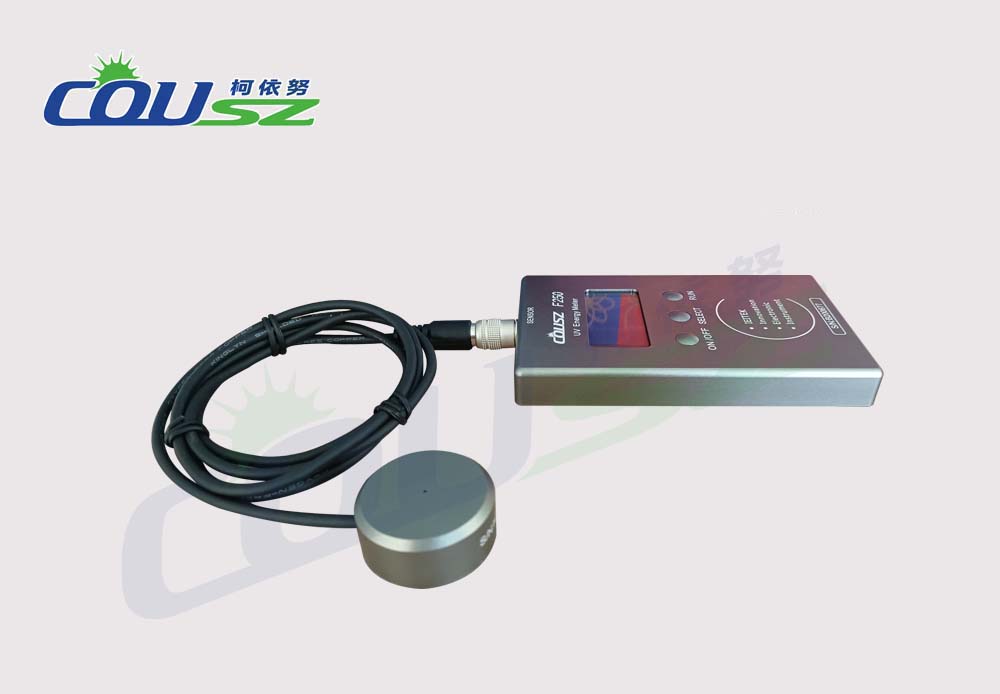
To accurately understand what this device is, we must define it as a specialized radiometer. It is an instrument capable of sensing and quantifying energy from ultraviolet wavelength bands (typically ranging from 200nm to 450nm) and converting them into readable technical parameters on an electronic display.
Unlike standard ambient light sensors, a UV meter is defined by its strict thermal resistance and optical filtering capabilities. In industrial environments, this device must operate stably under the high temperatures of curing chambers and intense radiation pressure without degrading its internal circuitry.
The silent inspector in modern factories
In modern production facilities, an industrial UV meter acts as a silent inspector. Whether you are measuring output for mercury lamps or LED systems, this device remains the sole standard to confirm that the irradiation energy reaches the threshold to trigger the chemical polymerization reaction. Because its definition is tied to precision, it is an indispensable tool in any QC engineer’s kit.
3. How does the operating principle of a UV meter work?
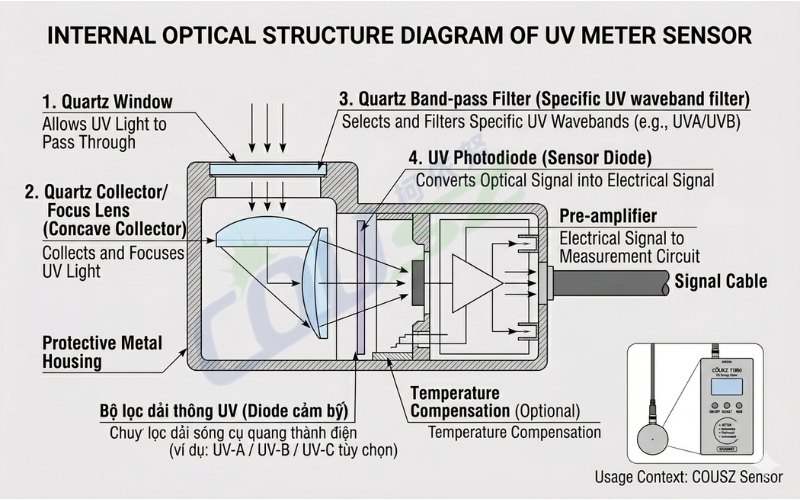
The operating principle is based on the photoelectric effect. When photons from an ultraviolet light source collide with the surface of the sensor (usually made from silicon or gallium nitride semiconductors), they release electrons, generating a weak electrical current.
This current is directly proportional to the incoming radiation. However, the crucial element in the operating principle lies in the optical filters. Since the light source often emits both heat (infrared) and visible light, the filter’s job is to eliminate unwanted wavebands, allowing only the target ultraviolet band (e.g., UVA 365nm) to enter the sensor.
Calculating energy over time
Following the photon capture, the device’s microprocessor executes a time-integration algorithm to calculate the UV energy density (mJ/cm²). This is particularly critical when measuring exposure for materials passing through a conveyor belt, where the dwell time changes according to the machine’s speed.
4. What is the connection between a UV meter and a UV curing system?
The relationship between these two systems is symbiotic, maintaining the “health” of the production line. The measurement device acts as the output calibration standard for the drying system. In the practical reality of measuring radiation for adhesive applications, the UV intensity dictates the light’s ability to penetrate deep into the adhesive layer, while the total energy dictates the level of complete chemical bonding.
When technicians inspect the curing chamber, they can detect “blind spots”—areas where the bulb is dirty or the reflector is clouded. Research from Professor R.W. Stowe, a leading expert in ultraviolet technology, confirms that if a reflector is merely 10% dirty, drying efficiency can drop by up to 50%, even if power consumption remains unchanged.
Establishing a golden standard
Furthermore, using a UV meter correctly helps establish a “Golden Standard” for production. When a new adhesive formula is introduced, checking the output determines the exact maximum conveyor speed that still guarantees adhesion, thereby optimizing labor productivity and throughput. For a broader understanding of this integration, you can read our comprehensive Overview of UV meters for UV curing quality control in industrial applications.
5. What are the core components of an industrial radiometer?
A durable industrial radiometer is constructed from high-grade components to withstand harsh environments. Understanding this anatomy helps users measure the UV curing process safely, avoiding leaving the device in the heat chamber too long and damaging the sensors.
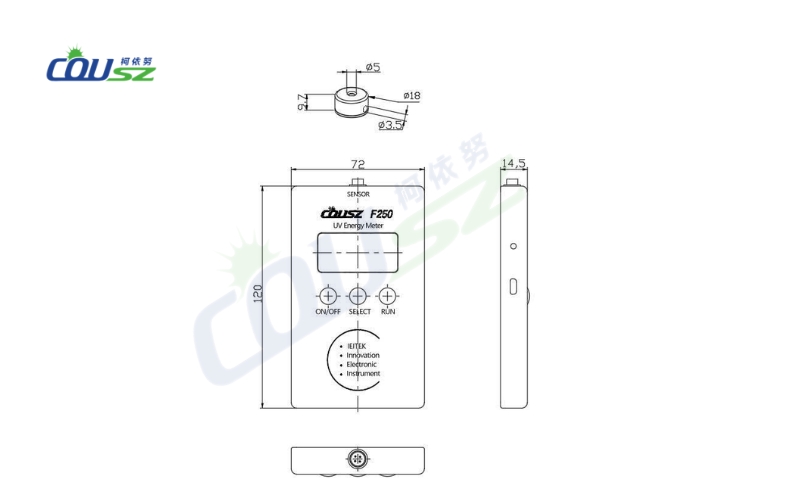
- Housing: Usually made of aircraft-grade aluminum or stainless steel, capable of reflecting heat to protect internal electronic components from overheating inside the curing chamber.
- Aperture: The light-receiving area, often equipped with a diffuser layer to ensure light is measured from multiple angles (Cosine Response).
- Optical filters and sensors: The “heart” of the machine, determining sensitivity to UVA, UVB, UVC, or UVV wavebands.
- Display and controls: Allows users to monitor parameters like Peak Irradiance and Total Energy.
- Battery and memory: Stores data from multiple readings to compare and analyze the degradation trend of the lamps.
| Component | Primary Function | Material / Tech |
|---|---|---|
| Housing | Thermal protection | Aircraft Aluminum / Stainless Steel |
| Sensor | Photon detection | Silicon / Gallium Nitride |
| Aperture | Cosine correction | Teflon / Quartz diffuser |
| Microprocessor | Integration calculations | Advanced PCB |
6. What are the strategic benefits of integrating a UV meter?
Integrating output inspection procedures into routine maintenance schedules brings four major strategic benefits to any manufacturing plant:
- Ensuring uniform quality: Completely eliminates the risk of defective products due to lack of heat or light, thereby enhancing brand reputation.
- Saving operational costs: Instead of replacing bulbs on an “estimated” schedule, businesses only replace them when the measurement shows parameters have fallen below acceptable levels. This saves thousands of dollars in material costs annually.
- Workplace safety: Minimizes the need for workers to expose their eyes directly to check lamp brightness, relying instead on objective numerical data.
In summary, this tool is not just a handheld device; it is an integral part of a comprehensive quality management system. When you rigorously check your curing output, you are protecting your profits and the very future of your enterprise.
7. How to contact COUSZ for technical consultation?
To receive a quotation and in-depth consultation on the most suitable measurement devices for your UV curing process needs, contact our expert team today:
👤 Ms. Yuna
✨ Consultant for UV Curing Systems, UV Meters & Plasma Solutions
📞 Tel/Whatsapp/Wechat/Zalo: (84) 965 535 348
📧 Email: sales03@cousz.com
🌐 Website: www.cousz-vn.com

8. FAQs – Frequently asked questions about UV meters
8.1. Does the device need periodic calibration?
Yes. Like all precision measurement instruments, the sensor will age due to exposure to high-intensity radiation. According to industry standards, you should calibrate the device every 12 months at an NIST-certified lab to ensure the error margin remains within acceptable limits (usually ±5%).
8.2. Can I use one device for both Mercury and LED lamps?
This depends on the spectral range of the instrument. Mercury lamps emit a broad spectrum (UVA, B, C), while LEDs usually emit a single spectrum (e.g., 365nm or 395nm). You need to use multi-functional devices or ones specifically designed for LEDs to get the most accurate UV intensity readings.
8.3. What is the difference between Irradiance (mW/cm²) and Dose (mJ/cm²)?
When checking your system, mW/cm² (Irradiance) represents the power of the light at a specific moment. Meanwhile, mJ/cm² (Dose) is the UV energy density—the total accumulated energy the surface receives. Imagine mW/cm² as the speed of water flowing from a hose, while mJ/cm² is the total amount of water in the bucket after a certain period.
8.4. Why measure both power and energy?
Measuring power checks the instantaneous operational capability of the bulb. Meanwhile, measuring energy checks if, at the current conveyor speed, the product receives enough radiation to dry completely. Both parameters are crucial to control the process effectively.
8.5. What exact parameters are displayed?
A standard unit will measure three main parameters: Peak Irradiance, Total Dose, and ambient Temperature. Some high-end models also allow for plotting power distribution charts over time to analyze the uniformity of the lamp array.