中文 (中国)
 Tiếng Việt
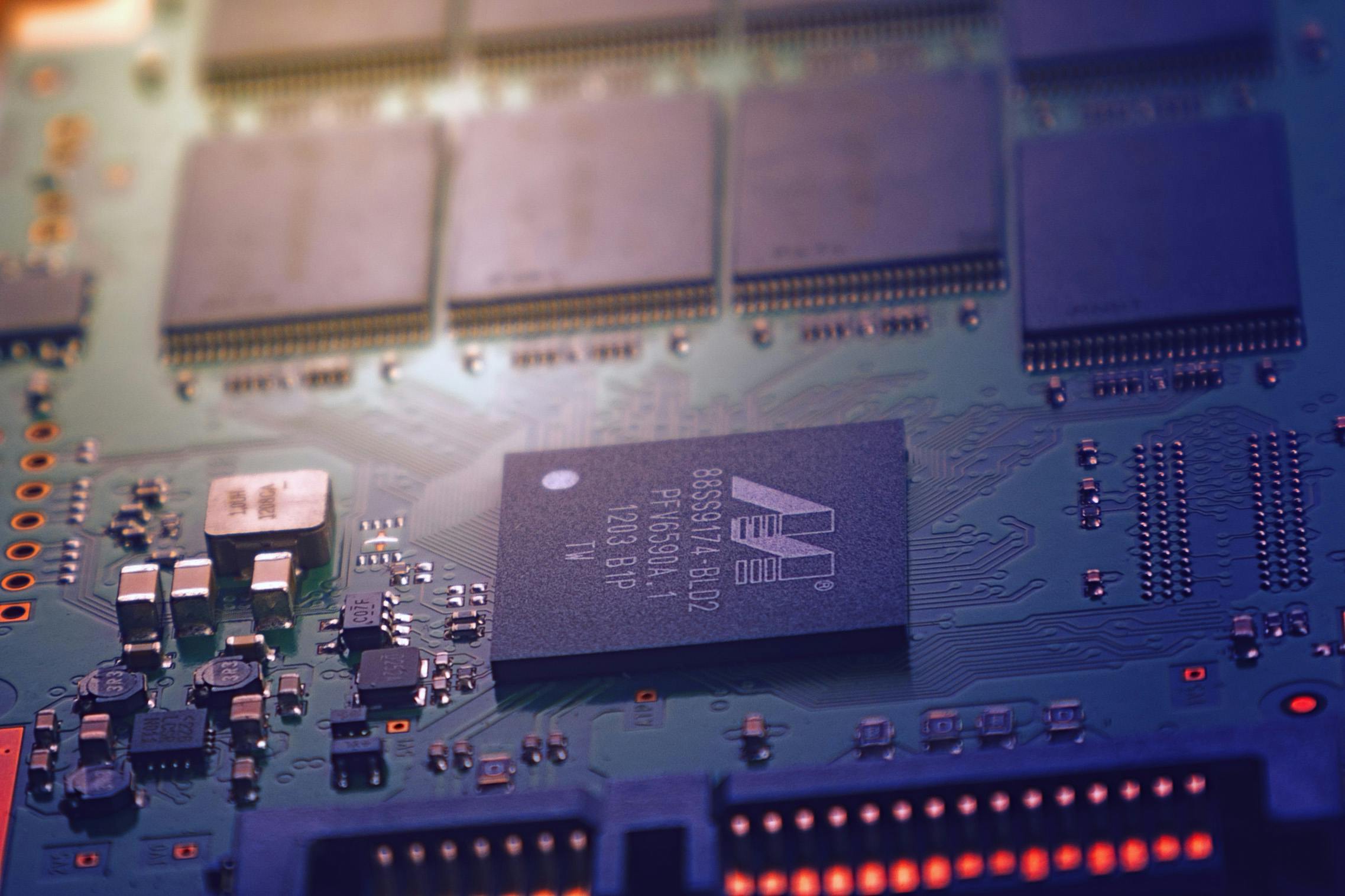
1. Common operational faults requiring UV meter repair
These instruments are high-precision electronic tools, yet they operate in deeply “hostile” environments: intense ultraviolet radiation and curing oven temperatures that routinely exceed 80°C. According to a landmark study by the Rochester Institute of Technology (RIT), optical measurement devices exposed continuously to high-energy UV rays experience material aging up to five times faster than under normal conditions. Below is a list of common faults that factory managers must monitor:
1.1. Inaccuracy and solarization
Inaccuracy is the most prevalent failure. When performing a routine UV intensity calibration, technicians often discover that the displayed value is 20-30% lower than reality. The root cause usually involves burnt optical filters or a phenomenon called “Solarization” (the rapid degradation and clouding of quartz glass under UV light).
1.2. LCD screen blackouts and probe errors
Under the impact of accumulated heat inside the curing chamber, the liquid crystal layers of the display can deform. If you do not schedule a professional UV meter repair promptly, the screen will lose its display capability entirely.
Probe errors frequently occur with models featuring detachable external probes, like the F250 or F460. The internal signal wire may break, or the connector jacks may oxidize, preventing the sensor’s signal from reaching the central processor. Additionally, forgetting to remove batteries during long storage periods can cause chemical leaks, severely corroding the micro-circuitry.
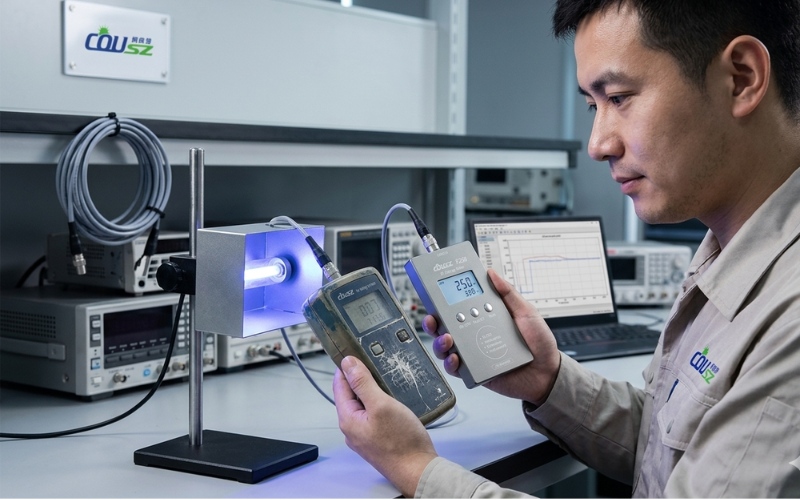
2. When do businesses need maintenance and UV meter repair?
Deciding when to request a UV meter repair should never be based on intuition or guesswork. Professors at the International RadTech Association strongly advise that measurement values are only truly reliable if the instrument is monitored using a weekly Control Chart.
2.1. When deviation exceeds ±10% from the standard
Every factory should maintain a strictly preserved “Golden Meter” (a master reference device). If your daily operational meter shows results deviating too far from the golden standard, it is a clear signal that you need UV intensity calibration immediately. If the error margin does not improve after adjusting the multiplier rate, internal components are failing.
2.2. After impact or overheating incidents
If the device is dropped on the concrete floor or gets stuck inside the high-heat curing oven for over 30 seconds, the optical adhesive and component solder joints will likely sustain damage. In such scenarios, optical measurement devices must undergo a full integrity check of the quartz filters before being put back into production.
2.3. Sensor lifespan limit
Ultraviolet sensors have a finite “photon lifespan.” After absorbing a specific threshold of radiation, their sensitivity drops along a logarithmic curve. Knowing exactly when to replace UV sensor components is the only scientifically sound way to maintain precision for high-power LED curing lines.
2.4. The mandatory 12-month cycle
Even if the machine appears to be working perfectly, sending it to a certified service center once a year is a strict requirement of ISO 9001 quality management systems. Periodic calibration helps businesses completely avoid the massive risks of quality complaints and rejected batches from international clients.
3. Introduction to technical services provided by COUSZ
COUSZ Vietnam does not merely sell equipment; we provide a comprehensive technical solution ecosystem. Hardware maintenance is just one small part of our dedication to supporting our customers’ manufacturing success.
3.1. Testing, renting, and installation
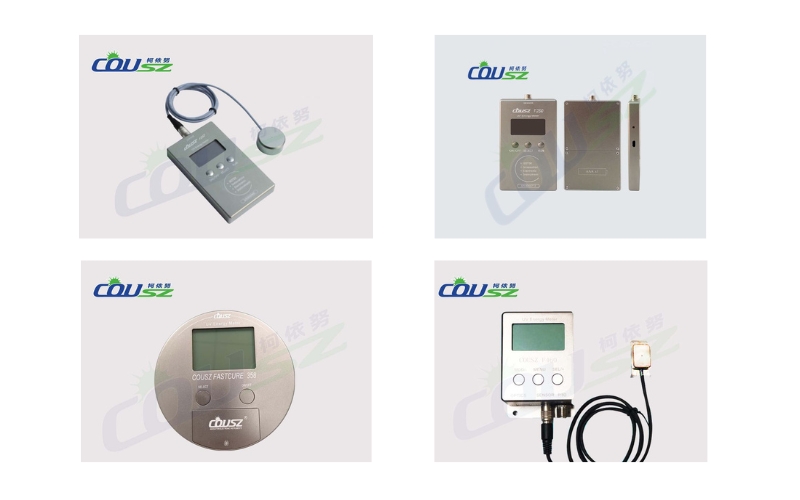
- Equipment Testing: We support customers by measuring actual lamp intensity right at the factory. Using premium models like the 4-band F358, our engineers help determine if your current drying system meets standards before you decide to buy new equipment or request a UV meter repair.
- Rental Services: While waiting for your device to be fixed or sent for international calibration, COUSZ offers rental units like the F150 or F250. This ensures your QC process never faces downtime.
- Installation Guidance: We teach you how to optimize the distance from the lamp to the material. Proper setup drastically reduces thermal impact on your measuring tools.
3.2. Upgrades and after-sales support
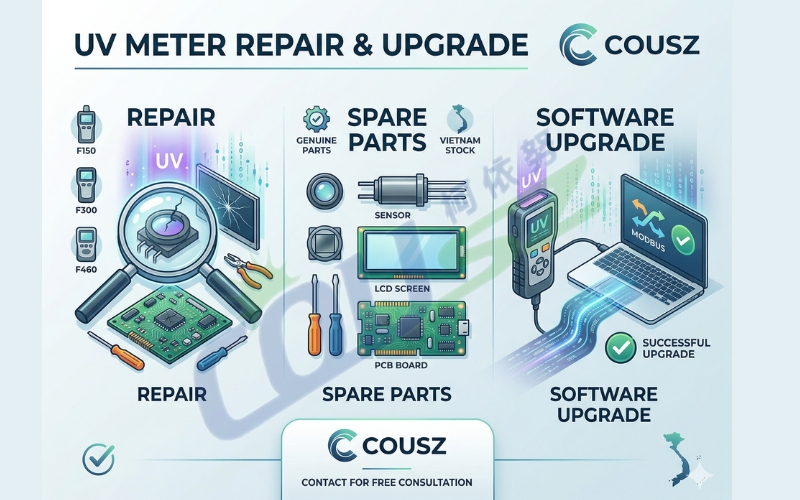
COUSZ takes immense pride in being the leading technical center in the Vietnamese market. We stock genuine replacement parts, from LCD screens to processing boards. Our engineers can replace UV sensor heads for various models ranging from the F150 to the F460. Furthermore, we offer software upgrades for MODBUS communication on online monitoring systems. Every service comes with a robust warranty and lifetime free consultation on preservation methods.
4. The standard UV meter repair and maintenance process at COUSZ
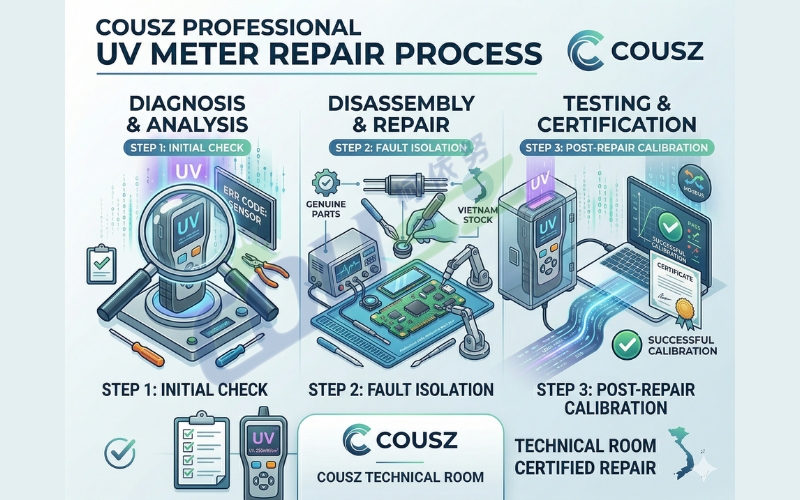
To guarantee absolute professionalism, every UV meter repair handled at COUSZ Vietnam strictly adheres to a rigorous 5-step industrial protocol.
Five steps to restore accuracy
| Process Step | Detailed Action |
|---|---|
| 1. Reception & Inspection | Technicians visually inspect the unit and test it under NIST-traceable light sources to determine the exact degree of deviation. |
| 2. Quotation & Strategy | After identifying the root cause (e.g., whether to replace UV sensor parts or just clean the filters), we send a detailed component quote. |
| 3. Execution | Technicians replace components inside a cleanroom environment to prevent microscopic dust from clinging to the sensitive optical surfaces. |
| 4. Post-Calibration | The repaired unit undergoes strict UV intensity calibration to reset the multiplication rate, ensuring the output perfectly matches the reference source. |
| 5. Handover | The device is securely packaged alongside its new calibration protocol report and operational guidelines to prevent recurring user errors. |
5. Contact for technical consultation
If your device is displaying erratic numbers, drifting deviations, or suffering from a broken screen, do not delay. A faulty reading can cost you a billion-dollar production batch. To thoroughly understand How to operate a UV meter correctly and identify component replacement signs, or to schedule a fast and highly effective UV meter repair, contact our experts immediately:
👤 Ms. Yuna
✨ Technical & Sales Department – COUSZ Vietnam
📞 Tel/Whatsapp/Wechat/Zalo: (84) 965 535 348
📧 Email: sales03@cousz.com
🌐 Website: www.cousz-vn.com
6. Faqs – frequently asked questions about technical issues
6.1. How long is the warranty for repaired components?
For entirely new devices, COUSZ provides a standard 1-year genuine warranty. For replaced components or structural fixes, we offer a dedicated warranty period ranging from 3 to 6 months, heavily depending on the specific harshness of the customer’s operational environment.
6.2. What are the most common user errors that damage the device?
The most frequent errors include failing to turn off the device after measuring (leading to dead batteries and acid leaks), using rough industrial cloths to wipe the delicate quartz filter (causing microscopic scratches), and forgetting to reset the device to zero before initiating a new exposure measurement.
6.3. What specific technical services does COUSZ offer?
We provide an end-to-end package encompassing UV meter repair, periodic NIST-traceable calibration, complete sensor replacements, communication software upgrades, equipment leasing, and advanced technical consultation for designing fully automated industrial UV drying systems.
6.4. Can optical measurement devices be fixed if dropped?
It depends entirely on the extent of the internal damage. If the external housing is dented but the quartz crystal and microprocessor are intact, it can often be recalibrated. If the optical filter is shattered, an entire sensor head replacement is mandatory before any calibration can be attempted.