中文 (中国)
 Tiếng Việt
1. What factors directly affect the market pricing of these devices?
When searching for measurement equipment in today’s highly saturated market, you will immediately notice a massive discrepancy in quotes, ranging from a mere few hundred dollars to tens of thousands. According to this UV meter buying guide, this vast difference does not stem from external aesthetics but is deeply rooted in the core internal technologies.
1.1. The number of wavelength channels and filters
One of the absolute primary factors dictating the final cost of a device is its ability to measure multiple spectral bands simultaneously. Single-channel models—those designed to measure only broad UVA or a specific narrow LED band like 395nm—typically feature a highly accessible UV meter price. These are excellent for straightforward, single-source curing lines.
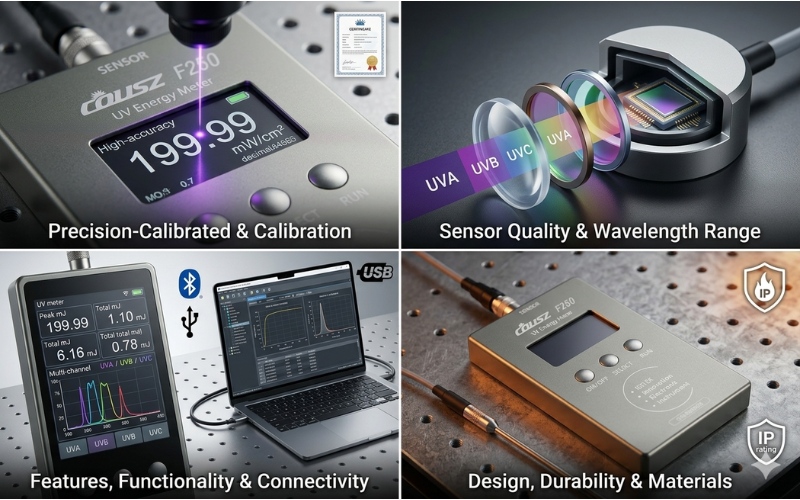
However, advanced multi-channel models (such as the industry-standard Power Puck series that concurrently measures UVA, UVB, UVC, and UVV) require significantly more complex optical engineering. Integrating four distinct semiconductor sensors and four distinct interference filters into a micro-sized, heat-resistant casing demands extreme mechanical and optical precision. This sophisticated manufacturing process inherently pushes the quotation into the premium, high-end industrial segment.
1.2. Sensor sensitivity and absolute accuracy
The photodiode sensor acts as the “heart” of the entire instrument. Genuine, high-quality devices utilize advanced semiconductor sensors (like Gallium Nitride or Silicon Carbide) that boast exceptional thermal stability and perfectly linear spectral responses. Based on rigorous standards set by NIST (National Institute of Standards and Technology), the maximum allowable error margin for industrial metrology is strictly under 5%.
Conversely, inexpensive devices heavily rely on standard commercial light sensors coated with cheap colored films. These budget sensors suffer from severe “zero drift” and solarization after only a few months of intense radiation exposure. Consequently, the data becomes entirely meaningless, directly threatening your overall UV curing quality and causing undetected production flaws.
1.3. Heat resistance and heavy-duty casing design
The interior of an industrial ultraviolet oven is an incredibly hostile environment, often exceeding 100°C. Premium radiometers feature specialized aerospace-grade aluminum alloy casings designed to reflect radiant heat and shield the fragile internal microprocessors. When utilizing a UV meter buying guide to evaluate costs, you must factor in the durability of this protective thermal shell. It is the only barrier preventing the internal battery and sensors from catastrophically exploding while traveling slowly through high-power conveyor systems.
2. How to compare operational costs versus initial investment?
When initially reviewing quotations from various distributors, many procurement managers have a strong tendency to select the absolute cheapest models to strictly conserve their initial departmental budgets. However, as any expert UV meter buying guide will warn you, this is frequently a devastating long-term operational trap.
2.1. The hidden financial costs of measurement errors
Imagine a scenario where your budget device has an undetected error rate of 15%. Due to this false reading, your technicians might unknowingly “over-cure” the product by running the lamps at maximum power, thereby wasting massive amounts of electricity and drastically reducing the expensive bulb’s lifespan. Alternatively, they might “under-cure” the product, leading to severe chemical peeling and structural failures.
In a landmark study published by Professor R.W. Stowe, utilizing inaccurate optical measurements can artificially inflate the factory scrap rate by up to 10%. If your daily production batch of medical devices or printed circuit boards is worth hundreds of thousands of dollars, “saving” a few hundred dollars on a cheap tool instantly becomes a monumental financial disaster.
2.2. Periodic calibration expenses and lifespans
Every single standardized measurement device globally requires formal recalibration every 12 months. The calibration costs for genuine equipment sourced from reliable suppliers are always transparent, standardized, and fully supported by certified local metrology centers. You receive a legally binding NIST-traceable certificate.
On the other hand, non-brand cheap devices often cannot be physically recalibrated. Even if they can be, the international shipping costs and customs fees required to send the machine back to a foreign manufacturer (who lacks local representation) are exorbitantly expensive and highly time-consuming.
| Evaluation Criteria | Non-Brand Cheap Devices | Genuine Premium Devices (COUSZ, etc.) |
|---|---|---|
| Initial Investment Cost | $200 – $600 USD | $1,500 – $4,500 USD |
| Data Accuracy | Error > 15%, rapid sensor drift | Error < 5%, long-term stability |
| Calibration Capability | Difficult or impossible locally | Full NIST/ISO certified support |
| Expected Lifespan | 6 – 12 months | 5 – 10 years |
Based on the empirical data above, if you divide the total expenditure by the years of active service, the premium UV meter price actually proves to be significantly cheaper than constantly repurchasing broken budget models. Smart industrial investment is about investing in long-term peace of mind and data accuracy.
3. What is the best strategy to avoid procurement traps?
Even though the ultimate goal is purchasing hardware, the true “soul” of any drying system is its ability to meticulously control radiant energy. To ensure you do not get scammed or overpay, you must strictly follow a comprehensive UV meter buying guide and evaluate the tool as part of a holistic quality assurance package.
3.1. Evaluating the total technical package
- Look beyond the initial quote: Do not just obsess over the upfront UV meter price. Strictly interrogate your vendors about their post-sales warranty policies and local on-site repair capabilities. A cheap machine that takes three months to repair overseas will entirely paralyze your factory’s production line.
- Demand calibration certificates: When you request a quotation, always explicitly ask: “Does this price include a fresh NIST-traceable calibration certificate?” This document is the highest form of legal proof regarding the instrument’s metrological value.
- Select the appropriate wavelength: Do not blindly purchase an expensive four-channel radiometer if your facility exclusively operates 395nm LED arrays. Deeply understanding your actual factory needs helps dramatically optimize the budget highlighted in this UV meter buying guide.
- Verify physical compatibility: Ensure the device you intend to purchase can physically pass through the height clearance of your curing oven. There are numerous documented cases where companies bought premium, highly accurate equipment, only to discover the casing was too thick to fit through the narrow gap of their electronics conveyor belt.
Ultimately, always remember that the value of a correct, repeatable measurement is priceless. Knowing the cost is merely the first preliminary step; fully grasping the immense value it injects into your UV curing quality management system is the final goal of any talented production manager. For a deeper dive into optimizing your investments, please review our detailed UV meter investment guide showing how to optimize costs and choose reliable suppliers.
4. Where to get a genuine quote and contact experts?
We are profoundly committed to delivering measurement solutions that are entirely transparent in pricing and fundamentally superior in build quality. Do not let uninformed, hasty choices violently waste your departmental budget.
If you need an honest UV meter buying guide tailored specifically to your factory’s unique architecture, contact us immediately. We will help you connect with reliable suppliers and provide the most optimal equipment for your specific manufacturing scale:
👤 Ms. Yuna
✨ UV Measurement Solutions Consultant – COUSZ Vietnam
📞 Tel/Whatsapp/Wechat/Zalo: (84) 965 535 348
📧 Email: sales03@cousz.com
🌐 Website: www.cousz-vn.com
5. Faqs – frequently asked questions about pricing and investments
5.1. Why are major brand meters much more expensive than e-commerce ones?
The vast price discrepancy lies entirely in the strict quality control processes and the raw optical components used. Genuine instruments utilize military-grade quartz filters and highly stable semiconductors that flawlessly filter out visible light interference. E-commerce devices use generic ambient light sensors with colored stickers, rendering their data suitable only for basic reference, never for strict technical acceptance.
5.2. How much does annual calibration usually cost?
Typically, the annual recalibration fee ranges from 15% to 20% of the device’s original purchase value, heavily depending on how many spectral channels require testing. This is a mandatory, unavoidable operational cost to legally maintain your ISO quality management systems. Reliable suppliers offer rapid turnaround times to ensure zero production downtime.
5.3. Should I buy a second-hand device to save money?
Purchasing used optical equipment carries exceptionally high financial risks because it is impossible to visually determine how severely the internal sensor has been degraded by “solarization” (ultraviolet aging). If you must buy used, this UV meter buying guide strongly advises demanding the seller perform a fresh calibration and provide the newest certificate before payment.
5.4. Is the quote for led meters different from mercury ones?
Yes, there is a distinct difference. LED technology requires highly specialized narrow-band optical filters and incredibly fast processing algorithms to capture sharp irradiance peaks. Consequently, advanced models that support both LED and traditional mercury lamps generally command a higher UV meter price than older, broadband-only legacy models.
5.5. What is an appropriate budget for a small printing workshop?
For a small-scale printing facility, you do not necessarily need an expensive four-channel instrument. A high-quality, single-channel device focused purely on UVA or 395nm LED (depending strictly on your ink formulation) priced between $1,000 and $1,800 USD is a highly rational investment. It guarantees excellent precision while ensuring a rapid return on investment.