中文 (中国)
 Tiếng Việt
1. Why does this tool play a crucial role in adhesive curing?
In the ultraviolet adhesive curing process, the photochemical reaction occurs extremely rapidly. Even a minor deviation in delivered energy can lead to total product failure. The fundamental role of measurement equipment here is to provide empirical, real-time data rather than relying on subjective guesswork.
According to research from RadTech International, the world’s leading organization for radiation curing technology, the output efficiency of ultraviolet bulbs (especially mercury vapor lamps) degrades significantly over their operational lifespan. If you do not utilize a UV meter in quality control, your business will fall into a state of “parameter blindness”. This leads to under-curing, causing adhesives to remain sticky or peel off. Conversely, over-curing—resulting from blindly pushing the power output too high to “compensate” for suspected degradation—will cause products to become brittle, yellowed, or thermally deformed.
Shifting from reactive to proactive maintenance
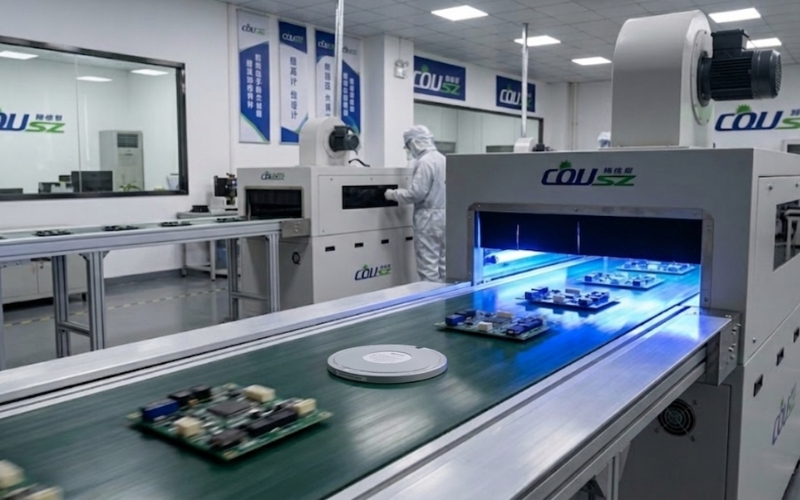
Performing UV intensity measurement during production helps precisely determine the exact moment when components need replacing or when the reflector housing requires cleaning. This shifts the operational mindset from reactive maintenance (fixing things only when they break) to proactive maintenance. Consequently, this optimization saves thousands of dollars in scrapped materials annually.
2. What exactly is a radiometer and what does it track?
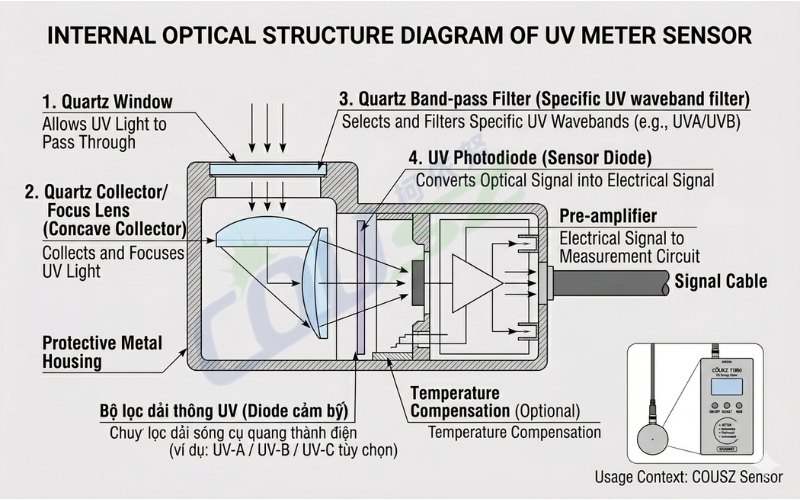
To properly apply a UV meter in quality control, we must understand that this device is a highly sophisticated radiometer designed specifically to withstand the extreme, high-temperature environments inside curing chambers. Unlike standard optical sensors, industrial radiometers are equipped with precise bandpass filters that allow only specific, targeted ultraviolet wavelengths to pass through and reach the sensor.
Critical parameters for accurate QC inspections
So, what exactly do these devices measure to support the QC process for UV curing systems? Below is a technical breakdown of the core metrics:
| Parameter | Unit of Measurement | Technical Significance in QC |
|---|---|---|
| Irradiance (Power) | mW/cm² or W/cm² | Measures the instantaneous peak power of the light at a specific point. It dictates the light’s ability to penetrate deep into thick adhesive or ink layers. |
| Energy Density (Dose) | mJ/cm² or J/cm² | When measuring UV energy density, this represents the total accumulated energy the product surface receives while passing through the exposure zone. It is the most critical metric for chemical bonding. |
| Temperature | °C / °F | Advanced models integrate thermal sensors to ensure the curing process does not warp or damage heat-sensitive substrates like thin plastic films. |
By mastering these parameters, the measurement device becomes the “all-seeing eye” that helps the quality assurance department control every variable of the manufacturing process.
3. The vital connection between measurement devices and curing hardware
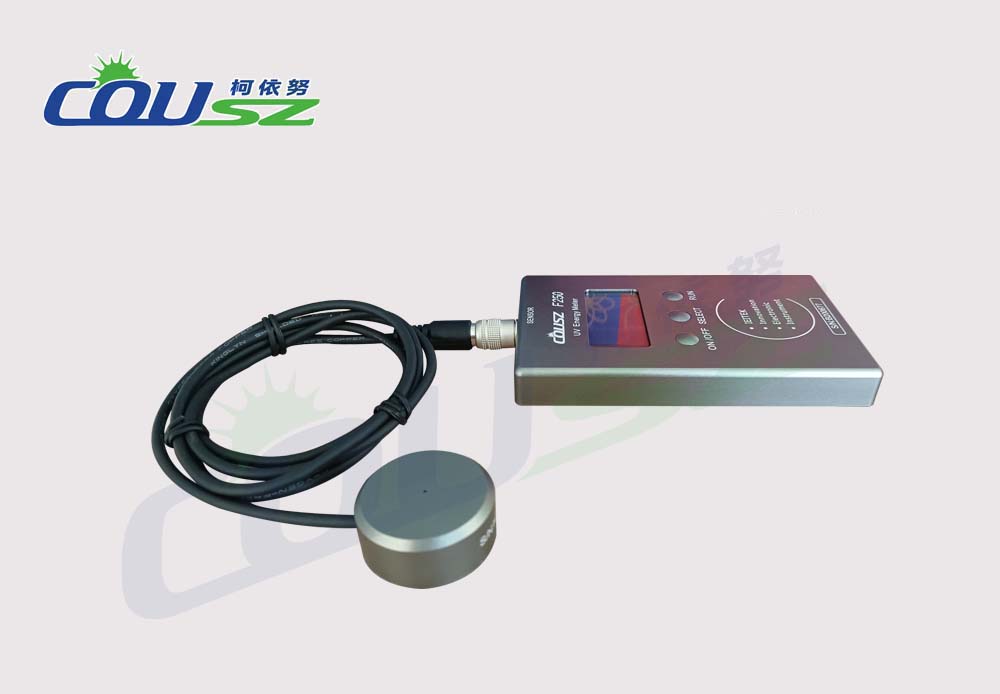
The relationship between measurement devices and UV curing systems is like that of a thermometer and a patient. The drying system supplies the energy, but only a UV meter in quality control can confirm if that energy is correct and sufficient.
Detecting uneven light distribution and conveyor speeds
In a standardized quality assurance protocol, the radiometer is used to map the relationship between conveyor speed and lamp power. For example, to dry a specific printing ink, the manufacturer might require a minimum energy of 400 mJ/cm². If the device reads only 350 mJ/cm², the QC team instantly knows they must reduce the conveyor speed or increase lamp power, rather than waiting to discover poor adhesion on the final finished product.
Furthermore, its role is evident in detecting unevenness across the lamp array. In wide-format drying machines, the intensity in the center of the belt is often stronger than at the edges. This is why UV intensity measurement is so critical at multiple points across the conveyor belt. It allows technicians to adjust the tilt angle of the reflector or replace localized weak bulbs, ensuring every product in the batch shares identical quality.
4. Strategic benefits of using a uv meter in quality control
Implementing a UV meter in quality control is not just an expense; it is a direct profit-generating investment through the following core values:
- Establishing objective metrics: Instead of guessing, measuring UV energy density allows you to establish concrete numbers for QC reports. This is vital when dealing with major clients who demand transparency in technical data.
- Minimizing the Not Good (NG) rate: By detecting lamp degradation early, businesses prevent the mass production of defective goods before they even leave the curing chamber.
- Extending component lifespan: Many operators run lamps at 100% capacity just for “peace of mind.” However, if the device indicates that only 80% power is needed to hit the target energy, reducing the power extends the bulb’s life by hundreds of hours.
- Complying with international standards: Certifications like ISO or IATF require measuring instruments to be calibrated and data to be recorded periodically. This is the foundational step to achieving those certificates.
Accessing comprehensive technical knowledge
To fully grasp how these tools integrate into broader industrial frameworks, we highly recommend reading our detailed UV meter overview showing how to control UV curing quality effectively
5. Industry-specific applications for production assurance
The role of a UV meter in quality control changes flexibly depending on the specific characteristics of each manufacturing sector:
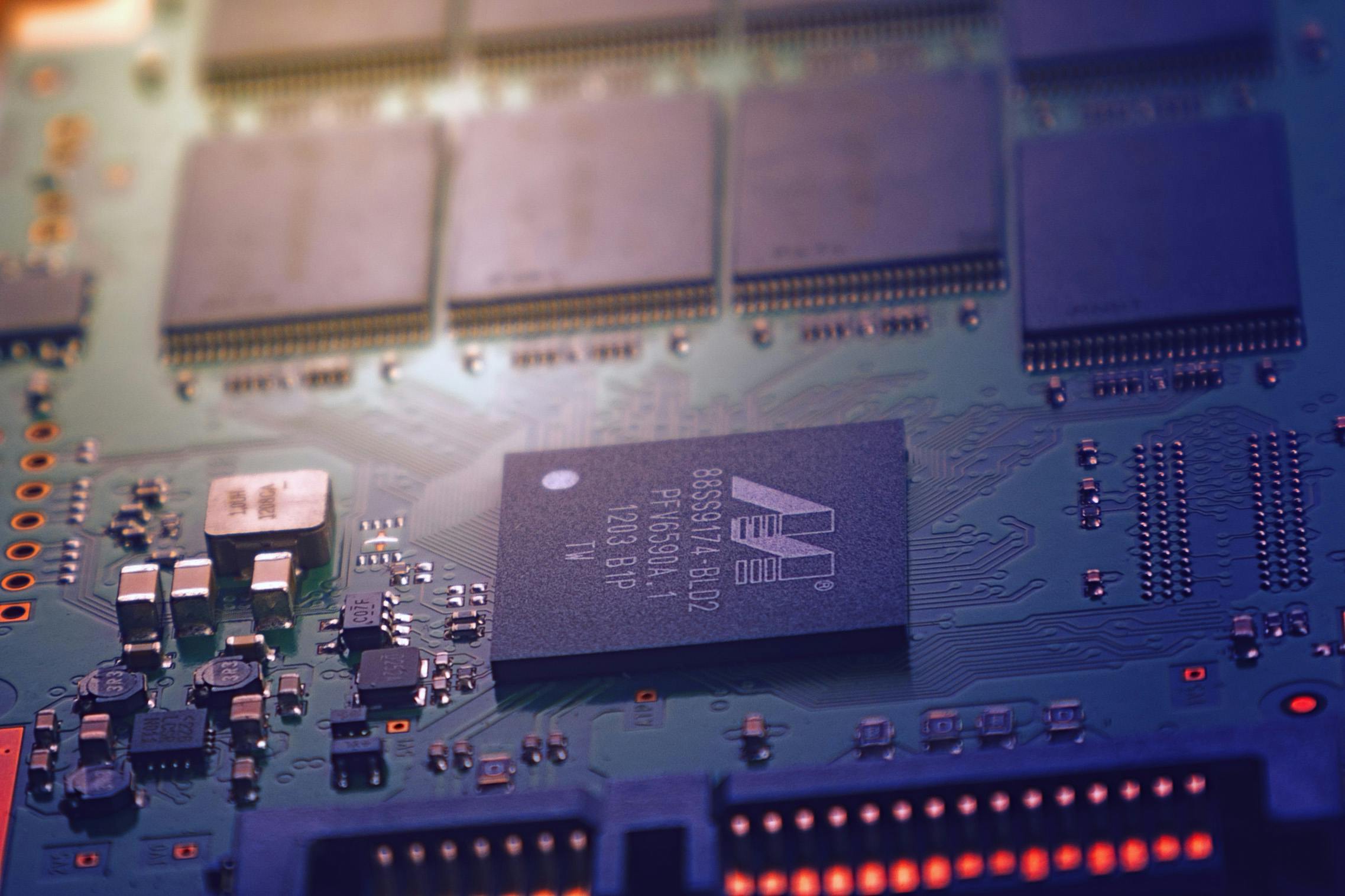
- Electronics manufacturing: Used to verify the curing of adhesives when mounting ICs or applying conformal coatings. A minor energy error can cause electrical leakage or destroy sensitive microchips.
- Printing industry (Offset/Flexo): In the printing industry, UV intensity measurement ensures that the ink dries completely, preventing color bleeding or residual chemical odors on food packaging.
- Medical device production: This sector demands the strictest measurement standards. The device ensures coatings on catheters or syringes are absolutely cured, guaranteeing sterility and patient safety.
- Automotive and furniture: Used to monitor the gloss and hardness of nano-coatings, ensuring the final products can withstand scratches and harsh environmental impacts.
Transforming manufacturing from art to science
Regardless of the field, affirming the role of these tools as instruments of truth is undeniable. They transform the production process from an “art of chance” into an “exact science.”
6. Contact us for technical solutions
If you are looking for optimal solutions to enhance your QC capabilities, understand radiation dynamics, and ensure your UV curing systems operate stably, contact our expert team today:
👤 Ms. Yuna
✨ Technical & Sales Representative – COUSZ Vietnam
📞 Tel/Whatsapp/Wechat/Zalo: (84) 965 535 348
📧 Email: sales03@cousz.com
🌐 Website: www.cousz-vn.com
7. Faqs about utilizing measurement tools in qc
7.1. How does it help establish a gold standard for processes?
A “Gold Standard” is the ideal operational parameter established when everything is perfect (new lamps, new adhesives). The device records the irradiance and energy density at that precise moment. Future checks only need to be compared against this “golden” number; if the deviation exceeds the allowable threshold (usually 10%), the QC team knows immediately that maintenance is required.
7.2. How often should periodic testing be performed?
Testing frequency depends on the factory’s workload. For 24/7 production lines, testing should occur once per shift or at least daily. For lower-volume facilities, checking at the start of the week is necessary to maintain stability.
7.3. Can we use a uv meter in quality control to check light uniformity across the conveyor?
Absolutely. This is one of its most critical applications.