中文 (中国)
 Tiếng Việt
1. Why is choosing the right uv meter crucial for production?
Many enterprises make the critical mistake of treating a radiometer as an optional, non-mandatory accessory. However, according to a comprehensive report from the RadTech International Association, over 65% of incidents involving poor UV adhesive adhesion stem from undetected lamp intensity degradation.
The process of choosing the right UV meter accurately helps a business establish a solid “Baseline.” As light bulbs age, the amount of emitted photons gradually decreases. Without proper measurement devices, technicians often resort to increasing lamp power based purely on “feel” or guesswork. This practice not only causes massive electricity waste but also risks overheating the product’s surface, leading to thermal deformation.
Transforming art into exact science
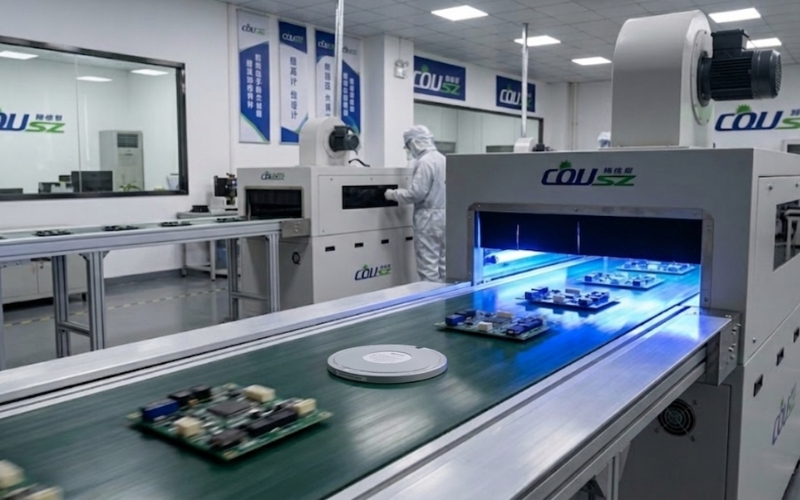
Research by Professor R.W. Stowe, one of the most respected scholars in ultraviolet technology, affirmed: “Measurement is the only way to turn the art of UV curing into an exact science.” Therefore, choosing the right UV meter is not merely buying a tool; it is investing in an “early warning system” for your UV curing systems to safeguard billion-dollar production batches.
2. How to identify your business needs before buying?
Before diving into complex technical specifications, the first step in the consultation process is to clearly define your intended use. A business must answer three core operational questions:
2.1. What is your exact light source?
Traditional medium-pressure mercury lamps emit a broad spectrum of light. In contrast, LED technology emits a narrow, single spectrum (typically peaking at 365nm, 385nm, or 395nm). A device designed for a mercury lamp will yield severely inaccurate results when used on an LED source. Identifying your source is the foundation of choosing the right UV meter.
2.2. What is the structure of your curing oven?
If you operate an enclosed conveyor belt, you will need a multi-channel UV meter in a thin “puck” design that can pass directly through the heat chamber. If you operate a manual, open drying station, a handheld radiometer with a detachable external probe might be a more economical and practical choice.
2.3. What is your measurement frequency?
Taking a quick weekly reading requires different equipment than performing continuous 24/7 monitoring on a fully automated production line. Based on practical purchasing experience, we advise businesses to prioritize models with upgradeable or interchangeable probes to adapt to future light source technology shifts.
3. What are the golden criteria when selecting a device?
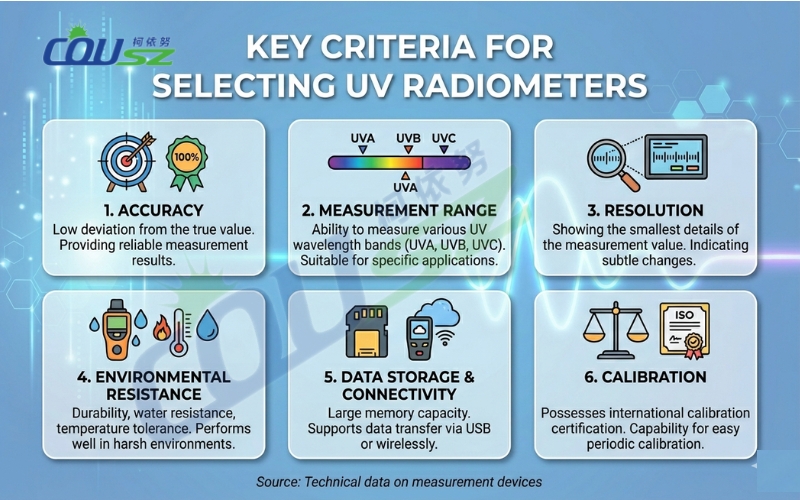
To make the purchasing decision highly effective, management must focus on the following three “golden” technical criteria when evaluating different models:
3.1. Matching spectral sensitivity to the source
Every adhesive, ink, or coating has a specific “activation window.” The most critical aspect of choosing the right UV meter is ensuring the device’s spectral sensitivity perfectly matches the emission band of your lamps.
- For Mercury Lamps: You need a broadband meter covering UVA, UVB, and UVC.
- For UV LED Lamps: You require a specialized device with narrow-band optical filters to prevent interference from ambient visible light.
3.2. Evaluating power and energy capabilities
A high-quality instrument must be able to display two vital parameters for proper UV intensity measurement:
- Irradiance (mW/cm²): The instantaneous peak power that helps ultraviolet rays penetrate deep through thick layers of material.
- Energy Density/Dose (mJ/cm²): The total accumulated energy the product receives over time.
Experts consistently emphasize that the accumulated dose determines whether the adhesive is fully cured, while peak irradiance determines the speed of the chemical reaction.
3.3. Thermal resistance and operational environment
Drying chambers are extremely harsh environments, with temperatures often soaring to 80°C – 100°C. A smart approach to choosing the right UV meter is selecting models built with high-grade aluminum alloy housings or dedicated thermal protection shields. A device without proper insulation will quickly suffer from “sensor drift” after just a few high-power readings.
3.4. Selecting models based on curing machine types
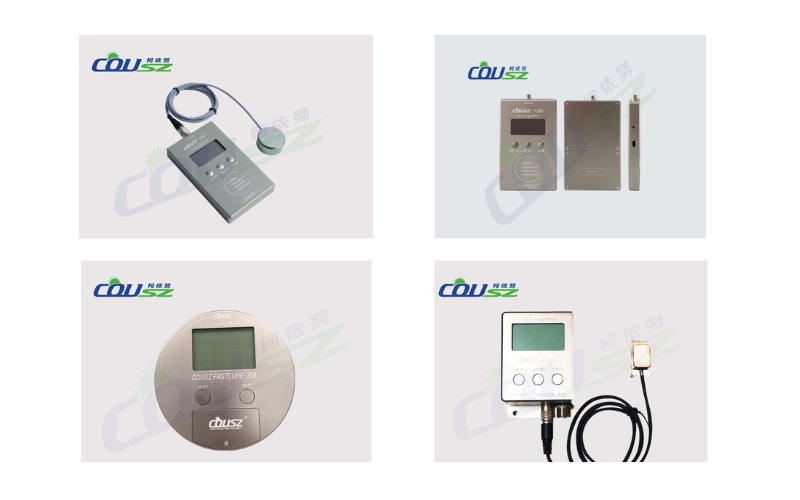
Depending on your hardware architecture, COUSZ recommends specific models to guarantee the highest data accuracy. For a comprehensive overview, please read our UV meter guide showing how to choose the right UV meter for accurate measurement.
| Curing Machine Type | Recommended Model | Primary Advantage |
|---|---|---|
| Spot / Flood Curing Systems | F250 Model | Handheld flexibility with high-precision external probes for targeted areas. |
| Standard Conveyor Systems | F358 Model | Ultra-thin puck design that safely travels directly under the lamp array. |
| Automated Integration Systems | F460 Model | Advanced connectivity for real-time monitoring and data-driven quality control. |
4. What are the common mistakes when buying radiometers?
During our customer support sessions, we record many cases where companies lose money due to fundamental errors in choosing the right UV meter. Below are the most typical pitfalls to avoid:
4.1. The hidden cost of cheap equipment and missing certificates
- Buying based solely on low price: Cheap devices utilize unstable optical sensors, leading to error margins of 30-40%. A report from the National Institute of Standards and Technology (NIST) notes that optical measuring instruments require high “Repeatability,” a standard that budget devices simply cannot meet.
- Ignoring the Calibration Certificate: A radiometer without a calibration certificate is like a clock that hasn’t been set. Ignoring this document renders your UV intensity measurement data meaningless when you need to cross-reference it with the chemical manufacturer’s strict standards.
- Using the wrong device for LED technology: This is currently the most prevalent error. Because LEDs emit a very narrow band, using a traditional broadband meter results in readings significantly lower than reality, prompting technicians to waste unnecessary energy trying to compensate.
To avoid these costly mistakes, partnering with a reputable technical consultant is the wisest step any production manager can take for their UV curing systems.
5. How to contact us for technical solutions?
Are you still wondering about choosing the right UV meter for your specific setup? Do not hesitate to connect with us to receive the most dedicated and profound support from our engineering experts:
👤 Ms. Yuna
✨ UV Measurement Solutions Consultant – COUSZ Vietnam
📞 Tel/Whatsapp/Wechat/Zalo: (84) 965 535 348
📧 Email: sales03@cousz.com
🌐 Website: www.cousz-vn.com
6. Faqs – frequently asked questions about equipment selection
6.1. How important is the thermal resistance of the device?
Extremely important. Optical sensors are highly sensitive to heat. If the device overheats, the internal electronic components will drift, resulting in inaccurate measurements (usually much lower than reality). When selecting an instrument, ensure it can withstand at least 10-20 seconds inside your heat chamber without exceeding its operational threshold.
6.2. Can I use a standard mercury meter for a 395nm led lamp?
No, you should not. Mercury lamps emit a broad spectrum from 200nm to 450nm, while a 395nm LED emits around one narrow peak. A standard meter has incompatible optical filters, leading to massive errors (up to 50%). Always look for devices labeled “LED-specific” when dealing with modern light sources.
6.3. Why is a multi-channel uv meter puck more expensive than a pen-type?
The difference lies in sensor complexity and data processing power. A multi-channel UV meter in a puck format must integrate multiple sensors, high-end spectral filters, and onboard memory into an ultra-thin profile to survive passing under lamps on a belt. Handheld pen devices are simpler and only measure at a single stationary point.
6.4. Does the equipment require periodic calibration?
Yes. According to global metrology standards, you must calibrate the machine once every 12 months. This is a critical practice for UV intensity measurement to ensure legal compliance and the reliability of your QC data in the eyes of international manufacturing partners.
6.5. Is there a model that measures uva, uvb, uvc, and uvv simultaneously?
Yes, these are specifically known as multi-channel radiometers. Measuring four wavebands simultaneously gives you a comprehensive profile of bulb performance, which is particularly useful for complex multi-layer printing lines running broad-spectrum lamps.