中文 (中国)
 Tiếng Việt
 한국어
한국어
In modern industrial manufacturing, maintaining peak surface activation performance is absolutely vital for ensuring superior adhesion quality. However, operational issues with your plasma surface treatment machine can occur unexpectedly, causing costly production interruptions and significant economic damage. This in-depth technical article provides a comprehensive plasma cleaner troubleshooting guide, helping your engineering team proactively identify common operating problems and execute professional repairs to optimize your production line’s throughput.
1. Why do operational errors occur in plasma cleaning machines?
1.1. Analyzing the root causes of system failures
Accurately identifying the root cause is the first essential step in minimizing plasma cleaning machine troubleshooting time. According to foundational research by Professor Alexander Fridman (Director of the Drexel Plasma Institute), atmospheric plasma is a highly sensitive system where the delicate balance between gas flow, high-frequency voltage, and temperature must remain strictly stable.
- Compressed Air Quality (CDA): Contaminated air is responsible for up to 60% of equipment failures. Compressed air containing even trace amounts of moisture or compressor oil will trigger catastrophic arc discharges, instantly incinerating the spray nozzle.
- Power Grid Instability: In concentrated industrial zones, sudden voltage drops directly impact the high-frequency RF Generator. Without a high-standard voltage regulator, the risk of damaging the power circuit—requiring professional plasma surface cleaning machine repair—increases significantly.
- Environmental Factors: High humidity levels characteristic of the tropical climate in Vietnam easily cause oxidation on electrical contacts and sensors, leading to the most frequent plasma machine common operating issues.
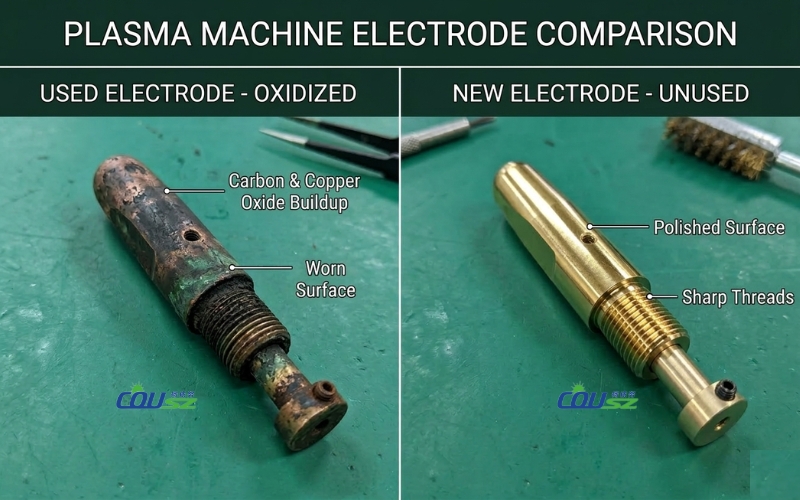
- Natural Component Wear: Plasma electrodes possess a finite operational lifespan. Neglecting to replace these components causes the plasma plume to become weak, flickering, or non-uniform.
2. How to resolve common operational issues in plasma systems?
Below is an expert analysis of the most common operating errors in plasma surface cleaners and immediate corrective measures for your factory’s technical team.
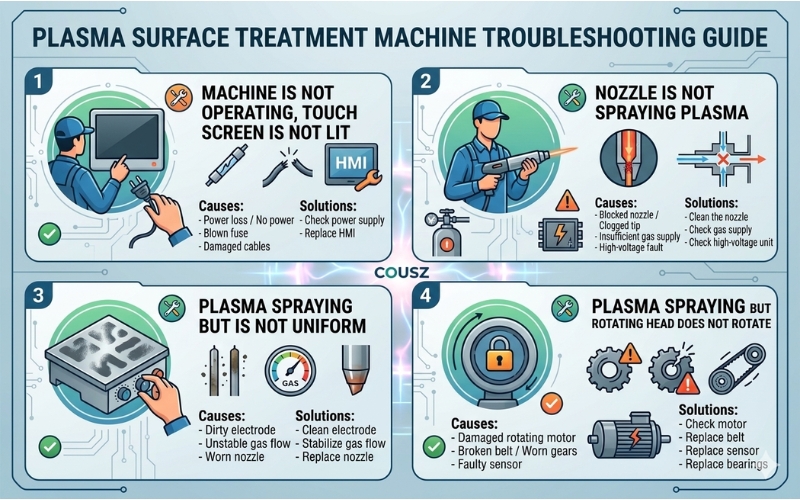
2.1. System is unresponsive, touch screen is dark
While this is a basic issue, it often causes significant panic on the factory floor. The root cause usually lies within the primary power supply or the central PLC unit.
Troubleshooting steps: Inspect the main power fuse and the 24V DC power supply module inside the machine. If the power input is stable but the screen remains dark, the HMI signal cable might be loose or the control board circuitry may be damaged. In this case, contact a professional service provider for plasma surface treatment machine repair to prevent incorrect intervention that could lead to further PLC damage.
2.2. No plasma plume is generated
When the machine reports a “Run” status but no plasma plume exits the nozzle, this is a typical plasma surface treatment machine operational issue related to the RF Generator or the high-voltage circuit.
Troubleshooting steps: Carefully inspect the electrode gap inside the nozzle. If the electrode has eroded excessively, the spark gap is compromised, preventing plasma ignition. You must clean the nozzle or execute a plasma cleaning machine repair by installing a brand-new electrode.
2.3. Plasma plume is unstable or non-uniform
An erratic or misdirected plasma stream directly impacts the surface Dyne level of your products. This is one of the most common plasma machine operating problems that negatively affects KCS quality control.
Troubleshooting steps: Verify the input compressed air pressure; unstable pressure causes the ionized gas stream to pulse. Additionally, inspect for carbon buildup around the nozzle tip—this soot is the primary culprit behind skewed ion streams.
2.4. Rotary nozzle fails to rotate
For Rotary Nozzle series, the spinning head is critical for expanding the treatment area. If the head remains stationary, heat accumulates at a single point, potentially melting the plastic surface.
Troubleshooting steps: Check the rotary motor and the drive belt. Mechanical plasma surface treatment machine repair issues are frequently caused by long-term dust accumulation causing bearing seizure.
2.5. Faulty temperature alarm system
This is an extremely dangerous operational failure that could lead to equipment fire. Industrial safety standards dictate that temperature sensors must always remain in an “Active” state.
Troubleshooting steps: Inspect the thermocouple signal wires. If the sensor is open-circuit, the controller cannot receive temperature data. This is a top-priority item in the COUSZ plasma machine operating instructions and maintenance schedule.
3. Quick-reference summary table for operational issues
Using this summary table helps your operators quickly identify common operating errors in plasma surface cleaners, reducing downtime and preventing small issues from becoming production disasters.
| Symptom | Probable Cause | Recommended Solution |
|---|---|---|
| Black/Dark Screen | Blown fuse, 24V supply failure | Replace fuse, verify power input |
| Flickering Plasma | Low gas pressure, eroded electrode | Calibrate gas, initiate plasma cleaner repair |
| Red/Orange Plasma Plume | Compressed air contaminated with oil/water | Replace air filters, clean the nozzle |
| Nozzle head seized | Dust accumulation, motor failure | Mechanical cleaning, replace motor if seized |
| No signal to Robot | EMI interference, loose I/O connection | Inspect signal cables, install EMI filters |
4. COUSZ professional support for plasma cleaner operation
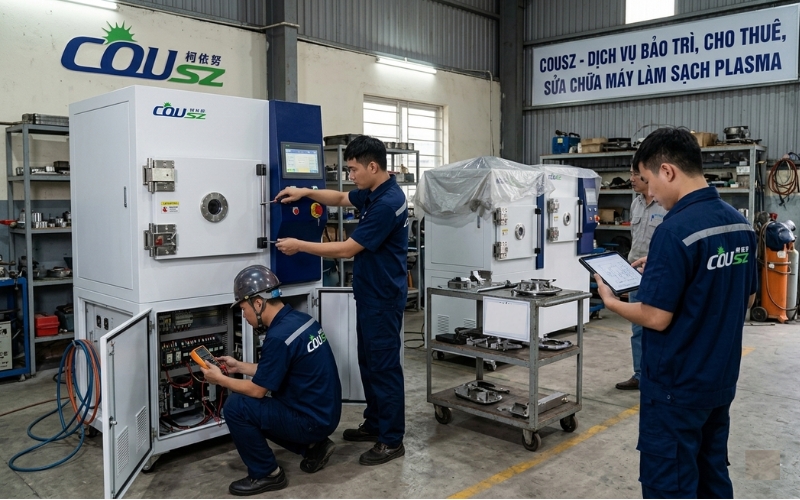
In Vietnam, COUSZ is not merely an equipment supplier; we are a dedicated technical service center. We profoundly understand that every minute of downtime equals lost revenue. Therefore, our plasma surface cleaning machine repair services are built upon three core pillars:
- Rapid Support: With a team of engineers stationed in major industrial clusters (Bac Ninh, Thai Nguyen, Binh Duong), we guarantee online support within 24 hours and on-site assistance within 3 days for all major plasma surface treatment machine operational issues.
- Genuine Spare Parts Inventory: COUSZ maintains a massive stock of electrodes, RF generators, and nozzles to immediately resolve any plasma machine operating problems, entirely eliminating wait times for international shipping.
- Preventative Maintenance Solutions: Rather than waiting for failure, we offer preventative maintenance packages to proactively eliminate common operating errors in plasma surface cleaners, ensuring your equipment operates at peak energy efficiency.
According to maintenance management studies from the Harvard Business Review, preventative maintenance can save enterprises up to 50% in emergency repair costs. Trusting a partner with proven plasma surface cleaning machine repair capabilities like COUSZ is a smart investment for your company’s sustainability.
5. Contact Ms. Yuna for professional support
Do not allow operational issues to delay your crucial production schedule. Connect immediately with our technical expert to receive the fastest, most accurate support for your plasma cleaner troubleshooting needs:
- ✨ Ms. Yuna – Senior Technical Plasma Solutions Expert
- 📱 Tel/Whatsapp/Wechat/Zalo: (84) 965 535 348
- 📧 Email: sales03@cousz.com
- 🌐 Website: www.cousz-vn.com
We are committed to providing professional plasma surface treatment machine repair services, helping you resolve all operational issues and bringing your production line back to full operation in record time.