中文 (中国)
 Tiếng Việt
 한국어
한국어
Mastering the exact customs clearance steps to securely import plasma surface treatment machine systems is a crucial factor that helps manufacturing enterprises heavily optimize logistics costs and slash clearance times. From accurately determining the precise plasma surface treatment machine HS code to calculating the exact plasma cleaner import tax, every single logistical detail requires absolute precision. This comprehensive technical article will guide your business step-by-step through the latest 2026 regulations, empowering you to confidently bring cutting-edge plasma technology directly into your factory.
1. What are the required documents to import plasma cleaner?
1.1. Essential customs dossier for importing plasma surface treatment equipment
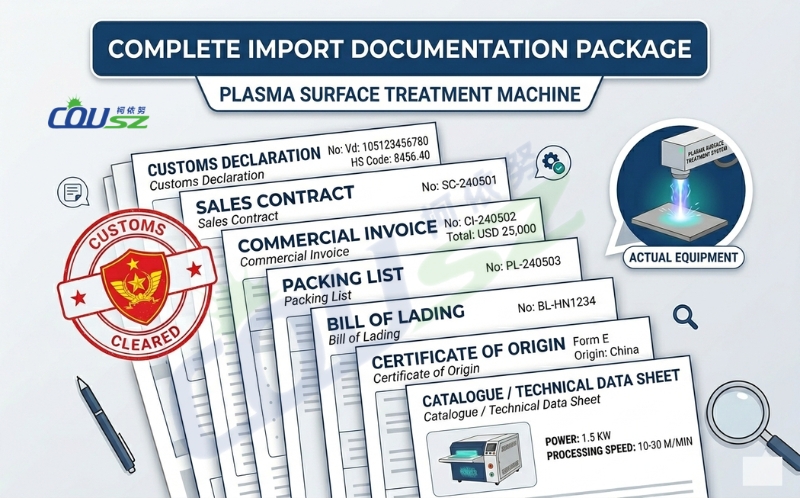
When executing the official plasma cleaner import procedure, your logistics enterprise must meticulously prepare a complete and legally binding documentation dossier in strict accordance with the latest customs circulars (such as Circular 39/2018/TT-BTC in Vietnam). This comprehensive dossier not only serves the immediate purpose of electronic declaration but also stands as the definitive legal basis for customs authorities to thoroughly inspect the technical legitimacy of the imported equipment.
The fundamental customs documentation required when seamlessly importing plasma surface treatment equipment typically includes the following critical paperwork:
- Electronic customs declaration (E-customs): The primary digital form submitted to the national single-window system.
- Sales contract: The legally binding commercial agreement between the overseas supplier and the local importing buyer.
- Commercial invoice: The official billing document detailing the exact transactional value of the machinery.
- Detailed packing list: A comprehensive breakdown of the machine’s dimensions, net weight, gross weight, and wooden crate specifications.
- Bill of lading (B/L) or Air waybill (AWB): The official transport document issued by the shipping line or airline proving cargo loading.
- Certificate of origin (C/O): An extremely vital document required to enjoy highly preferential plasma cleaner import duty rates under Free Trade Agreements.
- Original technical catalog: Detailed manufacturer brochures (preferably translated) to definitively prove the machine’s functional nature, which is absolutely mandatory for correctly applying the HS code.
Meticulously preparing the documentation for the import process for plasma cleaner systems actively helps businesses completely avoid unnecessary physical cargo inspections (Red Channel), thereby rapidly accelerating the schedule to integrate the machine into the active production line.
2. How to determine the precise plasma surface treatment machine HS code?
2.1. Classifying the plasma cleaner HS code correctly
Accurately pinpointing the correct plasma surface treatment machine HS code is arguably the single most important, high-stakes step in the entire declaration phase. The Harmonized System (HS) code does not merely dictate the final tax rate; it directly impacts all specialized sector management policies, including energy efficiency testing and quality inspections.
Based on the advanced internal structure and the fundamental working principle of the equipment (which utilizes high-frequency electrical energy to ionize gases into an active plasma state for molecular surface modification), the plasma cleaner HS code is predominantly classified under Chapter 84 or Chapter 85 of the global tariff schedule. Specifically:
- Primary reference HS Code: 8456.90. This specific heading covers: “Machine tools for working any material by removal of material, by laser or other light or photon beam, ultrasonic, electro-discharge, magnetic beam or ion-beam processes.” Because a plasma cleaner utilizes an ionized gas beam to modify and microscopically clean surfaces, this code is highly accurate and widely accepted globally.
- Alternative classifications: Depending on whether the machine is heavily integrated with liquid coating spray nozzles, certain variations might occasionally be argued under heading 8424 (Mechanical appliances for projecting, dispersing or spraying liquids or powders).
Successfully determining the precise plasma cleaner HS code demands deep, specialized knowledge of the import-export tariff schedule. If an enterprise applies the wrong code, they face the severe risk of heavy administrative fines or massive retroactive tax collection. Therefore, consulting with a seasoned customs expert regarding the plasma surface treatment machine HS code prior to formally opening the declaration is absolutely essential.
3. What are the plasma cleaner import tax and duty rates?
3.1. Understanding VAT and plasma cleaner import duty
Tax policies and financial overhead remain the top concerns for factory investors. When actively executing the plasma cleaner import procedure, your accounting department must carefully calculate and provision for two primary types of taxes:
Value Added Tax (VAT):
Generally, the standard plasma cleaner import tax regarding VAT is applied at a rate of 8% to 10%. However, depending heavily on the specific timeframe and the government’s active policies aiming to stimulate high-tech industrial investments, this VAT rate may experience favorable adjustments. Enterprises must continuously monitor and update themselves with the latest VAT tariff schedules to ensure perfectly accurate project cost accounting.
Import Duty:
The specific plasma cleaner import duty is heavily dependent on the exact declared HS code and the verified country of origin. This is where strategic sourcing plays a massive financial role.
- If you are importing plasma surface treatment equipment directly from allied nations that share a Free Trade Agreement (FTA) with your country (such as Japan, South Korea, China, or the ASEAN bloc), the applicable plasma cleaner import duty can often be aggressively slashed to a highly preferential 0%, provided that a fully valid Certificate of Origin (C/O) is presented.
- For imports originating from nations without an active FTA, the standard, non-preferential duty rate typically fluctuates between 0% and 5%.
Rigorously calculating the exact plasma cleaner import duty well in advance helps manufacturing enterprises establish a highly optimized, risk-free financial plan for their new equipment acquisition.
4. What is the step-by-step import process for plasma cleaner?
4.1. Navigating the customs clearance workflow
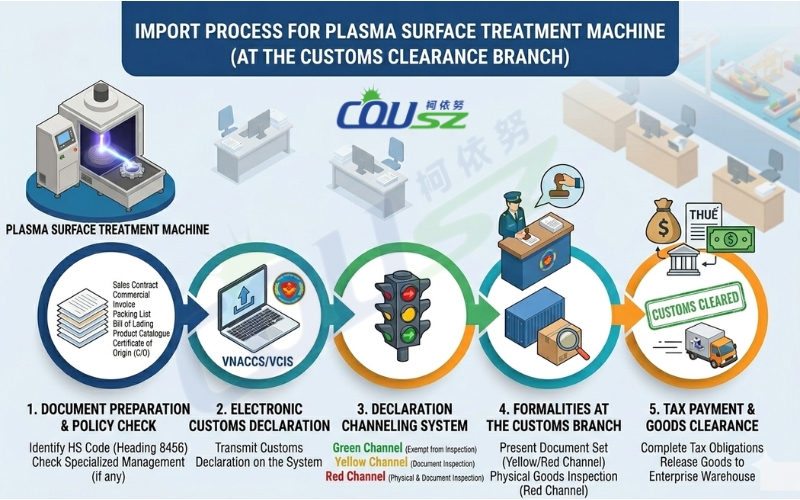
A standard, perfectly compliant import process for plasma cleaner systems generally flows through the following highly structured logistical steps:
- Electronic declaration transmission: Based entirely on the meticulously prepared documentation dossier and the verified plasma surface treatment machine HS code, the enterprise submits the digital declaration directly into the national customs software system (e.g., ECUS/VNACCS).
- Receiving the channel routing result: The automated system evaluates the company’s risk profile and assigns the shipment to a specific clearance channel:
- Green Channel: Immediate, direct clearance without further physical or documentary checks.
- Yellow Channel: Mandatory manual verification of the physical paper documentation by a customs officer.
- Red Channel: The strictest level, requiring both document verification and a hands-on physical inspection of the actual plasma machine at the port.
- Fulfilling tax obligations: Following the channel routing results and the final confirmation of the tax assessment, the enterprise swiftly transfers the required plasma cleaner import tax and duties directly to the state treasury.
- Final clearance and cargo retrieval: Upon completing the plasma cleaner import procedure, the customs authority releases the cargo hold, allowing the enterprise’s logistics fleet to pull the delicate machinery directly to the factory warehouse.
Flawlessly executing the import process for plasma cleaner systems helps businesses save incredibly significant amounts of money by avoiding costly seaport storage and container detention fees (DEM/DET).
5. Why is the certificate of origin vital for importing plasma surface treatment equipment?
5.1. Maximizing cost savings with proper documentation
Within the complex framework of the plasma cleaner import procedure, the Certificate of Origin (C/O) functions as an absolute “power card” for cost reduction.
Drastic tax reduction: As previously emphasized, presenting a valid, legally compliant C/O can force the plasma cleaner import duty down to a special preferential rate (most frequently 0%). This alone can save a factory thousands of dollars per machine.
Affirming brand quality: Beyond simple tax benefits, a C/O originating from technologically advanced manufacturing hubs (such as Germany, Japan, or South Korea) acts as a powerful, indisputable validation of the prestigious quality and brand integrity of your COUSZ plasma equipment.
Procurement managers must always aggressively demand that their overseas suppliers provide the exact corresponding C/O form (e.g., Form E for China, Form AK/VK for South Korea, Form D for the ASEAN region) to successfully minimize the plasma cleaner import tax and heavily optimize overall supply chain expenses.
6. Important notes for the plasma cleaner import procedure
6.1. Regulations on machine age, labeling, and specialized packing
When actively managing the import process for plasma cleaner systems, enterprise directors must pay strict, unwavering attention to the following compliance factors:
- 100% brand new condition: For advanced, high-tech industrial equipment like plasma systems, importing 100% brand new machinery vastly simplifies the customs protocol. If an enterprise opts to import a used, second-hand machine, they are legally forced to comply with stringent national regulations (such as Decision 18/2019/QD-TTg), which mandate that the machine’s total age must absolutely not exceed 10 years, and it must pass rigorous energy efficiency tests.
- Strict labeling compliance (Labeling): According to international and local decrees (e.g., Decree 111/2021/ND-CP), the physical machine must feature a clearly visible, permanently affixed original manufacturer label. This plate must accurately detail the exact commodity name, the manufacturer’s corporate name, the precise country of origin, and the year of manufacture to successfully finalize the plasma cleaner import procedure without friction.
- Specialized industrial packing: A high-end plasma surface treatment machine is a profoundly sensitive electronic device. It must be heavily secured within a fumigated wooden crate and securely vacuum-sealed in a thick foil bag containing highly active desiccants. This extreme precaution is absolutely mandatory to prevent catastrophic internal corrosion caused by highly corrosive sea salt vapor during long-duration ocean freight transit.
7. Common mistakes during the import process for plasma cleaner
7.1. How to avoid costly customs delays
In the practical reality of executing the plasma cleaner import procedure, numerous businesses repeatedly stumble into the same costly logistical traps:
| Common Customs Mistake | Consequence & Impact | Preventative Action |
|---|---|---|
| Incorrect HS Code Declaration | Immediate rejection of the preferential plasma cleaner import duty, leading to massive tax penalties. | Consult with an expert to lock in the 8456.90 plasma surface treatment machine HS code before shipping. |
| C/O Information Mismatch | The customs declaration is suspended if the C/O differs even slightly from the Commercial Invoice (e.g., typos). | Implement a rigorous triple-check process on all draft documents prior to official C/O issuance. |
| Missing Technical Catalogs | Prolonged physical inspections if authorities question the machine’s true functional nature. | Always attach the original English catalog and a legally certified local translation to the E-customs portal. |
8. Conclusion on importing plasma technology
Successfully navigating the rigorous customs procedures to import plasma surface treatment machine systems demands a profound, specialized understanding of international tax law and complex foreign trade operations. By accurately pinpointing the exact plasma surface treatment machine HS code and strictly adhering to the standardized import process for plasma cleaner equipment, manufacturing enterprises not only aggressively protect their financial bottom line but also guarantee that their critical production upgrade projects remain perfectly on schedule.
At COUSZ, we go far beyond simply manufacturing world-class equipment; we stand ready to comprehensively support our esteemed clients from detailed technical training to full-scale import consultation, ensuring that every single plasma device clears customs rapidly and flawlessly.
9. Contact technical and import consultation
If your enterprise still harbors any doubts or questions regarding the plasma cleaner import tax, the exact HS code classification, or the end-to-end logistics procedures, please do not hesitate to contact our team. Visit our headquarters at The Manor Central Park, Hanoi, or reach out directly to our specialists:
- 👤 Ms. Yuna – Senior Plasma Solutions & Import/Export Expert
- 📞 Tel/Whatsapp/Wechat/Zalo: (84) 965 535 348
- 📧 Email: sales03@cousz.com
- 🌐 Website: www.cousz-vn.com
10. FAQ – Frequently asked questions
10.1. Is a plasma surface treatment machine on the prohibited list for used imports?
No, a plasma surface treatment machine is definitively NOT on the restricted or prohibited list for importing used goods. However, if your factory decides to import a second-hand, previously used machine, the equipment must strictly be less than 10 years old. Furthermore, it must fully comply with all national safety standards and energy efficiency conditions as mandated by Decision 18/2019/QD-TTg.
10.2. Which HS code should I apply to enjoy the best preferential tax rate when importing?
The most universally accurate and legally safe plasma surface treatment machine HS code is typically 8456.90. However, depending heavily on the specific structural details of the plasma nozzle (e.g., whether it is a rotary head or direct jet) and the machine’s primary designated industrial purpose, a highly trained customs specialist may advise a slightly different classification to legally ensure your enterprise enjoys a preferential 0% tax rate under applicable FTAs.
10.3. What exactly is the import duty for a plasma cleaner?
Currently, the standard plasma cleaner import duty fluctuates between 0% and 5%, depending entirely on the verified country of origin. If you possess a fully valid preferential C/O from a region with an active trade agreement, this duty rate is overwhelmingly reduced to 0%. In addition to this duty, enterprises must always remember to account for the mandatory plasma cleaner import tax in the form of an 8% Value Added Tax (VAT).