中文 (中国)
 Tiếng Việt
 한국어
한국어
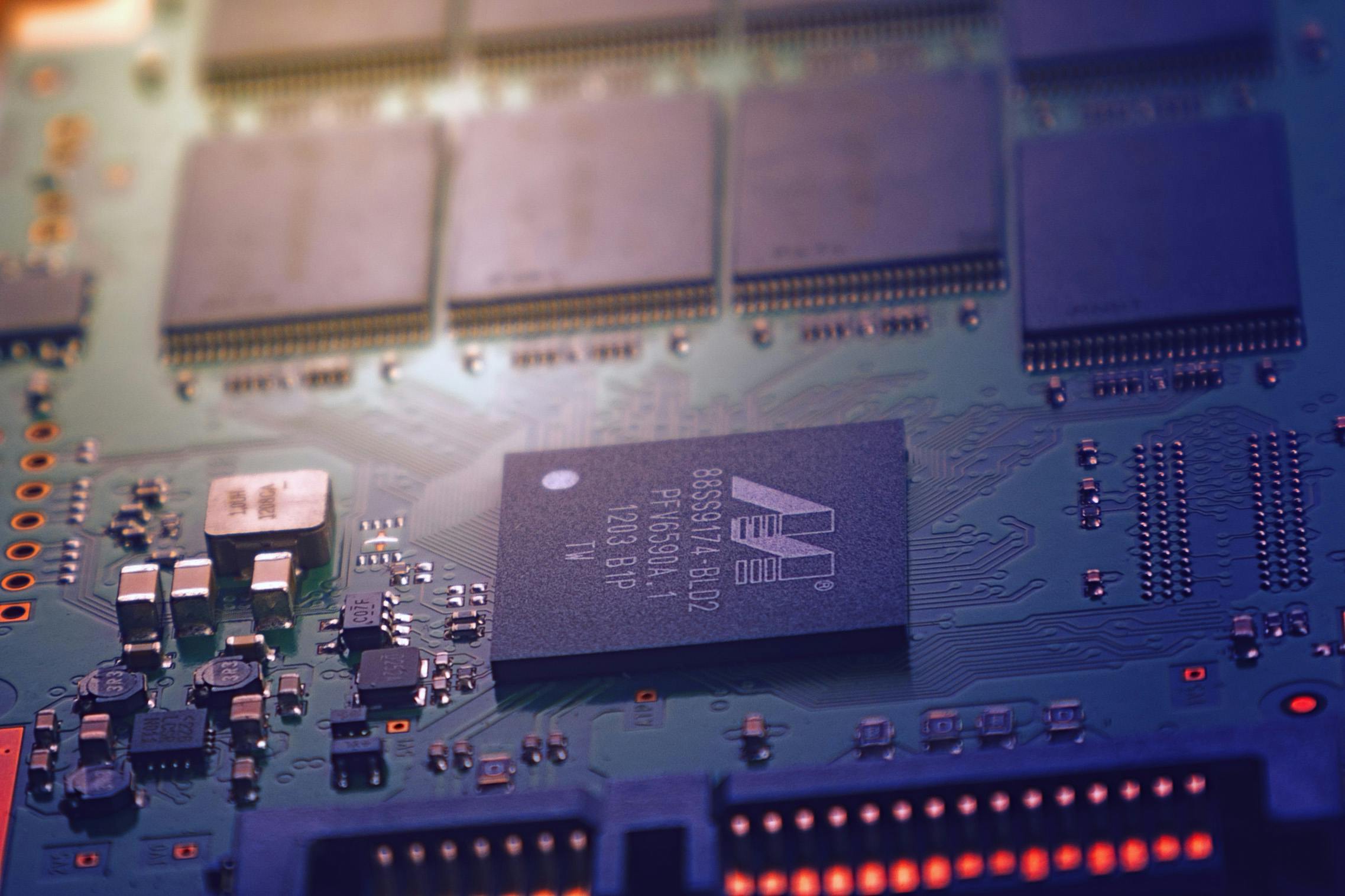
In modern industrial manufacturing plants, encountering a sudden equipment failure is the ultimate nightmare for every process engineer. Understanding the common issues when operating UV curing systems not only helps maintain strict production schedules but also fundamentally protects the lifespan of highly expensive semiconductor components. At COUSZ Vietnam, we have compiled this comprehensive technical guide to provide a precise troubleshooting roadmap, empowering you to master the technology and resolve errors professionally.
1. What causes the main faults in industrial environments?
To maintain photopolymerization efficiency at an absolute optimal level, accurately diagnosing the root disease is the most critical step. UV Curing Technology is highly sensitive to environmental and electrical variables. According to extensive industry reports published by RadTech International, over 70% of machine breakdown cases could be entirely avoided if factory operators clearly understood the early warning signs and implemented proper UV LED curing troubleshooting protocols.
1.1. How do environmental factors affect curing quality?
The vast majority of emerging problems do not stem from inherent manufacturing defects but rather from objective, harsh elements present within the industrial workspace:
- Harsh environments: Microscopic fine dust and vaporized adhesive outgassing adhere stubbornly to the quartz optical lens, causing severe photon scattering.
- Unstable temperatures: A weak or degraded thermal dissipation system causes the semiconductor LED chips to age at a rapidly accelerated rate.
- Fluctuating electrical voltage: Power spikes common in heavy industrial zones inflict severe thermal shock on the digital power supply (Driver board).
- Incorrect operational procedures: Running the automated conveyor belt at a speed totally incompatible with the lamp’s output intensity guarantees wet products.
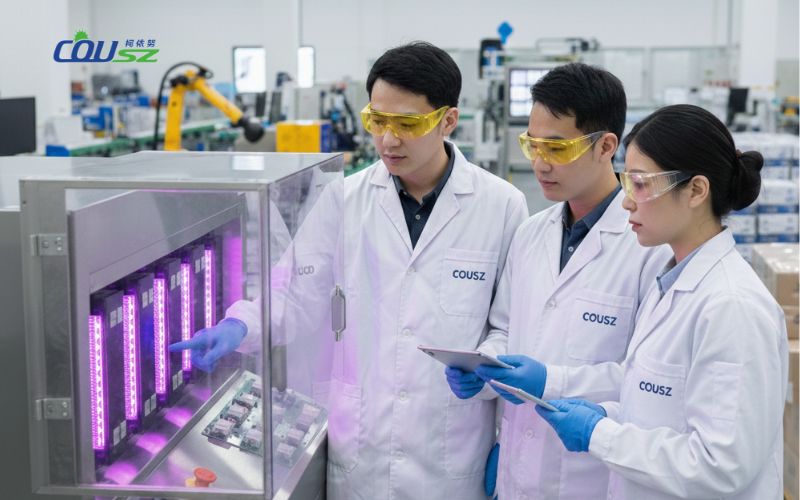
2. How to identify and fix specific curing problems?
Below is a highly detailed diagnostic list of the common issues when operating UV curing systems, alongside practical, field-tested troubleshooting solutions directly from elite COUSZ experts.
2.1. Why is the UV adhesive not drying completely?
This is the notorious condition where the product exits the radiation chamber but the surface remains tacky, or the internal core of the adhesive layer is still a wet liquid.
- Identifying signs: The glue surface retains visible fingerprints when lightly touched, or electronic components peel off effortlessly during quality control.
- Troubleshooting protocol: First, execute proper UV LED curing troubleshooting by measuring the peak irradiance using an industrial radiometer. If the raw intensity meets the factory standard, verify the chemical compatibility between the lamp’s specific wavelength (e.g., 365nm vs. 395nm) and the adhesive’s datasheet. Occasionally, you must manually reduce the conveyor belt speed to mathematically increase the total accumulated energy dose (mJ/cm²).
2.2. What causes uneven curing on the product surface?
Certain isolated spots on the substrate are perfectly solid, while adjacent locations remain completely uncured.
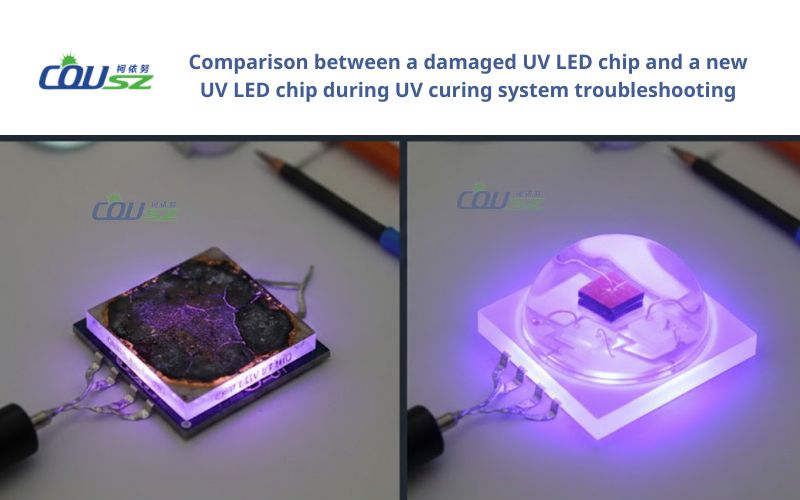
- Root causes: This usually occurs because a specific cluster of LED chips within the massive array has burned out, creating a “cold spot,” or the quartz optical lens is heavily contaminated in a localized area.
- Troubleshooting protocol: Safely inspect the emitting LED array using specialized UV-blocking safety glasses while the machine operates at a very low power setting (e.g., 10%). If you observe black, non-emitting diodes, you must replace the entire LED module immediately.
👉 Learn how to elevate your manufacturing lines:
How to operate UV curing systems safely and efficiently
2.3. Why is there a decrease in UV irradiance over time?
This describes the slow, natural decrease in UV irradiance due to unavoidable component aging or heavy chemical fouling.
- Physical mechanism: Radiant intensity ($I$) is inversely proportional to the square of the distance and is heavily dictated by the absolute transparency of the medium. The usable effective intensity is calculated as: $I_{effective} = I_0 \times t$ (where $t$ represents the transmission coefficient of the quartz lens).
- Troubleshooting protocol: Deep clean the quartz lens using 99% Isopropyl alcohol and a lint-free cleanroom wipe. If you still record a decrease in UV irradiance exceeding 30% from the original baseline after thorough cleaning, you must formally consider procuring a brand-new lamp head.
2.4. What happens during a UV curing system thermal failure?
If you touch the exterior casing of the lamp head and it feels abnormally blistering hot, your thermal management setup is in critical danger. High-end machines are equipped with built-in alarms to detect a UV curing system thermal failure, allowing technicians to react swiftly and limit enterprise downtime.
- Identifying signs: The machine abruptly shuts down mid-production and violently flashes a “Thermal Error” warning on the PLC touchscreen.
- Troubleshooting protocol: Immediately inspect the high-speed cooling fans or the industrial water Chiller. Ensure the circulating coolant water is perfectly clean, at the correct temperature, and completely free of hard scale buildup inside the delicate internal piping.
2.5. Why does the LED light flicker or fail to turn on?
A situation where the diodes refuse to illuminate is typically rooted in power supply failures or severely compromised signal cables.
- Identifying signs: The digital power supply screen is active and functioning, but the lamp head remains pitch black, or only half of the array illuminates.
- Troubleshooting protocol: Check the integrity of the heavy-duty aviation cables connecting the driver to the head. This requires advanced UV LED curing troubleshooting to isolate whether the catastrophic fault lies within the Driver’s logic board or the actual LED module itself.
2.6. Why is the controller screen on but the lamp is off?
This is one of the most confusing common issues when operating UV curing systems for junior technicians. The dashboard proudly displays a “Running” status, yet absolutely zero ultraviolet light is emitted.
- Root causes: This is almost always caused by a blown trigger circuit inside the Driver or an active safety sensor (interlock) that is physically blocking the electrical current to protect the operator.
- Troubleshooting protocol: Rigorously verify all physical door sensors, anti-UV curtain switches, and use a multimeter to measure the raw DC output voltage from the power supply.
2.7. How to fix automation and PLC communication errors?
The curing unit completely ignores start commands from the master factory PLC or fails to respond to Modbus RTU signals.
- Troubleshooting protocol: Double-check the machine’s assigned IP or Slave ID address within the communication network and verify the physical shielding integrity of the RS485 network cables against electromagnetic factory noise.
3. What is the quick troubleshooting matrix for operators?
Below is a rapid reference table designed to help you instantly diagnose and resolve common issues when operating UV curing systems on the factory floor:
| Observed Symptom | Most Probable Cause | Recommended Solution |
|---|---|---|
| Glue remains wet/tacky | Incorrect wavelength or low energy | Decrease conveyor speed; recalibrate with radiometer. |
| Light completely dead | Severed cable, Driver failure | Inspect cable pins; test power supply voltage. |
| Half the head is lit | Burnt LED cluster or dead Driver channel | Perform diode inspection; replace specific power module. |
| Machine alarms for heat | UV curing system thermal failure, clogged Chiller | Clean dust filters; flush water lines; replace fans. |
| Gradual power loss | Dirty lens, natural LED degradation | Clean quartz daily; if there is a severe decrease in UV irradiance, replace head. |
4. How does COUSZ support your factory’s technical needs?
At COUSZ Vietnam, we do not merely supply premium hardware; we deliver a highly comprehensive after-sales technical ecosystem. With elite engineers stationed strategically near major industrial hot zones, we strictly commit to helping you overcome any critical machine faults within 24 hours.
Our defining advantage is our unparalleled capability for remote digital diagnostics and maintaining a massive local inventory of genuine replacement parts right here in Vietnam. If you are currently struggling to fix common issues when operating UV curing systems, let our seasoned optical experts assist you in measuring, calibrating, and totally optimizing your assembly line.
5. Faqs – what else should you know about fixing these machines?
5.1. How can I accurately determine if an LED chip is truly dead?
You must strictly utilize a specialized industrial radiometer. If the optical intensity drops abruptly rather than gradually, or if distinct dark shadows suddenly appear across your curing footprint, it is a definitive physical sign that specific diodes within the array have burned out.
5.2. Why does the power supply show a green LED, but the head won’t fire?
It is highly probable that your factory’s Safety Interlock loop is currently open (e.g., a machine door is ajar), or the internal high-power switching circuitry within the Driver has catastrophically failed.
5.3. How often should maintenance occur to prevent a decrease in UV irradiance?
We strongly mandate physically wiping down the quartz lenses with high-purity alcohol at the end of every single production week. Furthermore, you must record the exact irradiance levels monthly to map out the long-term health and degradation curve of the semiconductor diodes, actively preventing a sudden decrease in UV irradiance from ruining a batch.
6. Contact our 24/7 technical support team
Do not allow your multi-million-dollar assembly line to grind to a halt because of easily solvable technical glitches. By understanding the common issues when operating UV curing systems, you can take immediate action. Connect directly with our elite engineering team today:
👩💼 Senior Technical Consultant: Ms. Yuna 🌟
📞 Tel / WhatsApp / WeChat / Zalo: (84) 965 535 348
📧 Email: sales03@cousz.com
🌐 Website: cousz-vn.com
🏢 Headquarters: Ngo Xa Village, Phat Tich Commune, Bac Ninh Province, Vietnam.