中文 (中国)
 Tiếng Việt
 한국어


In modern industrial manufacturing, Plasma surface treatment technology is increasingly used to improve the adhesion of adhesives, printing inks, paints, and coating materials on different substrates.
To meet various production requirements, Plasma surface treatment machines are available with different nozzle configurations. Two common options are direct Plasma nozzles and rotary Plasma nozzles.
What are the differences between these two types of Plasma nozzles? Which one is more suitable for plastic manufacturing, electronic components, medical devices, or other industrial applications?
In this article, COUSZ provides a detailed comparison of direct Plasma nozzles and rotary Plasma nozzles, covering their working principles, advantages, limitations, applications, and selection criteria.
1. What Is a Direct Plasma Nozzle?
A direct Plasma nozzle is a Plasma treatment device designed to deliver a Plasma stream toward a specific area of a material surface.
During operation, the nozzle generates Plasma and directs it toward the target surface. When reactive Plasma species interact with the material, they can help remove organic contaminants, modify surface chemistry, and improve surface energy and wettability.
Working Principle
A direct Plasma nozzle generally operates through the following process:
- Plasma is generated using a suitable gas or operating environment.
- The Plasma stream is delivered through the nozzle toward the target surface.
- The Plasma interacts with the material at a controlled distance.
- The nozzle or workpiece moves to treat the required surface area.
For atmospheric Plasma systems, treatment can often be performed directly on production lines without placing products inside a vacuum chamber.
Advantages of Direct Plasma Nozzles
- Simple design: Generally easier to integrate into automated production systems.
- Focused treatment: Suitable for applications requiring treatment in specific areas.
- Flexible operation: Treatment distance, movement speed, and exposure time can be adjusted.
- Automation compatibility: Can be integrated with industrial robots, linear stages, and conveyor systems.
- Localized treatment: Suitable for small areas or specific regions requiring improved adhesion.
Applications of Direct Plasma Nozzles
Direct Plasma nozzles are commonly considered for applications such as:
- Treating PP and PE plastic surfaces before adhesive bonding.
- Surface treatment of electronic components.
- Preparing surfaces before printing or coating.
- Improving adhesive bonding on plastic products.
- Surface preparation before painting or assembly.
2. What Is a Rotary Plasma Nozzle?
A rotary Plasma nozzle is a Plasma treatment device equipped with a rotating mechanism or a structure designed to produce rotational movement during operation.
This movement changes the direction of Plasma exposure and can help distribute treatment across different surface orientations.
Depending on the equipment design, rotation may be produced by a mechanical rotating mechanism or by a structure that generates a swirling Plasma flow. Therefore, it is important to distinguish between a physically rotating nozzle and a nozzle that produces a swirling Plasma jet.
Working Principle
A rotary Plasma nozzle generally operates through the following steps:
- Plasma is generated inside the treatment head.
- The rotating mechanism or rotational flow structure is activated.
- Plasma is distributed according to the rotational movement.
- The nozzle or workpiece moves to cover the required treatment area.
This configuration may help distribute Plasma exposure across wider areas or accommodate certain complex surface geometries, depending on the equipment design.
Advantages of Rotary Plasma Nozzles
- Improved Plasma distribution: Rotational movement changes the direction of Plasma exposure.
- Suitable for complex geometries: Can be useful for cylindrical or curved components.
- Flexible treatment: Can be combined with robotic movement or automated positioning systems.
- Potentially wider treatment coverage: Some designs help distribute Plasma across a larger treatment area.
- Specialized applications: Suitable for processes requiring different treatment directions.
Applications of Rotary Plasma Nozzles
Rotary Plasma nozzles may be used in:
- Surface treatment of cylindrical plastic components.
- Treatment of products with curved or complex geometries.
- Surface preparation before industrial adhesive bonding.
- Automated manufacturing processes.
- Applications requiring Plasma distribution in multiple directions.
3. Direct Plasma Nozzle vs. Rotary Plasma Nozzle: Key Differences
Choosing the right Plasma nozzle requires evaluating the actual production requirements and the characteristics of the materials being treated.
The following table summarizes the main differences.
| Comparison Criteria | Direct Plasma Nozzle | Rotary Plasma Nozzle |
|---|---|---|
| Design | Fixed or controlled treatment direction | Rotational mechanism or flow structure |
| Treatment direction | Focused in a defined direction | Changes according to rotational movement |
| Treatment area | Suitable for localized treatment | May provide broader or multi-directional coverage |
| Suitable surfaces | Flat or defined treatment areas | Can accommodate certain curved or complex surfaces |
| Automation integration | Robots, linear stages, conveyors | Robots and coordinated motion systems |
| System complexity | Generally simpler | May be more complex depending on design |
| Investment cost | Depends on power and configuration | Depends on rotation mechanism and configuration |
| Applications | Localized and specific treatment areas | Multi-directional or specialized surface treatment |
Note: Actual treatment performance depends not only on the nozzle configuration but also on Plasma power, treatment speed, nozzle-to-surface distance, gas type, material properties, and system configuration.
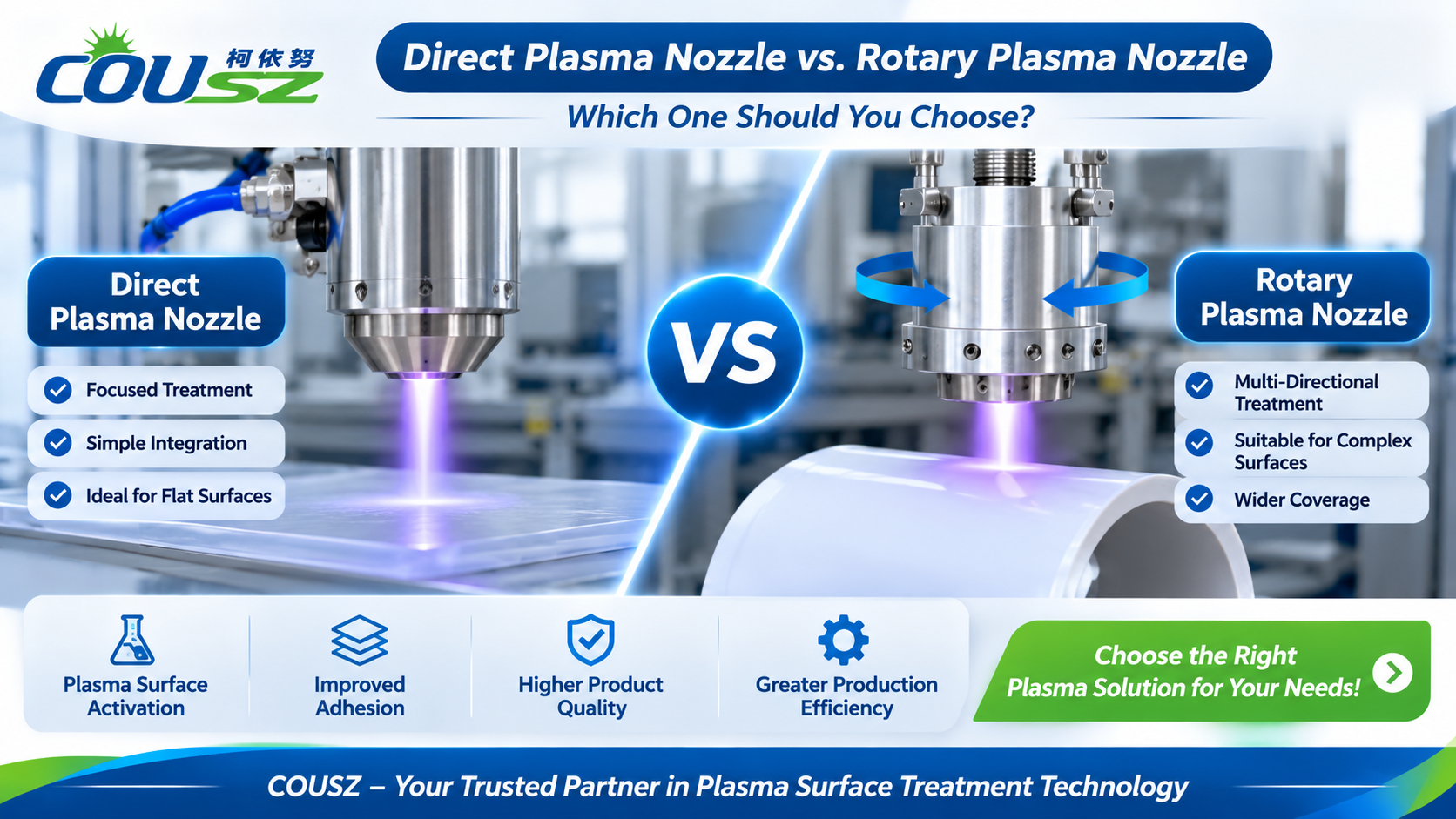
4. Direct Plasma Nozzle or Rotary Plasma Nozzle: Which One Should You Choose?
Selecting the right Plasma treatment system depends on product geometry, treatment requirements, production capacity, and integration with existing manufacturing processes.
When Should You Choose a Direct Plasma Nozzle?
A direct Plasma nozzle may be the right choice when:
- Products have clearly defined treatment areas.
- Surface treatment is required before adhesive bonding or printing.
- The production line uses robots or linear stages to move the nozzle.
- The equipment needs to be integrated into an existing production system.
- The company wants a practical solution for a specific surface treatment application.
Example:
In plastic component manufacturing, a direct Plasma nozzle can be used to treat a specific bonding area before adhesive dispensing or product assembly.
When Should You Choose a Rotary Plasma Nozzle?
A rotary Plasma nozzle may be more suitable when:
- Products have curved or cylindrical geometries.
- Surface treatment is required from multiple directions.
- Plasma exposure needs to be distributed across a wider treatment area.
- The process combines rotational movement with robotic or automated positioning.
- The application requires a specialized nozzle configuration.
Example:
For certain cylindrical plastic components, a rotary nozzle may help distribute Plasma exposure around the treatment area. However, treating the entire circumference requires evaluating nozzle access, rotational speed, and workpiece movement.
5. Important Factors When Selecting an Industrial Plasma Treatment Machine
In addition to choosing between direct and rotary nozzles, manufacturers should consider several important technical factors.
Plasma Power
Plasma power affects the intensity of Plasma interaction with the material surface. The appropriate power level depends on the substrate, production speed, and required treatment results.
Treatment Distance
The distance between the Plasma nozzle and the material surface influences treatment effectiveness. The optimal distance should be determined through practical testing.
Treatment Speed
The movement speed of the nozzle or workpiece determines the Plasma exposure time.
Excessively high speeds may reduce treatment effectiveness, while excessively low speeds may negatively affect production efficiency.
Material Compatibility
Materials such as PP, PE, PET, ABS, metals, and glass have different surface characteristics.
Therefore, the Plasma treatment method and operating parameters should be selected according to the specific material.
Production Line Integration
For automated manufacturing systems, manufacturers should evaluate compatibility with:
- Industrial robots.
- PLC control systems.
- Conveyor systems.
- Automated positioning equipment.
- Existing production control systems.
6. Can Direct and Rotary Plasma Nozzles Improve Surface Adhesion?
Both direct and rotary Plasma nozzles can help improve the adhesion of adhesives, printing inks, and coating materials when properly selected and operated.
Plasma surface treatment can modify material surfaces through several mechanisms:
- Removing organic contaminants from the surface.
- Modifying surface chemical composition.
- Increasing surface energy or improving wettability.
- Supporting better bonding between the substrate and applied materials.
However, treatment effectiveness varies depending on the substrate, operating conditions, and application requirements.
Not all materials achieve the same results under identical Plasma treatment conditions.
To evaluate performance accurately, manufacturers should conduct practical tests using actual production samples and measure relevant parameters, including:
- Contact angle.
- Surface wettability.
- Adhesion strength.
- Bonding durability.
These tests help determine the most appropriate Plasma configuration for each manufacturing process.
7. COUSZ – Plasma Surface Treatment Solutions for Industrial Applications
Choosing between a direct Plasma nozzle and a rotary Plasma nozzle requires more than simply comparing equipment designs. Manufacturers should evaluate the complete production process and specific application requirements.
COUSZ provides consultation on industrial Plasma surface treatment solutions, helping businesses select equipment based on:
- Material type and surface properties.
- Product geometry and dimensions.
- Adhesion requirements for adhesives, printing inks, and coatings.
- Production line speed and capacity.
- Automation and system integration requirements.
If your company is looking for a direct Plasma nozzle or rotary Plasma nozzle, testing actual product samples is an effective way to identify the most suitable configuration and optimize equipment investment.
Contact COUSZ today for professional consultation on Plasma surface treatment equipment and solutions tailored to your industrial manufacturing needs.
Frequently Asked Questions (FAQ)
1. Is a rotary Plasma nozzle faster than a direct Plasma nozzle?
Not necessarily. Treatment speed depends on Plasma power, treatment area, movement speed, material properties, and nozzle configuration.
A rotary nozzle may offer advantages in certain applications, but actual performance should be verified through practical testing.
2. Can a direct Plasma nozzle treat curved surfaces?
Yes. A direct Plasma nozzle can treat curved surfaces if it maintains suitable access, treatment distance, and positioning.
For complex geometries, additional nozzle movement or workpiece rotation may be required.
3. Can rotary Plasma nozzles be integrated into automated production lines?
Yes. Rotary Plasma nozzles can be integrated with industrial robots, linear stages, and automated systems, depending on equipment design and application requirements.
4. Should I select a Plasma machine based on power or nozzle type?
Both factors should be considered.
Plasma power influences the intensity of surface treatment, while nozzle configuration affects Plasma distribution and accessibility.
The best solution should be selected based on the actual material, application, and production requirements.
Conclusion
Both direct Plasma nozzles and rotary Plasma nozzles are useful solutions for industrial surface treatment. Each configuration offers specific advantages and is suitable for different manufacturing requirements.
Direct Plasma nozzles are generally suitable for localized treatment, defined surface areas, and applications requiring straightforward integration.
Rotary Plasma nozzles may offer advantages when Plasma exposure needs to be distributed in multiple directions or when treating certain complex surface geometries.
Choosing the right Plasma nozzle configuration can help manufacturers improve surface treatment performance, enhance product quality, and optimize production efficiency.
COUSZ is ready to support your business with Plasma equipment consultation, application testing, and customized surface treatment solutions.