中文 (中国)
 Tiếng Việt
In modern industrial manufacturing, heat acts as a double-edged sword for high-tech equipment. Implementing robust UV curing system cooling systems is absolutely essential to prevent equipment degradation. Proper temperature control of UV adhesive curing systems directly dictates both the lifespan of the internal components and the ultimate quality of the cured product on the assembly line.
1. Why is temperature control of UV adhesive curing systems so critical?
Managing the heat dissipation of your equipment is not merely about cooling the device; it is about safeguarding your entire production process. Without an effective mechanism for heat removal, the electrical energy that does not convert into light will accumulate as thermal energy. This lack of temperature control of UV adhesive curing systems leads to several severe consequences.
1.1 Maintaining wavelength stability
UV LED diodes operate at peak efficiency within very narrow wavelength bands (such as 365nm, 385nm, or 395nm). When temperatures rise uncontrollably, the wavelength tends to experience a “red-shift” (shifting to a longer wavelength). This means the emitted light no longer matches the absorption profile of the photoinitiators in the glue, resulting in incomplete curing.
1.2 Protecting sensitive substrates and materials
Many applications within the electronics and optical industries utilize highly heat-sensitive plastic films, delicate PET materials, or precision lenses. Excellent temperature control of UV adhesive curing systems keeps the surface temperature of the substrate extremely low, effectively preventing any thermal distortion, melting, or surface scorching during the fast curing cycle.
1.3 Optimizing operational costs and component lifespan
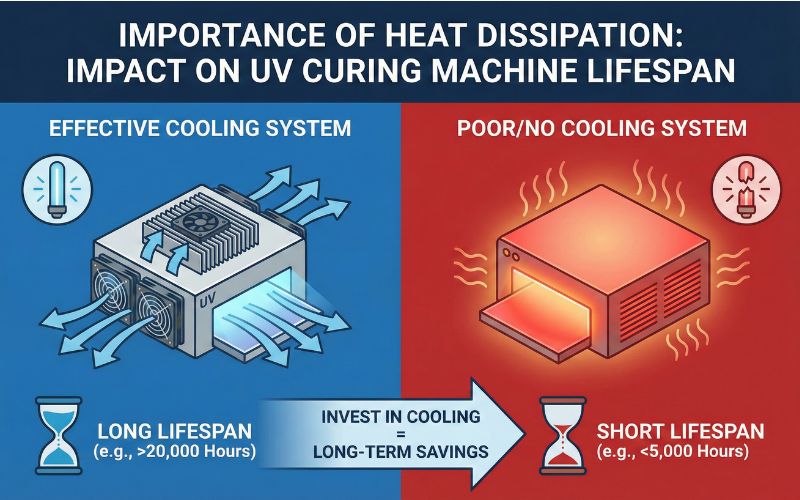
According to the Arrhenius equation in physical chemistry, for every 10°C increase in operating temperature, the lifespan of sensitive electronic components can be reduced by half. Therefore, investing heavily in premium UV curing system cooling systems is the most effective strategy to save on expensive replacement costs for high-intensity LED chips and drivers.
2. Where does the heat generated during the uv curing process originate?
A common misconception among manufacturers is that UV LED technology represents purely “cold light” with zero heat emission. In reality, the physics of semiconductor lighting tell a different story.
According to comprehensive industry reports from RadTech, only about 15% to 30% of the total electrical input energy is successfully converted into useful ultraviolet light. The remaining 70% to 85% is unavoidably transformed into thermal energy that accumulates rapidly at the LED chip junctions.
2.1 Heat generation in traditional vs. led systems
For older mercury vapor lamps, massive amounts of heat are generated through infrared (IR) radiation that is blasted directly onto the product. However, for modern LED systems, the heat is generated internally at the semiconductor junctions due to electrical resistance and non-radiative recombination processes.
Because industrial modules can reach extreme power densities exceeding 20W/cm², an enormous amount of heat is concentrated in a tiny surface area. To understand how to upgrade your lines efficiently, you can read our comprehensive guide on UV Curing Technology: How Manufacturers Increase Productivity and Cut Operating Costs to see how proper setups maximize yield.
3. What vital role do UV curing system cooling systems play?
High-performance UV curing system cooling systems act as the intelligent “thermostat” for your entire assembly line. They ensure the hardware survives the rigorous demands of 24/7 manufacturing operations.
3.1 Sustaining optical output efficiency
They guarantee that the radiant UV intensity remains perfectly stable from the very first second of operation all the way to the 20th hour of a continuous daily shift.
3.2 Ensuring factory fire safety
By actively dissipating extreme thermal loads, they prevent heat accumulation from melting the machine’s outer casing or catastrophically damaging the internal driver circuits.
3.3 Enhancing curing uniformity across wide formats
In wide-format printing or large-scale bonding applications, uneven heat dissipation causes different lamp heads to output varying UV intensities. Reliable UV curing system cooling systems eliminate this risk, preventing color banding in prints or unevenly cured wet spots on wide adhesive surfaces.
4. What are the 4 standard methods for UV curing system cooling systems?
Depending on the lamp’s power output and the specific working environment (such as a medical cleanroom versus a standard factory floor), COUSZ deploys four distinct cooling methodologies.
4.1 How does natural cooling for UV curing systems function?
Natural cooling for UV curing systems relies entirely on passive thermal convection utilizing large aluminum blocks known as heat sinks. This method of natural cooling for UV curing systems is strictly suitable for ultra-low power lamp heads typically used in R&D laboratories or small manual crafting applications. The distinct advantage of implementing natural cooling for UV curing systems is that it produces zero noise and requires absolutely no mechanical maintenance.
4.2 When is a cooling fan for UV adhesive curing systems appropriate?
Integrating a cooling fan for UV adhesive curing systems is the most widespread and economical solution for handheld devices or small chamber machines. A cooling fan for UV adhesive curing systems forces high-velocity ambient air across the aluminum fins to carry heat away into the environment. While highly cost-effective, a cooling fan for UV adhesive curing systems requires periodic cleaning and maintenance to prevent dust buildup from reducing its cooling efficiency.
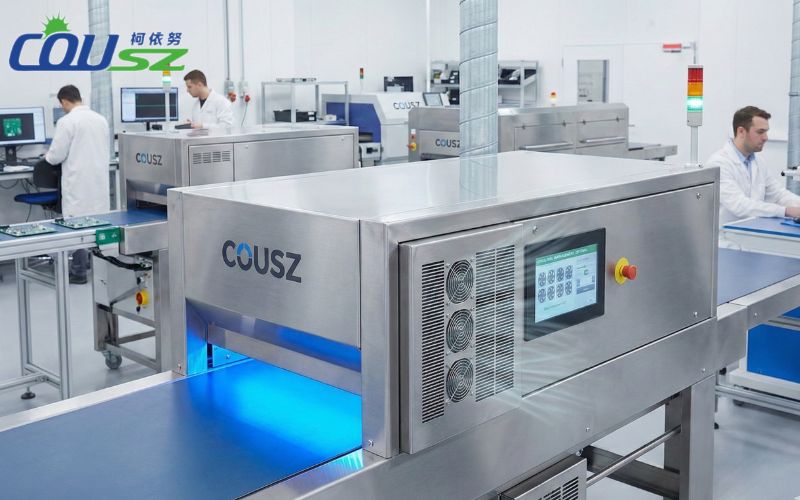
4.3 Why utilize an air cooling system for UV curing systems?
An air cooling system for UV curing systems utilizes compressed, clean air or chilled air driven through dedicated tubes directly to the lamp head. This air cooling system for UV curing systems is incredibly useful in strict cleanroom environments because it does not create the dirty air convection currents associated with standard fans. Furthermore, an air cooling system for UV curing systems offers significantly better thermal management than passive natural convection.
4.4 Why is water cooling for UV curing systems the industrial gold standard?
For massive, large-scale production lines, water cooling for UV curing systems is the ultimate gold standard. Water cooling for UV curing systems utilizes a dedicated industrial Chiller unit to circulate refrigerated water through specialized cold plates mounted directly against the LED chips. Because water has a thermal conductivity exponentially higher than air, water cooling for UV curing systems can keep the LED junctions at an ideal temperature (below 45°C), even when the ambient factory temperature reaches a sweltering 40°C. This is mandatory for high-power semiconductor or LCD manufacturing.
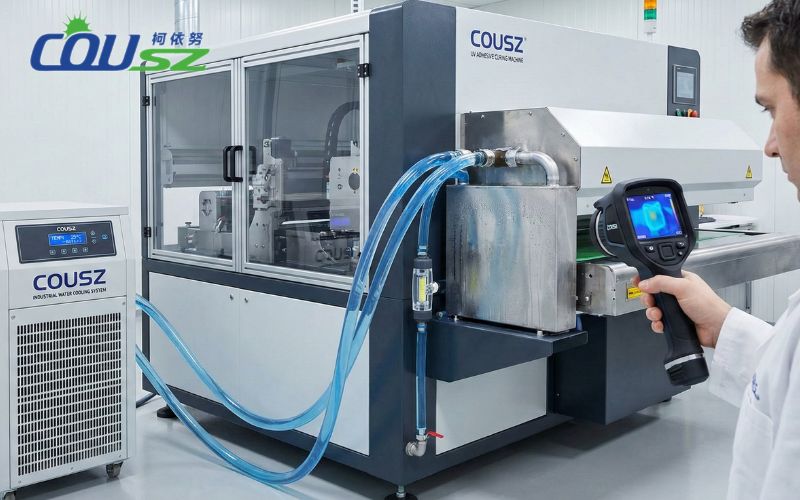
4.5 Comparison table of the 4 methods
| Cooling Method | Mechanism | Cooling Efficiency | Best Application | Main Advantage | Main Disadvantage |
|---|---|---|---|---|---|
| Natural cooling | Passive convection via aluminum fins. | Lowest | Small handhelds, Labs. | Zero noise, no maintenance. | Overheats easily on long runs. |
| Fan cooling | Forced ambient air via fans. | Medium | Short conveyors, low budget. | Cheap, easy to replace. | Noisy, circulates dust. |
| Compressed air | Chilled air via tubes. | High | Medical cleanrooms. | Clean, highly controlled. | High compressed air costs. |
| Water cooling | Circulating chilled water (Chiller). | Highest | 24/7 heavy industry (>500W). | Absolute stability & chip safety. | High initial cost, complex tubing. |
5. How to establish optimal temperature control of UV adhesive curing systems?
Selecting the incorrect thermal management method will lead to wasted capital investment and damaged products. To achieve the perfect temperature control of UV adhesive curing systems, consider these criteria:
Assessing lamp power and working environment
- Lamp Power (W): The higher the output power, the more aggressive your thermal management must be. Anything above standard manual operations generally requires forced air or liquid cooling.
- Working Environment: If you operate in an ISO-certified medical cleanroom, you must select water chillers or clean compressed air to avoid the dust contamination caused by standard rotary fans.
- Budgetary constraints: While air solutions are cheaper upfront, water chillers offer a higher return on investment for heavy-duty 24/7 lines due to extended LED lifespan.
6. Conclusion on modern thermal management
Ultimately, sophisticated UV curing system cooling systems are not optional accessories; they are an inseparable, critical component that ensures the sustainability and profitability of your manufacturing line.
At COUSZ Vietnam, we guarantee that proper temperature control of UV adhesive curing systems is integrated into every machine we design. We consult on the most optimal thermal solutions based on your exact production model, thereby enhancing both the lifespan of your equipment and the flawless quality of your final products.
7. Faqs about uv curing technologies and applications
Why should electronic component manufacturing (pcb, camera modules) use uv adhesive curing systems instead of thermal curing?
Electronic components are incredibly sophisticated and highly sensitive to heat. Traditional thermal curing easily causes uneven thermal expansion, which can permanently warp the circuit board or misalign delicate camera lenses. UV systems offer a completely “cold” process. They focus energy strictly on the photochemistry of the adhesive without heating the surrounding electronic parts, ensuring the highest possible yield rate and perfect temperature control of UV adhesive curing systems.
Can uv adhesive curing systems meet the stringent standards of the medical industry?
Absolutely. Modern industrial systems support specialized adhesives that achieve ISO 10993 (biocompatibility) certifications. Furthermore, by utilizing an enclosed air cooling system for UV curing systems or water chillers, the curing process remains completely clean. It generates zero dust, zero ozone, and zero toxic gases, making it perfectly suited for highly regulated medical Cleanroom environments.
In the printing industry, how do uv adhesive curing systems improve production speed?
Instead of waiting minutes for heavy ink layers to dry naturally or pass through a massive, energy-draining thermal oven, UV ink dries in less than 1 second when exposed to high-intensity LED light. This immediate photopolymerization allows printing presses to operate at maximum mechanical speeds and print overlapping colors continuously without any fear of smudging or bleeding, effectively boosting productivity by up to 300%.
Is integrating a uv adhesive curing system into a production line complicated?
Not at all. Professional suppliers like COUSZ design these machines with a highly modular architecture. Whether you require a compact cooling fan for UV adhesive curing systems for a small robotic arm or a massive chiller setup for a wide conveyor, the systems are plug-and-play. They easily integrate with existing PLCs and automated belts, minimizing factory downtime during installation.
8. Contact Cousz for UV Cuirng Management solutions
If your enterprise is experiencing overheating issues, reduced lamp lifespans, or if you simply want to upgrade to the most reliable UV curing system cooling systems on the market, contact the engineering team at COUSZ for a free technical survey.
👩💼 Consultation Expert: Ms. Yuna
📞 Tel / WhatsApp / WeChat / Zalo: (84) 965 535 348
📧 Email: sales03@cousz.com
🌐 Website: cousz-vn.com
📍 Address: Ngo Xa Village, Phat Tich Commune, Bac Ninh Province, Vietnam