中文 (中国)
 Tiếng Việt
1. What are the key variables affecting UV measurement accuracy?
Ultraviolet rays are high-energy electromagnetic radiation with wavelengths shorter than visible light. To understand why readings fluctuate between two passes or two devices, we must dissect the physical variables impacting the sensor. Achieving high UV measurement accuracy relies on a complex combination of the measurement device, the light source, and the ambient environment.
1.1. The type of light source (mercury vs. led)
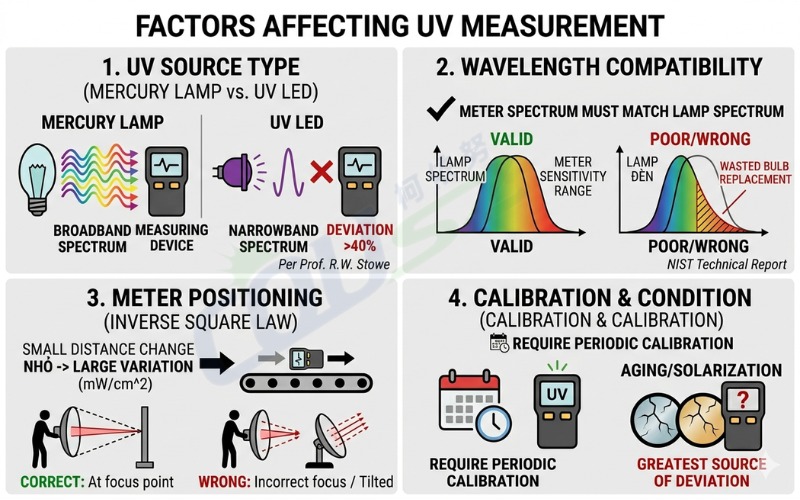
This is the primary barrier causing data discrepancies. High-pressure mercury lamps emit a broad spectrum (broadband), whereas LED systems emit an extremely narrow band (narrowband). According to research by Dr. R.W. Stowe, an eminent expert in optical metrology, a meter designed for mercury lamps inherently uses a broadband filter. When measuring a 395nm LED with this tool, the filter might physically cut off actual energy or overreact to secondary wavelengths, causing critical errors of up to 40%.
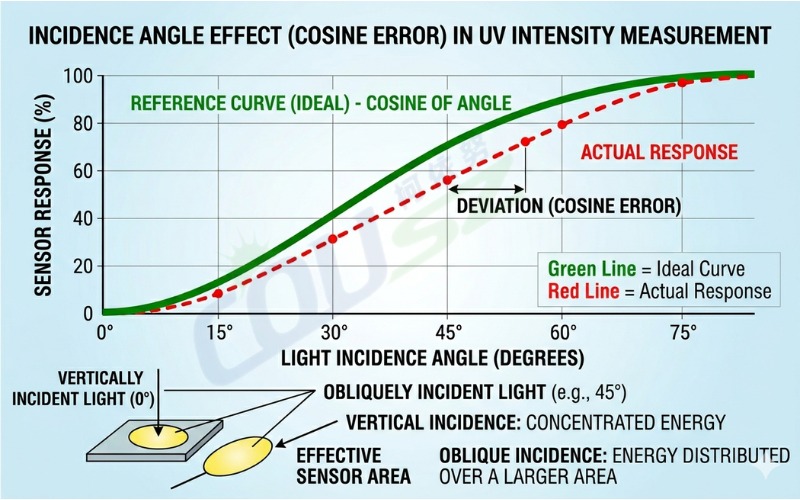
Furthermore, LED emission is highly directional compared to the diffused light of a mercury bulb. If the radiometer cannot process oblique rays effectively, the recorded data drops significantly. This is a pivotal factor that businesses transitioning to LED technology must recognize.
1.2. Spectral compatibility between meter and lamp
A primary cause of discrepancies is the mismatch between the sensor’s spectral sensitivity and the lamp’s emission profile. If your device peaks at 365nm but the curing lamp operates strongest at 395nm, the tool captures only the “fringe” energy. A technical report from NIST (National Institute of Standards and Technology) warns that mismatched spectra not only destroy UV measurement accuracy but also mislead technicians into prematurely replacing perfectly good bulbs, causing massive financial waste.
1.3. The positioning of the device during the run
Optical physics strictly dictates the inverse square law. A tiny shift in the vertical distance between the lamp and the sensor creates massive fluctuations in the mW/cm² reading. In a conveyor UV curing process, if the meter isn’t placed exactly at the reflector’s focal point, or is tilted even slightly, the gathered energy plummets. This is a geometric alignment error, not a failure of the equipment itself.
1.4. Equipment health and UV sensor calibration
Radiometers are essentially “self-sacrificing” tools. The internal glass filters and semiconductor sensors suffer from “solarization” under intense, continuous radiation. Skipping periodic UV sensor calibration is the biggest systemic cause of erroneous readings. Experts at RadTech International recommend strict maintenance because even during storage, optical components degrade due to humidity. Routine UV sensor calibration checks the “health” of the entire internal optical system to eliminate negative intrinsic variables.
2. How to execute a flawless UV intensity measurement?
To stabilize your data, operators must follow a strict protocol. Standardizing the way you operate the device ensures high repeatability and data reliability.
The 5-step execution protocol
- Clean the sensor window: Use high-concentration isopropyl alcohol and a lint-free cloth. A single fingerprint can scatter light and skew results by up to 5%.
- Warm-up the system: Lamps need time to reach thermal and output stability. Measuring a “cold” lamp immediately after turning it on is a fatal flaw.
- Configure the parameters: Select the correct wavelength band (UVA, UVB, UVC, or LED) and ensure the mode (Peak or Integrate) is consistently set across shifts.
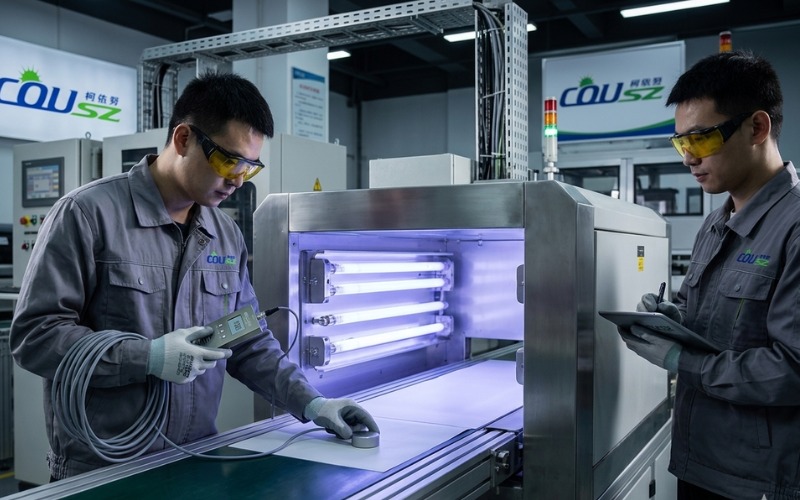
- Execute the run: Pass the device through the chamber at the standard production belt speed. Keep the unit perfectly flat and avoid vibrations.
- Record and compare: Document both the irradiance (mW/cm²) and energy dose (mJ/cm²). Comparing this to your initial “Golden Standard” reveals exactly how your system is degrading over time.
3. What common mistakes destroy UV measurement accuracy?
Even with premium equipment, human habits often ruin data integrity. Factory managers must train their staff to avoid these typical pitfalls.
Avoiding typical operational pitfalls
- Ignoring operating temperature: Heat heavily influences optical components. If the device overheats, the electronics suffer from “zero drift.” Running consecutive passes without allowing the meter to cool down yields artificially dropping numbers.
- Using the wrong tech for the source: Using an old mercury-era meter for a newly installed LED line guarantees massive errors, leading to false conclusions about the new system’s quality.
- Ignoring cosine response: Light rays rarely hit the sensor at a perfect 90-degree angle. Cheap devices have poor cosine responses, meaning they fail to capture oblique rays entering from the sides.
- Using expired equipment: A meter running two years past its UV sensor calibration date might still display numbers, but they hold no metrological value. Ignoring this timeline is a severe systemic failure.
4. How to contact COUSZ to optimize your UV curing process?
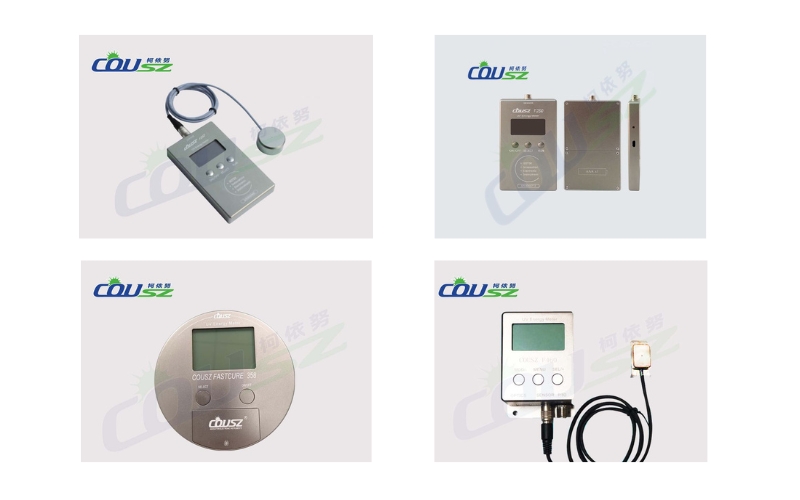
If you are struggling with data discrepancies or need expert consultation to navigate the complex variables discussed above, connect with our engineering team. We can guide you to an Industrial UV meter used for accurate UV intensity and energy measurement perfectly tailored to your needs.
👤 Ms. Yuna
✨ Technical Solution Specialist – COUSZ Vietnam
📞 Tel/Whatsapp/Wechat/Zalo: (84) 965 535 348
📧 Email: sales03@cousz.com
🌐 Website: www.cousz-vn.com
5. Faqs – deep dive into variables affecting data
5.1. Does temperature affect UV measurement accuracy?
Yes, immensely. Heat alters the sensitivity of the photodiodes inside the device. It also changes the emission spectrum of the lamp itself (especially for LEDs). Always utilize a thermal shield to protect the sensor during high-heat operations.
5.2. Can the device detect lamp degradation over time?
Absolutely. By performing a consistent UV intensity measurement daily, you will notice the energy graph trending downward. A 20-30% drop indicates the bulb has reached the end of its lifespan and requires replacement.
5.3. How often should we calibrate the devices?
The industry standard is once every 12 months. However, in high-heat environments running 3 shifts per day, shorten this to 6 months to maintain peak UV measurement accuracy and ensure ISO compliance.
5.4. How to select the correct wavelength for adhesives?
Consult your chemical’s Technical Data Sheet (TDS). If the adhesive requires activation at 365nm, you must ensure your device’s spectral response matches the UVA band perfectly. Mismatches here are a top cause of false readings.
5.5. Why do two identical meters show different results?
Every single unit has a slight manufacturing uncertainty (usually ±5%). Furthermore, the solarization degradation rate differs per device depending on its usage history. To ensure ultimate UV measurement accuracy internally, designate one single, freshly calibrated unit as the “Golden Standard” for the entire factory to compare against.