中文 (中国)
 Tiếng Việt
In modern manufacturing, selecting the right drying method is vital. We provide a detailed UV curing systems vs mercury lamps Comparison. By analyzing UV curing vs thermal curing and UV Curing Systems vs UV mercury, we help optimize your factory’s efficiency and slash costs.
1. Overview of the 3 primary curing methods
In the race for digital transformation and green manufacturing across major industrial zones like VSIP and Que Vo, choosing the ultimate curing technology plays a survival role. The Industry 4.0 revolution in Vietnam demands incredibly strict requirements for packaging and assembly speeds. According to a comprehensive report from Grand View Research, the market is shifting rapidly toward solid-state LED solutions, boasting a Compound Annual Growth Rate (CAGR) of 12.5%. To secure a firm position in the global supply chain, enterprises must adopt a highly durable, Energy-saving curing technology.
Currently, production managers typically weigh three primary methods for drying adhesives or inks:
1.1 The thermal drying mechanism
This is the most traditional technology, heavily utilizing massive Industrial UV curing ovens integrated with electrical heating elements or infrared (IR) lamps. The mechanism relies entirely on solvent evaporation. However, when evaluating UV curing vs thermal curing, the speed difference is staggering: thermal processes can take minutes to hours, whereas ultraviolet light finishes the job in mere seconds.
1.2 The traditional mercury vapor approach
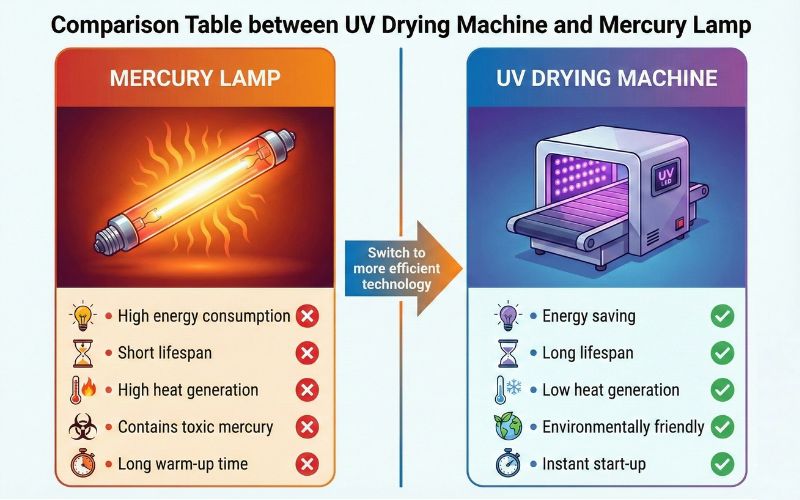
Once the undisputed “king” of the industry, mercury arc lamps produce a broad radiation spectrum suitable for many older materials. However, a deep look into UV Curing Systems vs UV mercury reveals severe drawbacks: they generate massive amounts of destructive heat and contain heavy metals that are highly detrimental to the environment.
1.3 The modern uv led curing technology
This is the most advanced technology available today. Instead of utilizing toxic bulbs, the system uses semiconductor LED chips emitting specific monochromatic wavelengths (typically 365nm or 395nm). Any standard UV curing systems vs mercury lamps Comparison clearly demonstrates that modern LED setups completely outclass older methods in terms of component lifespan and precise energy control.
2. The economic equation: Analyzing capex and opex
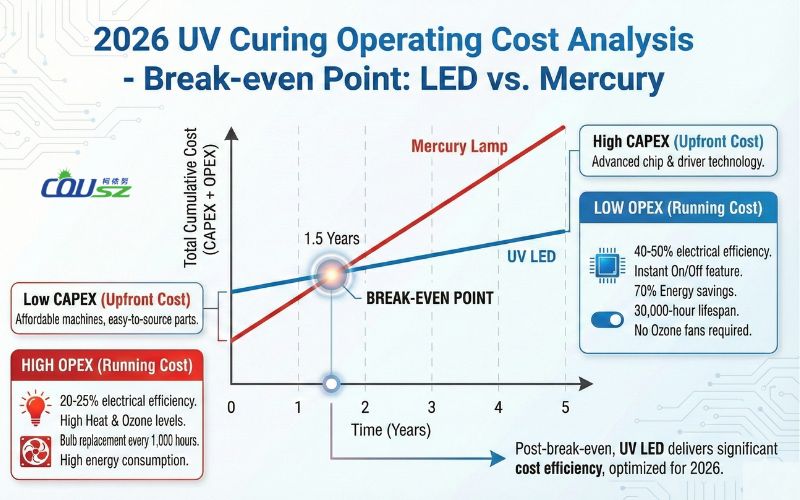
When reviewing vendor quotes, many enterprise directors hesitate because UV Curing Systems vs UV mercury present a significant discrepancy in initial purchase prices. However, COUSZ experts strongly advise looking deeper into the hidden, long-term Operating costs of UV curing systems in 2026.
2.1 Upfront capital expenditure (capex)
Legacy mercury setups are undeniably cheaper upfront, and replacement parts are widely available. Advanced LED architectures require a higher initial investment due to the sophisticated semiconductor chips and complex digital driver systems required to regulate power perfectly.
2.2 Operational expenditure (opex) – where the difference lies
According to profound photochemistry research by Professor J.P. Fouassier, the electrical conversion efficiency of a mercury bulb is a dismal 20-25%; the vast majority of your electricity is wasted as useless heat. In stark contrast, modern semiconductors achieve an impressive 40-50% efficiency.
- Electricity bills: This UV curing systems vs mercury lamps Comparison highlights that LED tech can slash electrical bills by up to 70% due to instant ON/OFF capabilities, entirely eliminating the mandatory, energy-draining warm-up periods.
- Consumables: Mercury bulbs desperately need replacing every 1,000 hours. High-end LEDs remain incredibly durable for up to 30,000 hours. In a 24/7 factory, you would replace a mercury bulb 8 times before ever needing to inspect a solid-state LED module.
- Ancillary systems: Older lamps mandate massive, noisy exhaust fans to extract toxic Ozone gas, further inflating the Operating costs of UV curing systems in 2026.
3. Technical comparison of the 3 curing methods
When process engineers conduct a rigorous UV Curing Systems vs UV mercury evaluation, they focus strictly on four pivotal technical metrics. Let’s analyze how they stack up against each other, particularly highlighting UV curing vs thermal curing differences.
| Criteria | Thermal Curing (Ovens) | Mercury Lamps | UV LED Curing Systems |
|---|---|---|---|
| Curing Mechanism | Solvent evaporation | Photopolymerization (Broad) | Photopolymerization (Narrow) |
| Surface Temperature | Very High (80-200°C) | High (60-120°C) | Low (35-45°C) |
| Component Lifespan | Varies by heating element | 1,000 – 2,000 hours | 20,000 – 30,000 hours |
| Environmental Safety | High VOC emissions | Contains mercury, creates Ozone | Zero lead, zero toxic Ozone |
| Process Speed | Minutes to Hours | Seconds | Fractions of a Second |
The ultimate supremacy of solid-state technology over older methods lies in absolute thermal control. In highly sensitive manufacturing sectors like smartphone camera module assembly or optical lens production, maintaining a low curing temperature is mandatory to prevent focal deviation caused by thermal expansion. According to the RadTech Association, the Yield rate of LED systems is consistently 15% higher than older methods thanks to this flawlessly stable Energy-saving curing technology.
👉 Discover how to drastically improve your assembly line speed:
UV Curing Technology in manufacturing and common myths
4. Expert advice from cousz for selecting your solution
Based on our extensive experience implementing thousands of industrial projects across Vietnam, COUSZ offers a highly optimized roadmap for your factory:
4.1 For newly established production facilities
Prioritize investing in solid-state LED systems from day one. Although the initial capital is higher, the sheer stability and drastically lower Operating costs of UV curing systems in 2026 will allow you to achieve full ROI in just 12 to 18 months.
4.2 For enterprises seeking an upgrade path
If you are currently struggling with older equipment, consider Upgrading UV curing systems partially. You do not necessarily have to scrap your entire conveyor belt. COUSZ can assist in retrofitting your existing frames with modern LED modules, replacing outdated Industrial UV curing ovens and massive exhaust hoods while retaining your core mechanical infrastructure.
4.3 Selecting the exact configuration
If your product is ultra-thin and highly heat-sensitive (like PET film), absolutely avoid thermal methods and arc lamps. This is where a proper UV curing systems vs mercury lamps Comparison saves your product from melting. Conversely, if your product requires incredibly deep resin penetration, select a precise 395nm wavelength for maximum effectiveness. Always consult an expert to evaluate UV curing vs thermal curing for your specific substrate.
5. Faqs – frequently asked questions about curing technology
Why do uv led curing systems have higher upfront costs but lower long-term operating costs than mercury lamps?
Because the “true cost” encompasses electricity bills, labor costs for constant bulb replacements, massive ventilation systems, and expensive product defect rates. When these factors are aggregated over 2 to 3 years, a comprehensive UV curing systems vs mercury lamps Comparison proves that LED tech is at least 40% cheaper in total cost of ownership.
Does thermal curing still offer any advantages compared to uv curing systems?
When analyzing UV curing vs thermal curing, traditional heat still holds an advantage when drying ultra-thick layers of glue (several centimeters deep) or curing highly complex 3D shapes where light simply cannot reach the “shadowed corners” inside massive Industrial UV curing ovens. However, the modern industry trend is utilizing Dual-cure adhesives (light + heat) to resolve this limitation entirely.
Can mercury lamps damage heat-sensitive products?
Yes, severely. The intense infrared heat radiated from traditional arc lamps can easily warp PET and PETG plastics and completely destroy the transparency of delicate optical lenses. This thermal damage is the primary catalyst driving the massive industry debate of UV Curing Systems vs UV mercury, pushing factories toward cooler LED solutions.
Can existing mercury lamp infrastructure be upgraded to uv led curing systems?
Absolutely. COUSZ provides highly modular retrofit kits specifically designed for Upgrading UV curing systems. We retain your existing conveyor belts and mechanical frames, entirely replacing only the optical lamp heads and digital drivers. This intelligent retrofit strategy saves businesses up to 40% compared to purchasing a brand-new machine from scratch.
6. Contact our technical team for cost optimization
Are you still hesitating between Upgrading UV curing systems or sticking with outdated technology? Let the COUSZ engineering team conduct a comprehensive factory audit and run live physical samples using your actual products to guarantee the best Energy-saving curing technology for your specific needs.
We provide undeniable proof that modernizing your line is the most profitable decision your factory will make this year.
👩💼 Senior Technical Consultant: Ms. Yuna
📱 Zalo / WhatsApp / Wechat: (84) 965 535 348
📧 Email: sales03@cousz.com
🌐 Website: cousz-vn.com
🏢 Headquarters: Ngo Xa Village, Phat Tich Commune, Bac Ninh Province, Vietnam.