中文 (中国)
 Tiếng Việt
In modern high-speed assembly lines, prioritizing operator health is the absolute foundation for maintaining continuous factory productivity. Unlike natural sunlight, the high-intensity ultraviolet radiation utilized in industrial photopolymerization can inflict severe biological damage if proper shielding is ignored. At COUSZ Vietnam, we provide this comprehensive UV curing systems safety guide to empower enterprises with the knowledge required to completely safeguard their workforce and confidently operate compliant, world-class manufacturing facilities.
1. Why is a UV curing systems safety guide critical for modern factories?
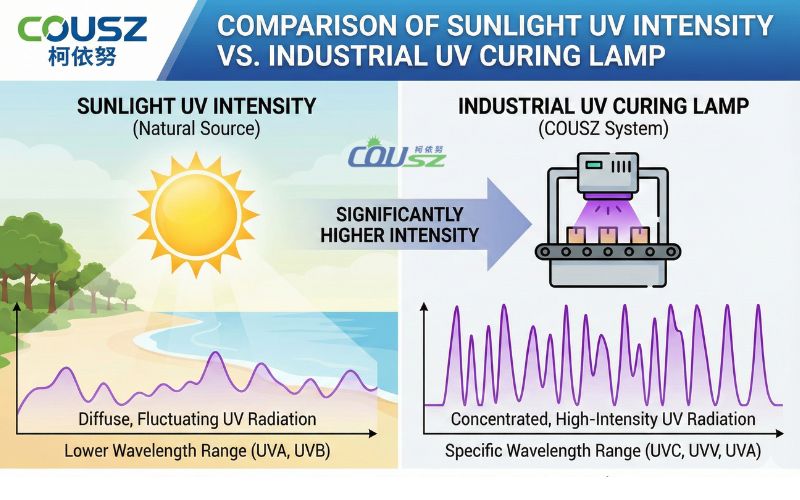
Ultraviolet (UV) light is scientifically categorized into three distinct spectral bands: UV-A (315-400nm), UV-B (280-315nm), and UV-C (100-280nm). While industrial UV-A is the primary spectrum used to trigger photoinitiators in adhesives, it still possesses massive photon energy capable of deeply penetrating human epidermal layers. The true danger of working without a proper UV curing systems safety guide lies in the fact that this intense radiation is entirely invisible to the naked human eye and does not immediately project the burning heat sensation associated with infrared (IR) lamps, leading operators into a false sense of security.
1.1 Understanding the invisible threat of ultraviolet radiation
According to reports published by the World Health Organization (WHO) and verified by the optical engineering team at COUSZ, the concentrated ultraviolet intensity inside an industrial curing chamber can easily exceed thousands of times the strength of direct midday sunlight.
The photon energy within this specific spectrum is powerful enough to violently shatter chemical double-bonds within liquid polymers—and unfortunately, it possesses the exact same destructive capability against the DNA strands within living human cells. Prolonged, unshielded exposure inevitably leads to irreversible health consequences, destroying workforce morale, severely damaging the enterprise’s international reputation, and skyrocketing corporate medical insurance liabilities. Therefore, adhering to strict industrial UV safety protocols is not merely an option; it is a mandatory legal requirement.
2. What are the primary UV LED curing hazards in the workplace?
When operating unshielded equipment, factory workers frequently face severe biological threats. Identifying these UV LED curing hazards is the critical first step in building an impenetrable defense for your assembly line.
2.1 The severe impact on human vision and skin
- Catastrophic eye damage: Photokeratitis—commonly referred to in the industry as “welder’s flash” or “arc eye”—is a painful inflammatory condition of the cornea. It can occur after merely a few seconds of directly staring into a high-powered LED array. Over the long term, repeated micro-exposures accelerate the development of cataracts and irreversible macular degeneration.
- Dermatological destruction: The skin is highly vulnerable. Unshielded exposure causes severe chemical sunburns (erythema), rapidly accelerates premature skin aging (photoaging), and drastically multiplies the risk of developing basal cell carcinoma and melanoma.
2.2 Thermal risks and secondary fire hazards
While LED technology is often marketed as a “cold source” because it does not emit infrared heat, this is one of the most misunderstood UV LED curing hazards. The raw optical photon energy concentrated at the focal point is immense. If the automated conveyor belt suddenly stalls and the lamp fails to shut off, this concentrated optical energy will rapidly heat up flammable plastic substrates or paper webbing, creating an immediate and severe factory fire hazard.
👉 Learn how to elevate your manufacturing lines safely:
UV curing systems maintenance and troubleshooting guide
3. Which industrial UV safety protocols must be strictly followed?
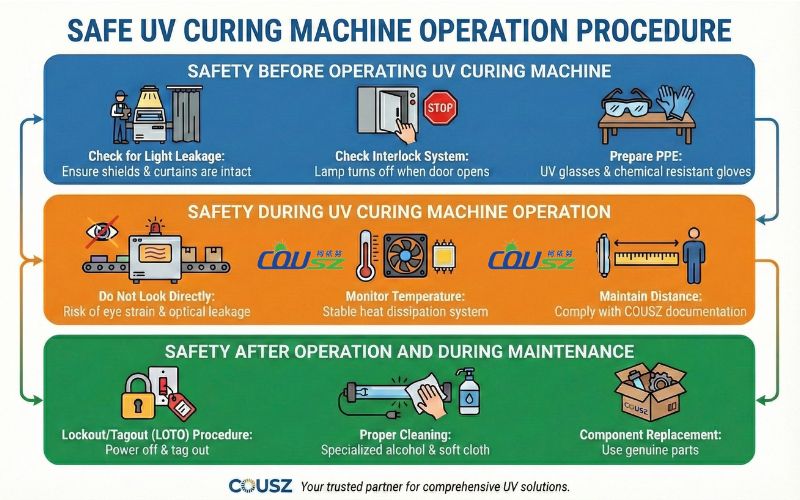
A flawless safety record is not achieved by accident; it is the result of rigorous, uncompromising procedures. To guarantee the well-being of your staff, the following industrial UV safety protocols must be implemented across three distinct operational phases.
3.1 Pre-operation safety checks
- Optical leakage inspection: Before energizing the system, meticulously inspect all physical metal shields, dark acrylic enclosures, and anti-ultraviolet rubber curtains. Ensure there are absolutely no tears, gaps, or misaligned panels where stray photons could escape into the ambient workspace.
- Interlock system verification: This is arguably the most critical electromechanical safety mechanism. A functional safety interlock guarantees that the exact millisecond the curing chamber door is opened, the LED power supply is instantly severed. Test this mechanism daily.
- PPE readiness: Visually inspect the integrity of all personal protective equipment to ensure it is free of scratches or degradation.
3.2 Safety measures during active operation
Even with physical barriers in place, operators must never attempt to look directly into the primary light source or the highly reflective focal zone. Furthermore, operators must strictly monitor the machine’s thermal telemetry. Ensure the industrial water chiller or high-velocity exhaust fans are maintaining the LED junction temperatures within safe limits. Finally, all personnel must maintain the manufacturer’s recommended safe physical working distance as outlined in the COUSZ technical manual.
3.3 Post-operation and maintenance safety (LOTO)
When a technician needs to open the machine to clean the quartz lenses or replace a diode module, they must execute a strict Lockout/Tagout (LOTO) procedure. This involves physically padlocking the main electrical breaker and attaching a warning tag to ensure no one accidentally powers the machine on while hands are inside the chamber.
During cleaning, use only 99% Isopropyl alcohol and lint-free cloths. For legacy mercury systems, never touch the bare glass bulb with your bare fingers; the acidic oils from human sweat will bake into the quartz, creating a “hot spot” that causes the pressurized bulb to violently explode.
4. What UV light eye protection and gear are mandatory?
When primary engineering controls (like enclosed dark cabinets) cannot completely eliminate the risk of scattered radiation, Personal Protective Equipment (PPE) serves as the ultimate final line of defense.
4.1 Selecting the correct personal protective equipment (ppe)
Not all safety gear is created equal. Utilizing standard tinted sunglasses on a factory floor is a dangerous mistake. You must deploy specialized gear designed to block specific nanometer wavelengths.
| Equipment Type | Required Specifications | Primary Function |
|---|---|---|
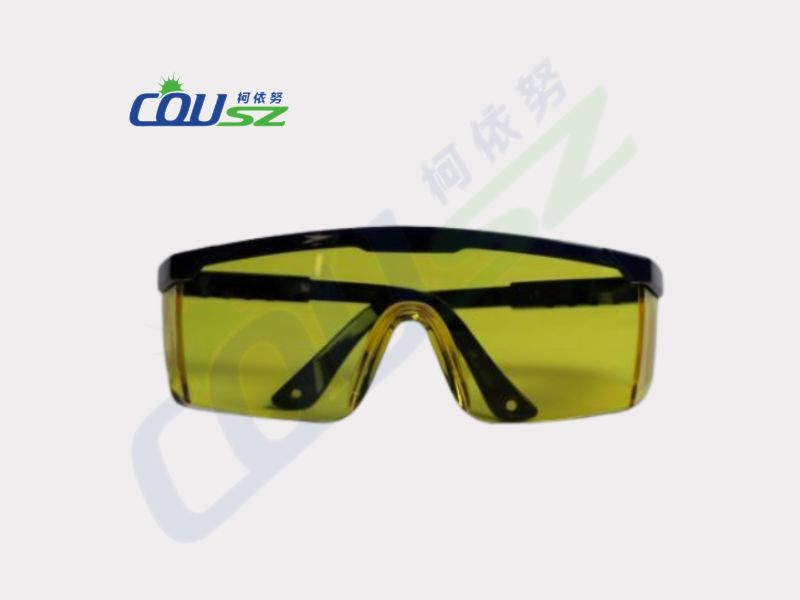
| UV light eye protection | Must strictly meet ANSI Z87.1 or EN166 standards. Must feature wrap-around side shields. | Blocks 99.9% of UVA/UVB/UVC radiation from entering the cornea via direct or scattered peripheral angles. |
| Full Face Shields | Polycarbonate construction with specialized UV-blocking optical coatings. | Protects the entire facial epidermis from severe radiation burns during open-cabinet maintenance or intensity testing. |
| Protective Clothing & Gloves | Tightly woven fabrics or specialized textiles with a high UPF (Ultraviolet Protection Factor) rating. Nitrile gloves. | Prevents radiation from piercing through standard thin cotton clothing, shielding the arms and torso from long-term cellular damage. |
While broad-spectrum industrial sunscreen can be utilized as an absolute last resort in highly specific, unusual scenarios, it must never replace physical barriers. At COUSZ, we continuously remind our clients that investing heavily in premium UV light eye protection is the single greatest investment you can make in the sustainability of your human resources.
5. Conclusion: building a culture of safety
Strictly adhering to a comprehensive UV curing systems safety guide does more than just shield workers from the devastating biological effects of radiation; it actively asserts your enterprise’s profound professionalism to international auditors and global partners. Always remember that eliminating the dangers of high-intensity photopolymerization begins with the smallest, most disciplined actions: wearing your safety glasses, lowering the dark acrylic curtains, and respecting the machine’s immense power.
To upgrade your factory with fully enclosed, intelligently shielded industrial UV curing systems, contact COUSZ Vietnam today and experience true operational peace of mind.
6. Faqs – common questions about radiation protection
Can standard welding masks be used as protection?
While heavy-duty welding masks do block ultraviolet light, they are typically heavily tinted to block intense visible glare, making it nearly impossible for an operator to clearly see and perform delicate electronic assembly tasks. You must utilize clear, specifically rated polycarbonate glasses that block 365nm-405nm wavelengths without obstructing visible light.
What should I do if I accidentally look into the UV light?
If you experience a flash, immediately turn away and power down the equipment. If you develop symptoms such as a severe “sand in the eyes” feeling, intense tearing, or extreme sensitivity to normal room light over the next 6 to 12 hours, you have likely developed Photokeratitis. Seek professional medical attention from an ophthalmologist immediately.
Are all UV LED curing hazards the same as traditional mercury lamps?
No. While both emit dangerous ultraviolet radiation, traditional mercury lamps also emit massive amounts of infrared (IR) heat and generate toxic Ozone gas (O3) by breaking down oxygen molecules in the air. LED systems are significantly safer because they completely eliminate the production of highly toxic, respiratory-damaging ozone.
7. Contact for safety consultation and factory upgrades
Do you need expert assistance establishing bulletproof industrial UV safety protocols or training your factory personnel on operational hazards? Do not hesitate to connect with our elite engineering team:
👩💼 Senior Safety & Technical Consultant: Ms. Yuna 🌟
📞 Zalo / WhatsApp / Wechat / Tel: (84) 965 535 348
📧 Email: sales03@cousz.com
🌐 Website: cousz-vn.com
🏢 Offices: Bac Ninh & HCM, Vietnam.