中文 (中国)
 Tiếng Việt
1. Introduction to popular models on the market today
The vast diversity of light sources in modern manufacturing—including traditional mercury vapor, advanced LED arrays, and halogen lamps—demands a corresponding variety in equipment dedicated to measuring UV intensity. Below is an in-depth look at the top-tier high-performance UV meters that any electronics, printing, or packaging facility should strongly consider integrating into their quality assurance protocols.
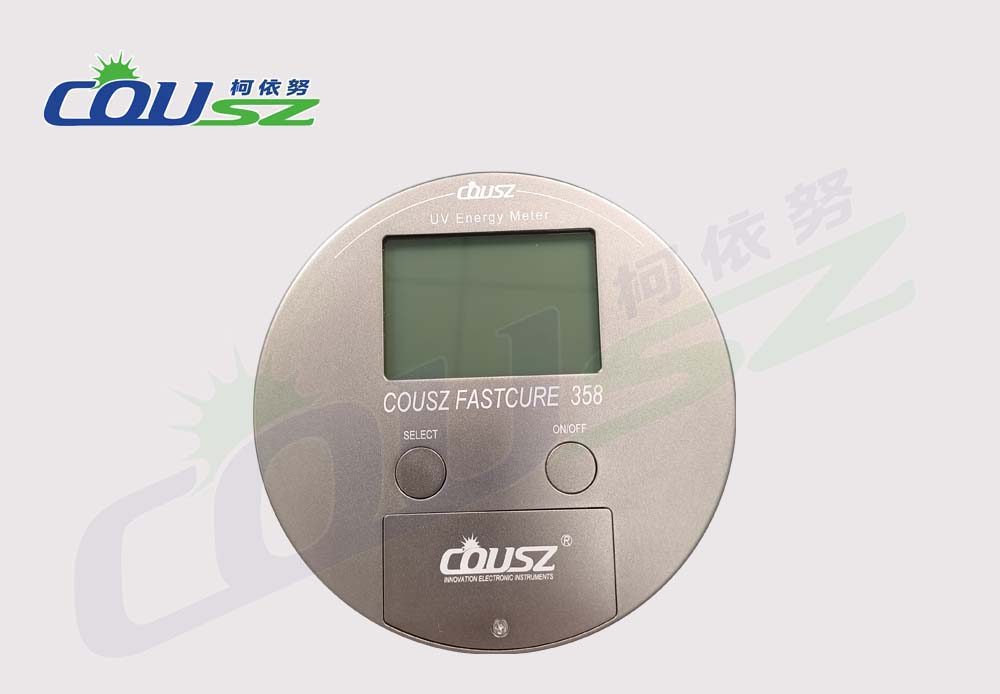
1.1. The F358 UV power puck series
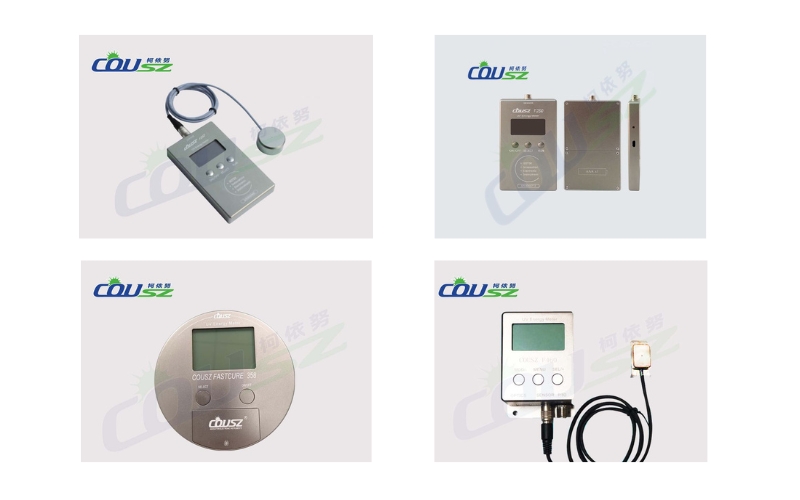
Widely considered the “golden standard” in the curing industry, the F358 multi-channel puck is an indispensable tool for wide-format conveyor drying belts. Featuring a flat, circular design resembling a hockey puck, this instrument can safely “travel” through high-temperature curing ovens while flawlessly protecting the highly sensitive optical sensors housed inside its robust aluminum casing.
The F358 series is typically integrated with four distinct spectral channels: UVA, UVB, UVC, and UVV. According to comprehensive research published by RadTech International, utilizing a multi-channel device allows engineers to detect bulb degradation across different wavebands simultaneously—a critical diagnostic feature that single-channel models completely miss. It is highly favored because it records both Peak Irradiance and accumulated Dose at the exact same time.
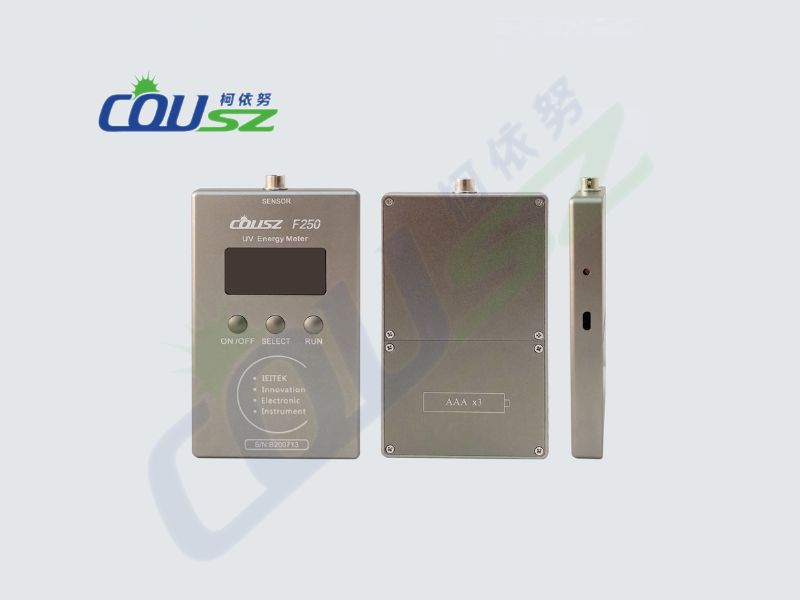
1.2. The F250 series – compact and flexible
If you are searching for mobility in confined spaces, the F250 stands out as a remarkable solution. This handheld device is frequently used for rapid spot-checking of localized curing stations. Despite its compact footprint, when conducting a rigorous UV radiometer comparison against larger laboratory units, the F250 maintains astonishing accuracy, particularly within the standard UVA spectrum. It is the preferred economical choice for manual inspection stations and handheld spot-curing wands.
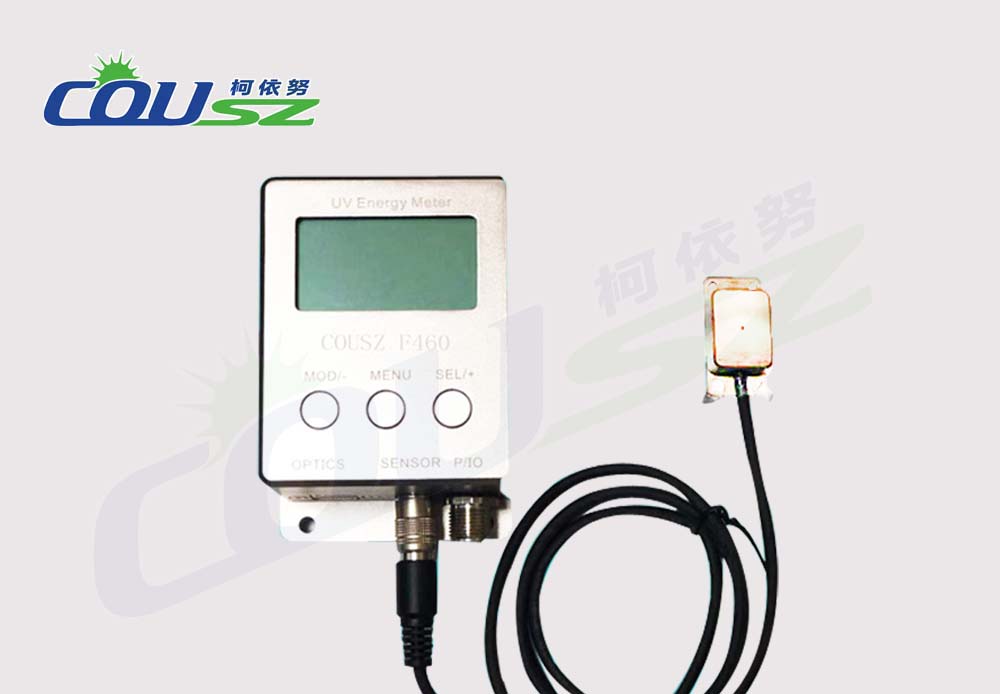
1.3. The F460 series – industrial efficiency
The F460 represents a significant technological upgrade, focusing heavily on extreme heat resistance and advanced data storage capabilities. Among the various high-performance UV meters available, the F460 is highly rated for its intuitive digital display and rapid data connectivity. This device makes cross-referencing data between different production shifts easier than ever thanks to its smart internal memory buffer, which stores hundreds of historical reference points.
1.4. The F580 series – the peak of accuracy
The F580 is frequently the top choice for enterprises that demand absolute strictness regarding technical specifications. Boasting an ultra-high sampling rate, the F580 captures even the most minute micro-fluctuations in ultraviolet energy. It excels at generating real-time energy distribution graphs, empowering technicians to optimize conveyor speeds with microscopic precision.
1.5. Specialized equipment for lab and R&D
Unlike rugged field devices, equipment designed for laboratory environments requires exponentially higher sensitivity and a much broader dynamic measurement range. These models often feature detachable external sensors connected to specialized PC software for deep algorithmic analysis. This represents a crucial segment of industrial UV measurement tools dedicated to the research and development of next-generation photoinitiators, adhesives, and advanced 3D printing resins.
2. UV radiometer comparison: which is the optimal choice?
To provide businesses with a highly intuitive perspective, let us perform a detailed UV radiometer comparison across these flagship models. This evaluation is based on core criteria: the number of spectral channels, thermal resistance limits, and practical factory applications.
| Evaluation Criteria | F358 (Power Puck) | F250 Series | F460 Series | F580 Series |
|---|---|---|---|---|
| Spectral Channels | 4 Channels (UVA, B, C, V) | 1 Channel (Usually UVA) | 1-2 Channels | Advanced Multi-channel |
| Physical Design | Flat circular puck | Handheld (detachable probe) | Integrated Handheld | Heavy-duty Industrial |
| Thermal Resistance | Very High (Protective shield) | Medium | High | Extremely High |
| Data Storage | Yes (Graph support) | Basic memory | Advanced logging | In-depth PC analysis |
| Primary Application | Large conveyor ovens | Manual stations, basic Lab | Automated lines | Strict QC, R&D labs |
Through this objective analysis, it becomes evident that there is no absolute “best” machine; there is only the “most suitable” machine for your specific curing process. For instance, if you utilize a 395nm LED system, choosing high-performance UV meters with highly sensitive UVV bands is absolutely mandatory.
Experts such as Professor R.W. Stowe (author of numerous landmark studies on optical metrology) frequently emphasize the “repeatability” of a measurement. A reliable instrument must yield consistent results across at least 10 consecutive passes under the exact same light source to be deemed acceptable for production use.
3. Evaluation criteria for quality industrial UV measurement tools
How do you know if a device is truly worth the enterprise’s capital investment? When researching industrial UV measurement options, you must base your procurement decisions on the following stringent assessment standards:
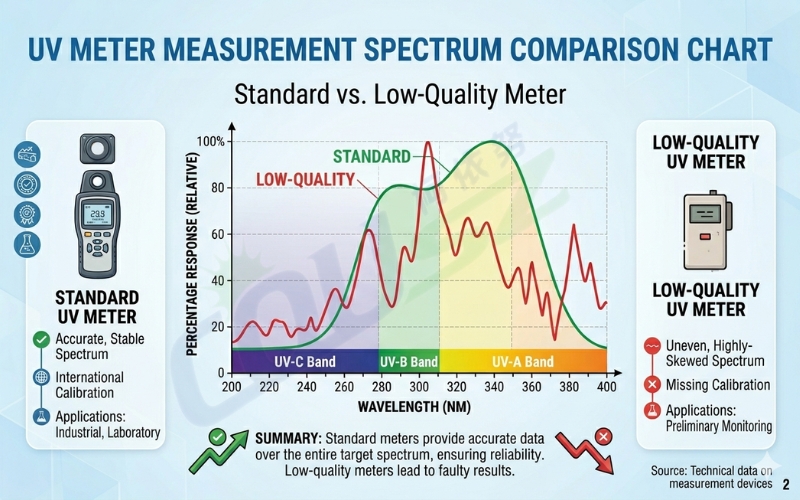
- Accuracy and calibration traceability: A standardized instrument must be calibrated according to NIST (National Institute of Standards and Technology) protocols. Purchasing genuine high-performance UV meters guarantees that your device includes a verifiable calibration certificate, preventing disastrous errors during critical QC audits.
- Spectral response matching: This is a life-or-death factor. The device’s optical filter band must perfectly match the light source you are using. A minor deviation in the targeted waveband can result in under-reading or over-reading the actual energy by up to 20%, leading to massive product failure.
- High-speed sampling rate: For manufacturing conveyor belts running at high speeds (exceeding 50 meters per minute), you require equipment with exceptionally fast processing speeds to ensure you do not miss the absolute Peak intensity as the sensor flashes under the bulb.
- Maintenance and spare parts availability: Buying from reputable entities like COUSZ Vietnam ensures you always have access to replacement components and professional support for your mandatory 12-month periodic recalibration.
Investing in precision technology is not merely buying a machine; it is purchasing an insurance policy for your brand’s reputation. Do not skip a thorough evaluation to save a small initial cost. For a deeper understanding of making the right purchase, read our comprehensive guide on How to select a UV meter and avoid common measurement errors.
4. Contact for genuine equipment and technical consultation
Do you need an uncompromising, exact measurement solution tailored for your factory floor? Contact our engineering team immediately to receive in-depth consultation on the best high-performance UV meters and a detailed UV radiometer comparison tailored for your specific lamp types:
👤 Ms. Yuna
✨ Technical & Sales Representative – COUSZ Vietnam
📞 Tel/Whatsapp/Wechat/Zalo: (84) 965 535 348
📧 Email: sales03@cousz.com
🌐 Website: www.cousz-vn.com
5. FAQs – Frequently asked questions about measuring UV intensity
5.1. What is the biggest difference between the F250, F460, and F580?
The primary differences lie in the sophistication of the microprocessor and their tolerance to extreme heat. While the F250 is a fundamental tool for spot-checking, the F460 and F580 are heavy-duty devices capable of storing thousands of data points and rendering deep graphical analysis. Furthermore, the F580 offers the highest stability in environments with strong electromagnetic interference (EMI), making it a top-tier choice among high-performance UV meters.
5.2. Why do labs need specialized tools instead of common ones?
In R&D, determining the absolute minimum Dose required for an adhesive to fully cure demands ultra-high resolution. Laboratory industrial UV measurement devices feature extremely sensitive ranges and accompanying PC software, assisting scientists in pinpointing the most precise “Process Window.” This is a major distinction when categorizing equipment by their intended end-use.
5.3. What are the critical parameters to read?
There are two “survival” parameters that any system dedicated to measuring UV intensity must provide:
- Irradiance (mW/cm²): The peak intensity, which dictates the ultraviolet ray’s ability to penetrate deeply into thick layers of adhesive or ink.
- Energy Density (mJ/cm²): The total accumulated energy received, which ultimately determines the complete and thorough drying of the surface layer.
5.4. How to choose a reputable supplier?
Always select distributors capable of providing on-site technical support and complete NIST calibration documentation. Purchasing high-performance UV meters is not just about acquiring the physical product; it heavily relies on the quality of the warranty, the after-sales calibration services, and the expert technical solutions provided.