中文 (中国)
 Tiếng Việt
In modern manufacturing lines across Vietnam, optimizing UV curing efficiency is not just about boosting raw productivity; it is the ultimate guarantee of product quality. However, without a firm grasp of the Technical specifications of UV curing systems, businesses risk uneven hardening or severe substrate damage. Let COUSZ guide you through the 6 key elements to master your UV Curing Performance and dominate the Industry 4.0 landscape.
1. UV curing efficiency: what exactly is it?
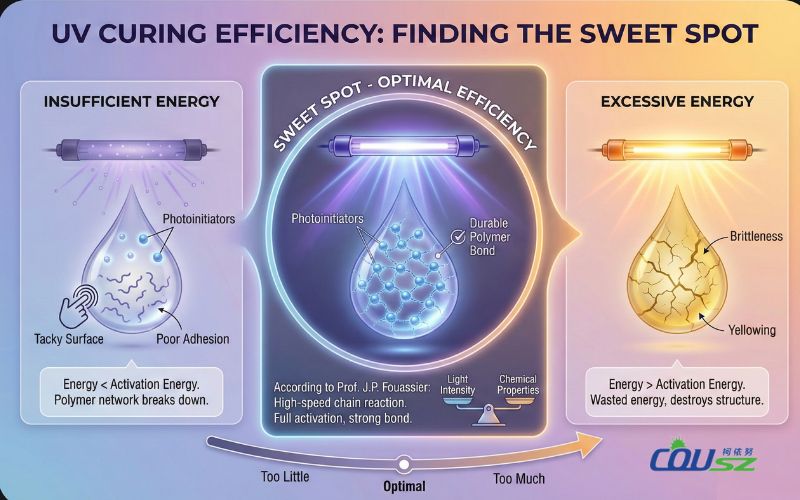
In simple terms, UV curing efficiency is the capability of an irradiation system to perfectly activate the photoinitiator molecules embedded inside an adhesive or ink, thereby generating a highly durable, solid polymer cross-link. This transition from liquid to solid happens in fractions of a second, but it requires extreme precision to execute correctly without damaging the underlying material.
According to profound photochemistry research from Professor J.P. Fouassier, photopolymerization is an ultra-high-speed chain reaction. If the supplied photon energy fails to reach the critical Activation Energy threshold, the polymer network structure will immediately break down. This chemical failure leads directly to tacky, wet surfaces or extremely poor adhesion strength. Conversely, blasting the substrate with excessive, unregulated energy not only wastes massive amounts of factory electricity but also causes severe yellowing and embrittlement of the materials. Ultimately, achieving peak UV Curing Performance means finding the exact “sweet spot” between the machine’s light intensity and the specific chemical properties of your chosen adhesive.
2. Technical specifications of UV curing systems: 6 key elements
To fully optimize a high-speed assembly line, process engineers must look at the comprehensive picture. You must carefully analyze multiple layers of the Technical specifications of UV curing systems. Below are the six definitive factors that dictate success.
2.1. Irradiance vs energy density
These two concepts are the most frequently confused terms on the factory floor, yet they form the very backbone of the Technical specifications of UV curing systems. Understanding them is vital for maximizing UV Curing Performance.
- Irradiance (mW/cm²): This is the peak power density striking the surface at any exact given moment. It dictates the “punching power” required to break through the surface of the glue and overcome oxygen inhibition. Conducting a proper UV irradiance measurement ensures this peak power is consistently met.
- Energy Density / Dose (mJ/cm²): This is the total accumulated volume of photons that the surface receives over the entire exposure time. The formula is:
E (mJ/cm²) = I (mW/cm²) × t (s).
A high-end machine must possess a peak irradiance high enough to penetrate the surface, combined with a large enough energy density to guarantee a deep, structural “through-cure.”
2.2. Optimal UV curing distance
The Optimal UV curing distance usually ranges tightly between 5mm and 15mm, depending entirely on the optical lens design of the lamp head. Operators must strictly remember the “Inverse Square Law” of physics: light intensity drops exponentially as you increase the physical gap.
According to extensive laboratory testing at COUSZ, slightly altering the Optimal UV curing distance from 3mm to 50mm can easily slash the useful radiant intensity by an astonishing 40%. Therefore, permanently locking in the correct physical working gap is an absolute prerequisite to maintaining consistent UV curing efficiency across moving conveyor belts.
2.3. Curing time and conveyor speed
In manufacturing, time is money. However, if the exposure time is too brief, your overall UV curing efficiency will remain incomplete. The speed of the automated conveyor belt must be perfectly synchronized with the optical intensity of the LED array. If you desire to speed up production, you are strictly required to upgrade the Technical specifications of UV curing systems to output a higher irradiance, ensuring the total accumulated energy (mJ/cm²) remains identical.
👉 Learn how to elevate your manufacturing lines:
UV curing technology explained with common misconceptions
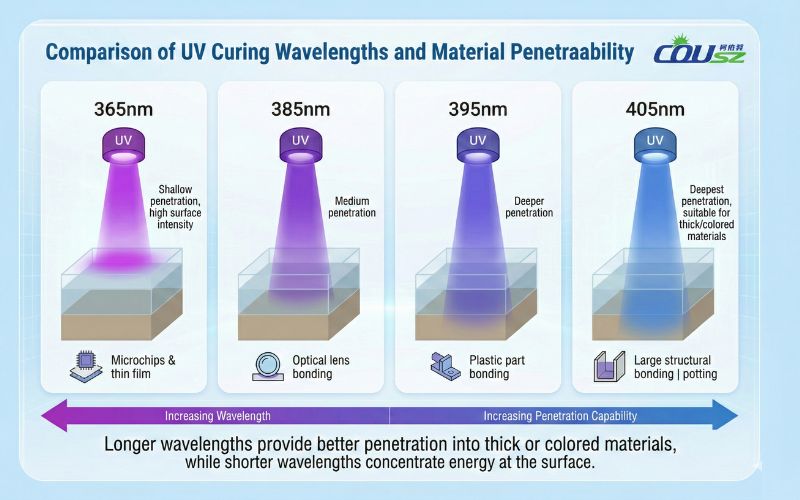
2.4. UV curing wavelength (365 nm, 385 nm, 395 nm, 405 nm)
Selecting the correct UV curing wavelength (365 nm, 385 nm, 395 nm, 405 nm) is exactly like choosing the perfect key for a lock. Every industrial glue or ink is chemically engineered to react most violently to one highly specific wavelength. Utilizing the wrong UV curing wavelength (365 nm, 385 nm, 395 nm, 405 nm) will result in extremely poor UV Curing Performance.
| Wavelength | Characteristics | Common Industrial Applications |
|---|---|---|
| 365nm | High photon energy, best for deep penetration. | Glass bonding, medical devices, optics. |
| 385nm | Perfect balance between surface and through-cure. | High-end printing, PCB conformal coatings. |
| 395nm | Most popular LED spectrum, highly safe. | Packaging ink, thick industrial coatings. |
| 405nm | Near-visible light, penetrates opaque plastics. | 3D printing, ultra-thick potting resins. |
2.5. Equipment condition and lifespan tracking
Just because the “lamp is glowing blue” does not mean the “lamp is curing effectively.” According to global reports from RadTech International, the optical output of traditional mercury vapor bulbs plummets by 20% after merely 500 hours of operation due to severe internal degradation. While COUSZ’s advanced LED technology boasts a lifespan of up to 20,000 hours, industrial dust accumulating on the quartz lenses can still silently degrade your UV curing efficiency. Therefore, routinely checking the Technical specifications of UV curing systems is mandatory.
3. UV Curing Performance: how to measure and control it
To avoid blindly guessing the quality of your output, modern enterprises must implement strict, scientific measurement protocols to guarantee peak UV Curing Performance.
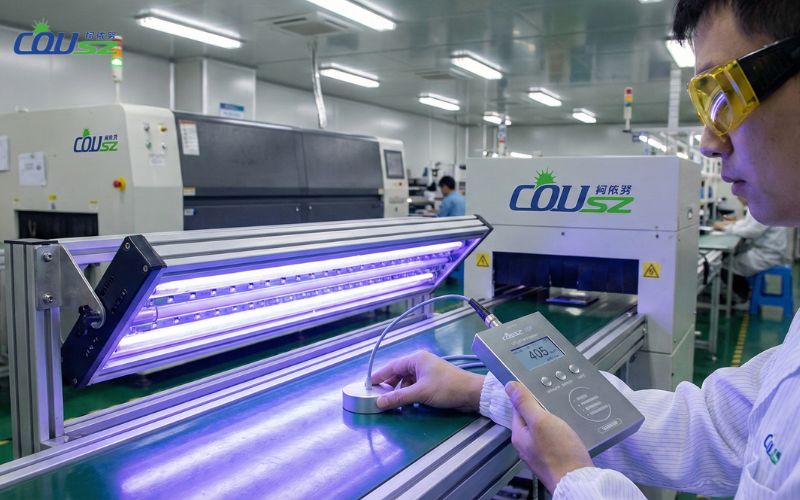
- Utilize a radiometer: Frequent UV irradiance measurement is absolutely mandatory. An industrial radiometer provides exact, real-time data regarding the peak irradiance (mW/cm²) and accumulated energy (mJ/cm²). If your UV irradiance measurement indicates a drop below 80% of your factory baseline, it is time for immediate lens cleaning or module replacement.
- Cross-hatch adhesion testing: After the part exits the conveyor, perform a physical cross-hatch tape test to verify the actual chemical bond strength on the substrate.
- Temperature monitoring: Track the thermal load. Excessive heat generation can permanently warp PET plastics or fry sensitive electronic microchips.
Standardizing your UV irradiance measurement protocols effectively eliminates the risk of mass-producing defective batches and drastically cuts down on unnecessary maintenance costs across your entire facility. Deeply understanding the Technical specifications of UV curing systems ensures you always stay ahead.
4. FAQs – common questions about the process
Here are the most frequently asked technical questions we receive from factory managers attempting to maximize their UV curing efficiency while navigating the complex Technical specifications of UV curing systems.
4.1. Why do UV lamps cure UV adhesives?
The fundamental process is not “drying” (evaporating a wet solvent into the air) like a traditional thermal oven; it is a violent chemical “cross-linking.” The intense ultraviolet light delivers massive photon energy that shatters the chemical bonds of the photoinitiators embedded inside the liquid glue. This creates an instantaneous polymerization chain reaction, turning liquid to solid plastic. This photochemistry is the secret behind ultra-high-speed UV Curing Performance.
4.2. Why working distance matters in UV curing systems
The physical distance is strictly inversely proportional to the light intensity due to beam divergence. If you mistakenly double the Optimal UV curing distance, the actual light intensity striking the adhesive surface drops by a factor of four. This guarantees the glue will only dry on the very top skin while remaining a weak liquid underneath, causing catastrophic peeling failures. Always consult the Technical specifications of UV curing systems provided by the manufacturer to lock in the perfect gap to maintain maximum UV curing efficiency.
4.3. Is the 365 nm wavelength the peak wavelength?
The 365nm spectrum is widely considered the “golden” wavelength for applications demanding extremely deep penetration and maximum adhesion on clear substrates like glass. However, it is not a universal magic bullet. For heavily pigmented dark inks or ultra-thick industrial coatings, selecting the 395nm spectrum within the UV curing wavelength (365 nm, 385 nm, 395 nm, 405 nm) range often provides vastly superior, much safer UV Curing Performance for factory operators.
5. Contact COUSZ for technical support
Mastering the complex Technical specifications of UV curing systems is a highly rigorous engineering journey that demands absolute precision. The dedicated engineering team at COUSZ is always ready to stand by your side to optimize your production lines, maximize your UV curing efficiency, and ensure your factory achieves flawless UV Curing Performance.
Contact us today for an expert consultation and free on-site sampling:
👩💼 Senior Technical Consultant: Ms. Yuna
📱 Zalo / WhatsApp / Wechat / Tel: (84) 965 535 348
📧 Email: sales03@cousz.com
🌐 Website: cousz-vn.com
🏢 Headquarters: Ngo Xa Village, Phat Tich Commune, Bac Ninh Province, Vietnam.