中文 (中国)
 Tiếng Việt
Selecting the right photopolymerization equipment is vital for factory productivity. If you are wondering how to choose a UV curing system, COUSZ Vietnam is here to help. We share our expert experience in purchasing a UV adhesive curing system to optimize budgets and eliminate product defects.
1. Why must businesses select the correct curing equipment?
Selecting the incorrect curing device does not merely increase the immediate product defect rate; it directly and severely inflicts massive financial damage upon the long-term Operating costs of UV adhesive curing systems. A machine lacking sufficient optical intensity will cause the adhesive to remain partially wet, leading to catastrophic component detachment after the product leaves the factory floor. Conversely, an overly powerful, incorrectly calibrated system will blatantly waste factory electricity and potentially cause severe thermal damage (melting or warping) to the delicate substrate materials.
Based on rigorous scientific studies conducted by industry experts at RadTech International, the precise efficiency of the adhesive curing phase directly impacts up to 30% of the total quality value of a finished electronic device. Therefore, strictly adhering to a professional Guide to choosing a UV curing system is a mandatory strategic move to ensure your factory’s Yield Rate (the percentage of products meeting quality standards) consistently remains above the 99% threshold.
2. Core criteria for selecting the perfect machine
To make a profoundly accurate purchasing decision, enterprise engineers must conduct a multi-dimensional analysis, transitioning from evaluating actual daily production needs to scrutinizing deep, complex engineering parameters.
2.1 Identify your actual production needs
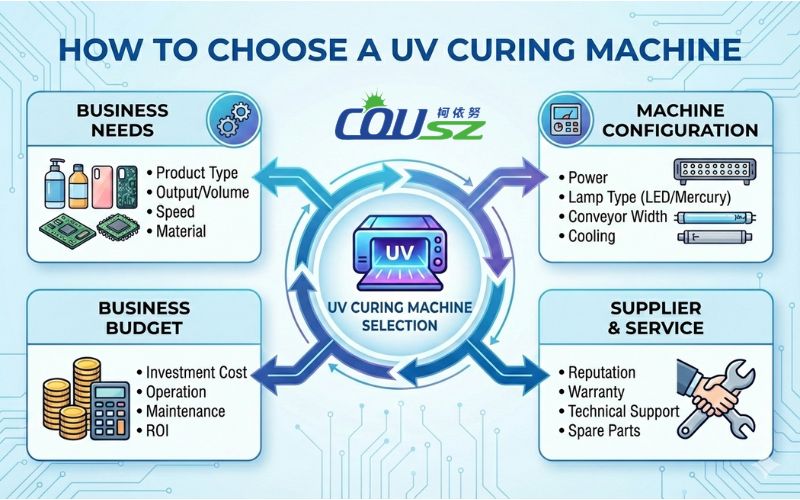
This is undeniably the very first step in any reliable Guide to choosing a UV curing system. You must comprehensively answer these fundamental questions to establish a baseline:
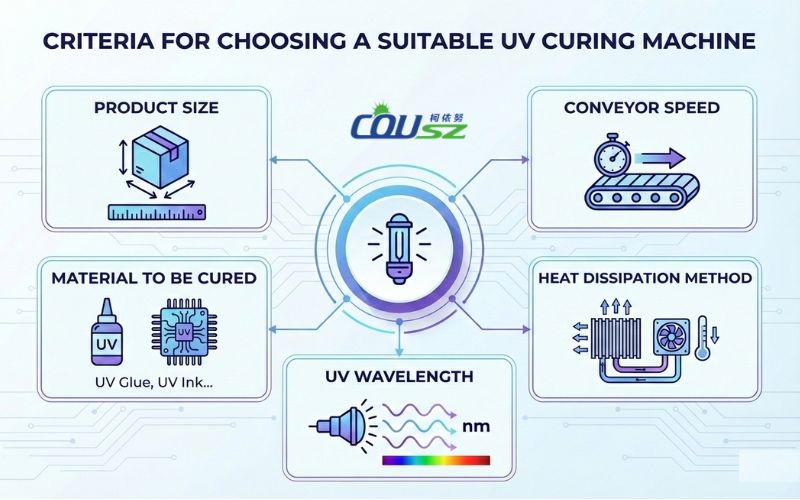
- Target material: Are you curing standard UV adhesive or heavy UV ink? What specific wavelength and optical energy dose are chemically required to dry it perfectly?
- Product dimensions: The designated curing area must entirely cover the glued joint. Miscalculating this spatial dimension creates dangerous “dark zones” where the glue receives absolutely zero photon energy, resulting in liquid pockets.
- Conveyor speed: If your automated assembly belt runs rapidly at 10 meters per minute, the curing system must possess a massive radiant intensity capable of completing the entire photopolymerization process in just a few fleeting seconds.
Clearly defining the core Criteria for selecting a UV curing system during this initial evaluation phase will drastically help you narrow down your list of potential equipment suppliers. Figuring out exactly how to choose a UV curing system begins with knowing your own product inside and out.
2.2 Evaluate the technical configuration
This is the heavy engineering focus when analyzing the Technical specifications of UV curing systems. There are two primary technological generations you must carefully weigh:
- Traditional mercury arc lamps: These feature a much lower initial capital cost and output a broad-spectrum wavelength suitable for many older, legacy adhesives. However, they generate massive, destructive infrared heat and the fragile glass bulbs suffer from an incredibly short lifespan (merely 1,000 – 2,000 hours).
- Advanced UV LED systems: This is the undeniable industry standard for 2026. This solid-state technology offers a vastly superior Experience in purchasing a UV adhesive curing system, boasting incredible lifespans up to 30,000 hours, instant ON/OFF capabilities without warm-up times, and absolutely zero toxic Ozone generation.
When you sit down to meticulously review the Technical specifications of UV curing systems on a manufacturer’s datasheet, you must pay extreme attention to:
- Wavelength (nm): Is it 365nm, 385nm, or 395nm? This specification must perfectly match the absorption spectrum of your specific chemical glue.
- Irradiance (mW/cm²): This peak optical intensity directly dictates the surface drying speed.
- Accumulated dose (mJ/cm²): This total energy volume dictates the depth of the chemical cross-linking within thick resin layers.
2.3 Analyze operating costs and project budget
Never exclusively look at the upfront sticker price of the machinery. A truly professional Guide to choosing a UV curing system will always mandate calculating the Total Cost of Ownership (TCO) over a 5-year span.
The true, long-term Operating costs of UV adhesive curing systems encompass several hidden variables:
- Electricity consumption: Modern LED arrays can slash your factory’s electrical draw by up to 70% compared to energy-hogging mercury ovens.
- Consumables: Calculate the recurring costs of buying replacement quartz lenses, cooling fluids, or fragile mercury bulbs.
- Routine maintenance: High-power water-cooled systems operate with incredible thermal stability but require periodic Chiller maintenance, whereas air-cooled systems are cheaper but highly susceptible to factory dust accumulation.
👉 Learn how to elevate your manufacturing lines:
Understanding UV Curing Systems and their key benefits
According to seasoned industrial financial analysts, heavily investing in premium LED technology typically yields a highly lucrative Return on Investment (ROI) in merely 12 to 18 months, primarily due to vastly reduced Operating costs of UV adhesive curing systems.
2.4 Assess safety features and compliance standards
Industrial machinery must legally achieve stringent global certifications such as CE, RoHS, or ISO radiation safety standards. For the physical protection of the factory workers operating the line, the equipment must be robustly equipped with dark UV shielding cabinets and automated safety interlock sensors to prevent any harmful skin and eye exposure. Assessing these safety mechanisms is a non-negotiable step when determining how to choose a UV curing system.
3. Common mistakes to avoid when buying equipment
Based on our extensive, hands-on consulting Experience in purchasing a UV adhesive curing system with thousands of global clients, COUSZ has identified that many enterprises still fall victim to basic, highly avoidable procurement errors:
- Mistake 1: Focusing only on electrical wattage (W). A machine pulling 2000W of wall power does not automatically mean it cures better than a 500W unit. The optical conversion efficiency is what truly matters. You must focus solely on the actual radiant intensity measured hitting the product surface.
- Mistake 2: Ignoring the thermal cooling system. Many buyers share their painful Experience in purchasing a UV adhesive curing system where the wavelength “drifts” or the expensive LED chips burn out completely after just one month. The root cause is almost always a cheap, underpowered cooling system that allows the semiconductor junction temperature to exceed safe limits (>60°C).
- Mistake 3: Failing to run physical samples before purchasing. Every single adhesive formulation features unique chemical properties. The absolute safest method for how to choose a UV curing system is to mail your actual physical product and glue samples directly to the manufacturer’s laboratory for live testing and precise parameter measurement.
- Mistake 4: Chasing ultra-cheap, unbranded machines. Floating, grey-market machines often print completely fake Technical specifications of UV curing systems on their brochures. They lack genuine replacement parts, leading to agonizingly long factory downtime when even a minor component fails.
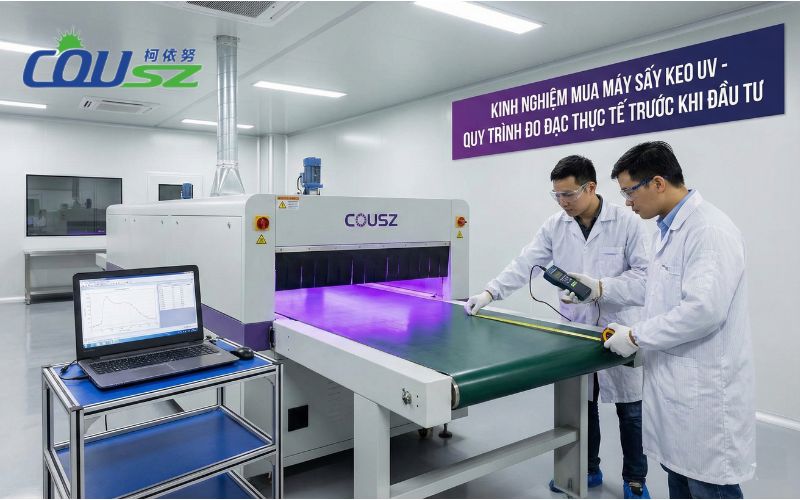
Always remember that actively learning from the deep Experience in purchasing a UV adhesive curing system provided by highly reputable engineering firms will help you completely avoid these disastrous hidden cost traps. Once you firmly grasp how to choose a UV curing system, you will negotiate with suppliers with absolute technical confidence.
4. Faqs – common questions about equipment selection
How do you calculate the required curing area size for your products?
You must meticulously measure the maximum physical width of the liquid adhesive track on your component and deliberately add a 10% to 20% safety margin. For example, if your product’s glue line is 100mm wide, you should procure a lamp head with an effective emitting length of at least 120mm. This ensures the photon energy at the extreme edges remains uniformly high. A highly valuable piece of Experience in purchasing a UV adhesive curing system is to always buy a slightly larger irradiation area to future-proof your line for larger upcoming product iterations.
What does the operating cost of a UV curing system include?
Beyond standard electricity (which is a massive burden for mercury lamps but extremely minimal for LED arrays), you must heavily budget for consumable parts (replacing fragile mercury bulbs every 1,000-2,000 hours), dedicated cooling system maintenance (topping up pure coolant, replacing air filters), and eventual spare parts. Successfully optimizing the long-term Operating costs of UV adhesive curing systems begins strictly at the procurement phase by selecting a high-durability, premium machine.
What are the key operating cost components of UV curing systems?
The core financial components are energy draw, consumable replacements, and mechanical downtime. When you correctly establish your Criteria for selecting a UV curing system and invest in solid-state LED technology, you effectively eliminate bulb replacement costs and slash your energy bills. Lowering these key operating components ensures a rapid ROI and higher overall factory profitability.
5. Contact cousz for expert technical consultation
Understanding exactly how to choose a UV curing system does not have to be a stressful, risky gamble. If your enterprise is currently standing at the precipice of a massive new installation project, or you desperately need to upgrade a failing legacy curing line, let the elite engineering team at COUSZ stand by your side.
We provide comprehensive factory audits, highly accurate technical documentation, and completely free on-site sample testing to prove our machine’s capabilities. Maximize your production yield today!
👩💼 Senior Technical Consultant: Ms. Yuna
📱 Zalo / WhatsApp / Wechat / Tel: (84) 965 535 348
📧 Email: sales03@cousz.com
🌐 Website: cousz-vn.com
🏢 Headquarters: Ngo Xa Village, Phat Tich Commune, Bac Ninh Province, Vietnam.