中文 (中国)
 Tiếng Việt
In booming industrial hubs, selecting the right photopolymerization equipment is critical. However, many factory managers lose massive amounts of capital by falling for myths about UV curing technology. By understanding the true photophysics behind this equipment, you can optimize your production line and guarantee absolutely flawless product quality.
1. Why is understanding the myths about UV curing technology crucial?
In the highly competitive landscape of Industry 4.0, particularly within massive manufacturing centers like Bac Ninh and Binh Duong in Vietnam, ultraviolet drying technology acts as the primary “driver” for maximizing assembly line productivity. However, a severe lack of deep technical knowledge frequently leads to catastrophic purchasing decisions.
The high cost of technical misunderstandings
The transition from highly toxic, outdated mercury arc lamps to modern, energy-efficient UV LED curing systems is an undeniable technological leap forward for the global manufacturing sector. According to extensive peer-reviewed research published by RadTech International, deploying a solid-state LED architecture can phenomenally improve chemical cross-linking efficiency by up to 30%, but only if it is configured perfectly to match the substrate.
Unfortunately, the thin boundary line between a highly profitable UV curing equipment investment and a devastatingly expensive factory failure usually lies in understanding the core optical physics of the hardware. By clearing up these myths about UV curing technology, you ensure your capital expenditure directly translates into higher yield rates and zero product defects on the conveyor belt.
2. The first of the myths about UV curing technology: 365nm is always best
When selecting equipment, factory engineers often fall into the dangerous “one-size-fits-all” mindset regarding optical wavelengths.
Matching wavelengths to photoinitiators
This is perhaps the most widespread of all myths about UV curing technology. A massive number of procurement engineers falsely assume that the 365nm wavelength is the ultimate “gold standard” simply because it possesses the absolute highest photon energy within the standard UVA spectrum. In the actual realm of physical chemistry, the optimal LED wavelength depends entirely on the specific absorption spectrum of the photoinitiators mixed inside the glue, as well as the physical thickness of the applied chemical layer.
- 365nm: This extremely energetic wavelength is phenomenal for instantly curing the top surface of adhesives and is perfect for ultra-thin, highly transparent coatings used in medical glass bonding.
- 385nm and 395nm: Because these photons possess a slightly longer wavelength, they boast a significantly higher physical penetration depth. They can successfully drive through incredibly thick layers of resin or heavily pigmented industrial inks where 365nm light would simply bounce off or be blocked.
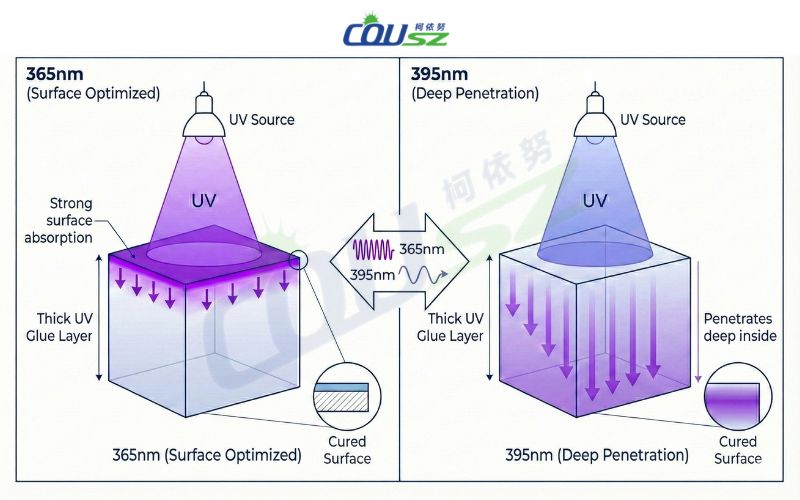
According to Professor J.P. Fouassier, a globally recognized leading expert in photochemistry, if you mistakenly utilize a 365nm light source to cure a massive 2mm thick layer of heavy industrial adhesive, 100% of the photon energy will be violently absorbed at the very top surface. This leaves the entire bottom layer completely liquid and unreacted, which inevitably causes catastrophic peeling and structural failure after the product is packaged and shipped.
3. Another of the myths about UV curing technology: watts equal performance
When evaluating hardware quotes, purchasing departments frequently make a massive technical error by only looking at the electrical wattage printed on the machine’s external label.
Differentiating electrical draw from useful output
Buying machines based on electrical wattage is one of the most expensive myths about UV curing technology. This is a disastrous confusion between “Total Electrical Power Consumption” and “Useful Optical Radiation Output”. In the world of photopolymerization, the actual performance relies heavily on UV light intensity (irradiance), not the electricity pulled from the factory wall socket.
The true, usable power of the system must be strictly measured in Peak Irradiance (mW/cm²) and Accumulated Energy Density (mJ/cm²). A cheap machine that consumes a staggering 1000W of electricity but features terrible thermal management and low-grade quartz glass can easily produce a much weaker optical output than a highly optimized, premium 500W machine. To guarantee flawless chemical cross-linking, you must force the supplier to provide the exact irradiance metric at a highly specific working distance (for example, guaranteeing 1500 mW/cm² at exactly a 10mm gap). This measurable optical output is the only metric that dictates the true speed of your assembly line.
👉 Discover how to drastically improve your assembly line speed:
Overview of UV curing technology systems and applications
4. Heat-related myths about UV curing technology: leds are entirely cold
Marketing brochures frequently and aggressively advertise solid-state LED systems as a magical “cold light source.” While partially true, this statement is highly misleading without context.
Managing junction temperatures effectively
Addressing these thermal myths about UV curing technology is critical to preventing sudden machine failure. It is a scientific fact that LEDs do not emit infrared (IR) radiation, meaning they will not project burning heat across the air onto the surface of your delicate plastic product like an old mercury arc lamp does. However, the internal semiconductor chip itself generates an absolutely massive amount of thermal energy during operation.
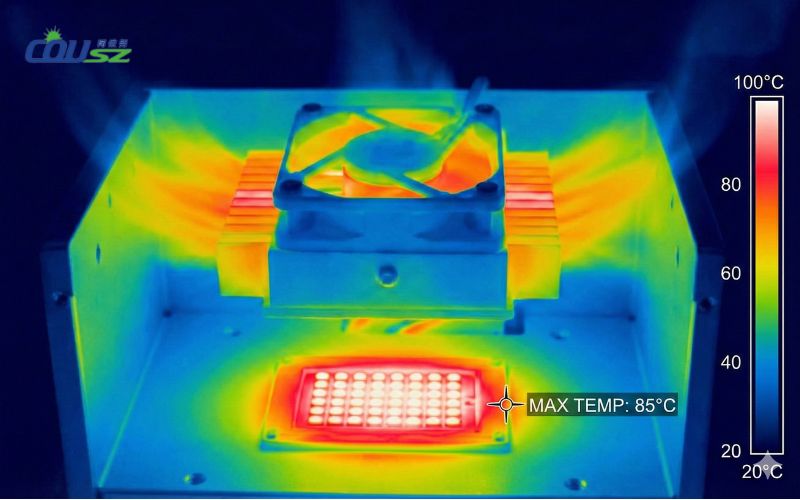
According to the laws of thermodynamics, approximately 60% to 70% of the raw electrical energy fed into an LED chip is instantly converted into destructive heat right at the microscopic P-N junction. If the internal temperature of this LED junction exceeds the manufacturer’s strict safety threshold (which is typically around 80°C), the semiconductor will rapidly degrade. This thermal degradation causes the optical intensity to plummet permanently, ruining your production speed. High-quality UV LED curing systems require robust chillers or massive high-speed cooling fans to survive. Maintaining a perfectly stable junction temperature is the ultimate secret to preserving a uniform optical output over the machine’s entire 20,000-hour lifespan.
5. Datasheet myths about UV curing technology: perfect lab conditions
Relying exclusively on glossy marketing PDF datasheets to configure your factory’s production line is a recipe for severe operational disaster.
Why live factory sampling is mandatory
You must look past paper myths about UV curing technology and test the equipment in the real world. The glorious optical specifications printed on a chemical glue’s datasheet are always meticulously measured inside a pristine, climate-controlled laboratory. They assume a perfect microscopic working distance, exactly 25°C ambient room temperature, and absolutely zero airborne dust particles.
In stark contrast, the brutal reality of an active industrial manufacturing floor in Vietnam involves high humidity, aggressive temperature fluctuations, heavy airborne particulate matter, and unstable electrical grid voltages. All of these chaotic environmental variables will negatively skew the curing results. Protect your UV curing equipment investment by running live physical samples (sampling) using your actual products on COUSZ demonstration equipment before signing any purchase orders. Integrating this hands-on testing phase completely eliminates the catastrophic risk of generating thousands of defective scrap units later on.
6. Hardware myths about UV curing technology: lenses don’t matter
When analyzing machine quotes, many buyers forget to evaluate the UV curing optical lens, assuming the raw LED diodes are the only components that actually matter.
The critical function of optics
Ignoring optics is one of the most destructive myths about UV curing technology. The optical array is the literal “soul” of the machine. A raw, naked LED chip naturally emits its photons in a highly divergent, wide-angle scattered beam (typically spreading out at a 120-degree angle). If you operate the machine without a premium quartz lens, the photons will wildly scatter into the surrounding air, causing the optical intensity hitting the actual glue target to drop to near zero.
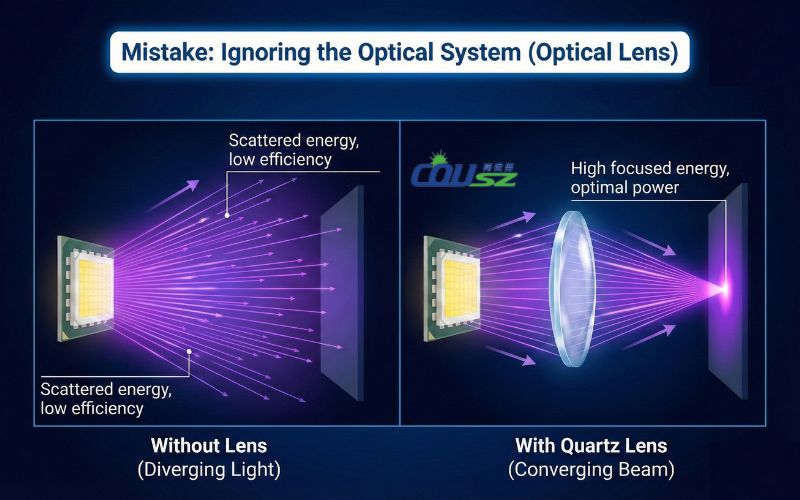
A premium UV curing optical lens gathers diverging photons and forces them into a highly concentrated, parallel beam. This precision focusing drastically amplifies the peak irradiance without requiring you to consume any additional electricity. It guarantees that the energy distribution remains flawlessly uniform across the entire width of the conveyor belt. If a manufacturer uses cheap, low-grade plastic lenses to cut costs, the intense ultraviolet radiation will quickly turn the plastic yellow and cloudy, permanently blinding the machine.
7. Faqs – clarifying the myths about UV curing technology
Below are the most frequently asked questions we receive from factory engineers who are actively trying to optimize their assembly lines.
7.1. Why is the lamp still on, but the ink is not curing?
This is a classic symptom of severe LED “aging” or thermal degradation. To the naked human eye, the machine still appears to be glowing with a bright purple light (which is just the visible spectrum bleed-off). However, the actual invisible ultraviolet wavelength intensity has likely plummeted far below the chemical activation threshold required by the photoinitiators in the ink. Without measuring the actual UV light intensity, you cannot diagnose this. You must use a professional radiometer weekly to track degradation.
7.2. What do the wattage numbers on the machine label indicate?
The wattage number strictly indicates the raw electrical power the machine will draw from your factory’s electrical grid, which helps your facility electricians size the correct circuit breakers and wiring. It absolutely does not directly reflect the speed or power of the curing process. You must always request the Irradiance (mW/cm²) metric to evaluate true performance.
7.3. How important is the UV curing optical lens for a curing machine?
It acts as the primary steering wheel for the photons. An LED system lacking a proper optical lens is exactly like a bare lightbulb illuminating an entire room—the energy is scattered everywhere and highly diluted. A system equipped with a high-purity quartz lens acts like a focused laser pointer, concentrating all the available destructive energy precisely onto the microscopic drop of adhesive where it is desperately needed.
7.4. Why does LED UV generate heat despite being a cold source?
LEDs do not emit infrared (IR) wavelengths, so they do not radiantly heat up the product sitting 10mm away from the lamp. However, the semiconductor base of the chip itself experiences massive electrical resistance, converting roughly 60% of the input power directly into localized heat. If the aluminum heat sinks or water chillers fail to remove this localized heat, it will back up into the machine head, destroying the delicate internal soldering and ruining the diode.
8. Conclusion: move past the myths about UV curing technology
Mastering photopolymerization requires looking past outdated industry rumors. By discarding these false myths about UV curing technology, enterprise managers can confidently select the exact wavelengths, demand proof of optical irradiance, and ensure massive thermal stability for their assembly lines. Maximize the ROI of your UV curing equipment investment with data-driven engineering.
To upgrade to genuine UV LED curing systems, contact the expert technical team at COUSZ Vietnam. We provide free factory audits, live sample testing, and exact radiometer measurements to guarantee your success.
👩💼 Senior Technical Consultant: Ms. Yuna
📱 Zalo / WhatsApp / Wechat / Tel: (84) 965 535 348
📧 Email: sales03@cousz.com
🌐 Website: cousz-vn.com
🏢 Headquarters: Ngo Xa Village, Phat Tich Commune, Bac Ninh Province, Vietnam.