中文 (中国)
 Tiếng Việt
 한국어
한국어
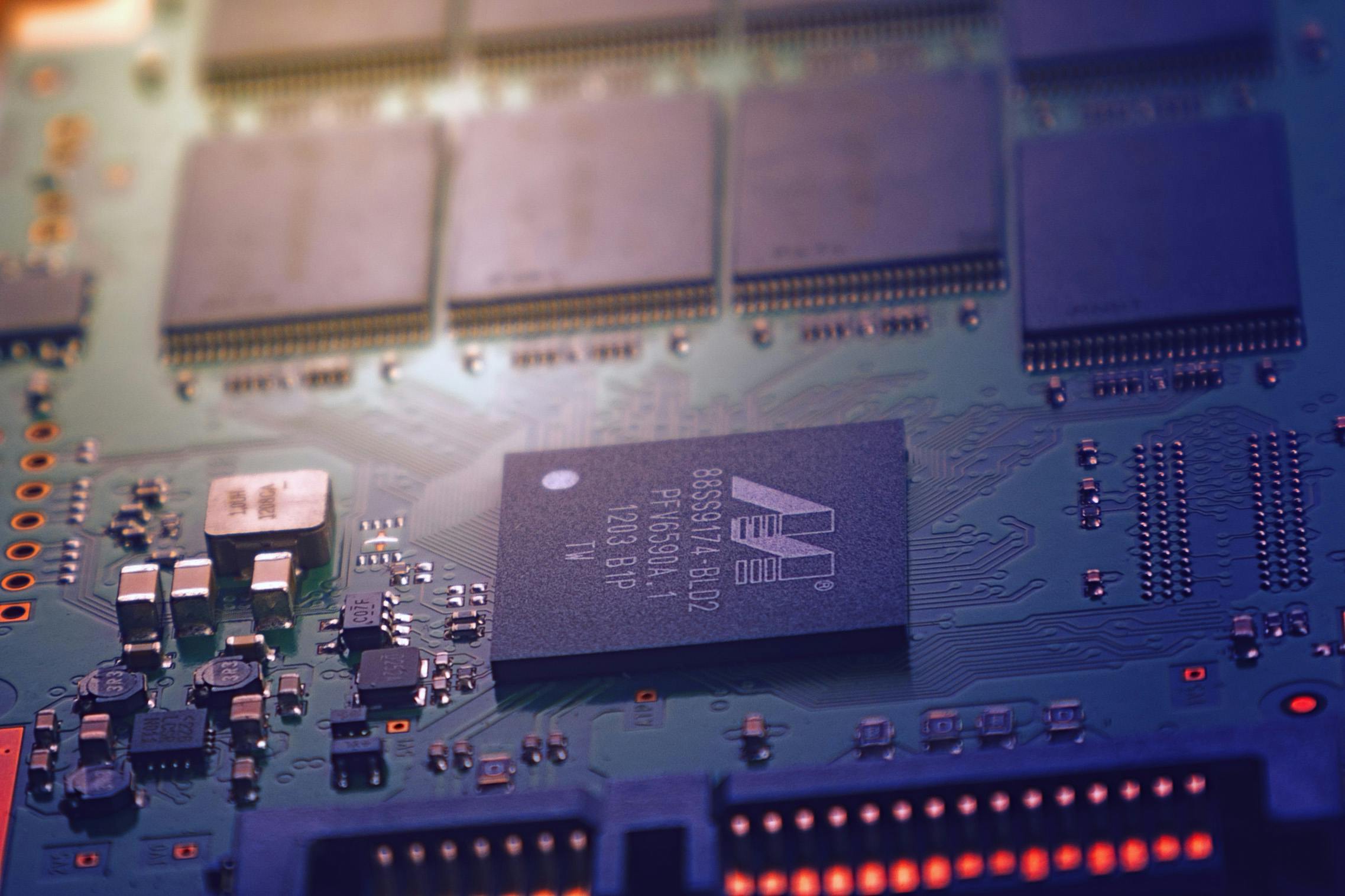
In modern manufacturing, product quality depends not only on materials or assembly processes, but also on surface preparation. Whether for painting, gluing, soldering, or coating, a properly cleaned and activated surface is the deciding factor for ultimate durability and performance. Traditional methods often reveal many limitations in terms of efficiency, safety, and cost. That is when plasma surface treatment technology becomes a breakthrough solution. Let’s delve deeper into this advanced technology.
1. What is Plasma Surface Treatment?
Plasma is often defined as the fourth state of matter. While everyone understands the first three states of matter—solid, liquid, and gas—plasma is generally less known. Simply put, plasma is an ionized gas, meaning a gas that contains free electrons and positive ions.
Plasma Modification (or Plasma Surface Treatment) is the use of plasma to effectively remove contaminants from the surface of an object. This is an environmentally safe process because it does not emit toxic chemicals in significant quantities. It can easily remove organic substances because the plasma cleaning process is capable of breaking the organic bonds of contaminants on the surface to be removed.
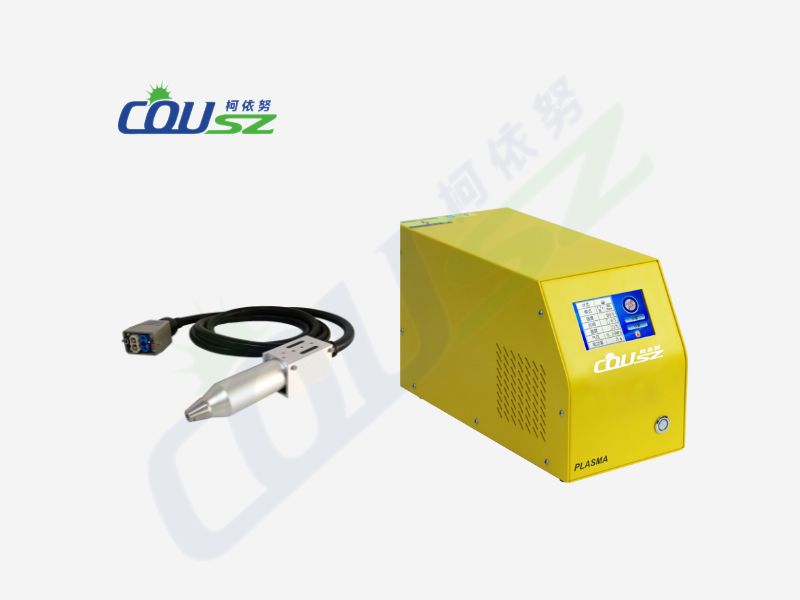
2. How does a Plasma Surface Treatment Machine work?
The objects to be cleaned are placed into a vacuum chamber. The vacuum chamber is usually a metal chamber where all the air is pumped out by a vacuum pump until the desired vacuum level is reached. For plasma cleaning applications, the vacuum level typically ranges from 0.1 – 1.0 mbar (75 – 750 mTorr).
After the correct vacuum level is established, one or more process gases are introduced into the plasma chamber. These gases will be the raw materials for creating plasma (ionized gas).
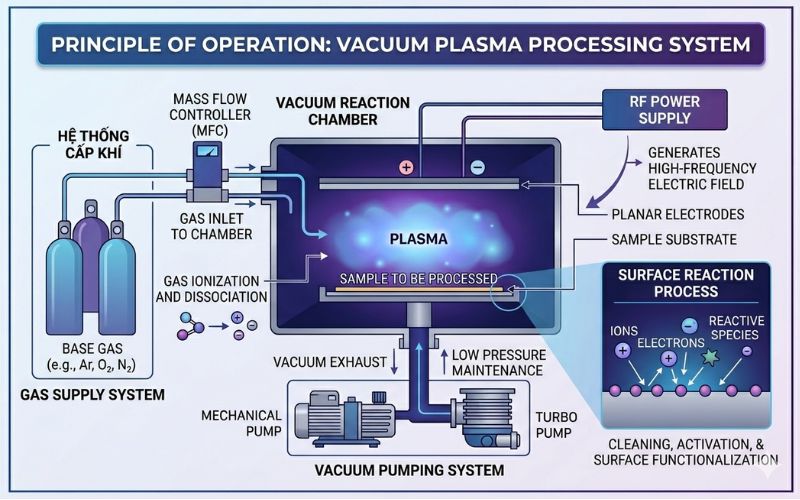
To generate plasma, a power source is used. This power source can be:
- DC (Direct Current)
- MW (Microwave at 2.54 GHz)
- RF (Radio Frequency, typically 13.56MHz)
The power source has the ability to break down and ionize the process gas, creating plasma.
The highly reactive plasma then begins to interact with the object’s surface, particularly with contaminants, breaking their chemical bonds. The byproducts of this physicochemical reaction are smaller organic molecules that can vaporize at the vacuum pressure of the process.
This means that these molecules will leave the object’s surface and immediately enter a gaseous state. They will then be removed through the exhaust stream of the vacuum pump.
Simply put, plasma cleaning equipment vaporizes unwanted contaminants on an object using plasma. This process leaves no dirt, chemicals, or toxins behind.
3. Types of Plasma Surface Treatment Processes
3.1. Oxygen Plasma Cleaning
The oxygen plasma cleaning process generates plasma from pure oxygen gas. The characteristic of Oxygen plasma is its high oxidizing capability. This means it will easily break down organic contaminants through chemical reactions similar to combustion.
Because of its high oxidizing nature, Oxygen plasma should not be used when the object to be cleaned is made of sensitive materials like copper or silver, or generally when the object should not have an oxide layer after the plasma cleaning process.
3.2. Hydrogen Plasma Cleaning
The hydrogen plasma cleaning process generates plasma from pure hydrogen gas. The characteristic of Hydrogen plasma is its high reducing capability, which is the exact opposite of Oxygen plasma.
Although Hydrogen plasma creates a reducing environment, it can still be used to remove organic contaminants. The chemical process may be different, but the overall mechanism is the same: Hydrogen plasma will create smaller molecules that evaporate from the object’s surface and are removed by the gas flow.
An important application of Hydrogen plasma is oxide removal. Because Hydrogen plasma promotes reduction reactions, it can reverse oxidation reactions that lead to the presence of oxide layers on surfaces. For oxidized metals, this means that after treatment with Hydrogen plasma, the metal will return to its pure form, exposing the original surface.
3.3. Argon Plasma Cleaning
Argon plasma cleaning is slightly different from Oxygen or Hydrogen because Argon plasma does not react chemically with organic contaminants, but only exchanges energy through inelastic collisions.
Argon is a heavy element compared to carbon, oxygen, or nitrogen – the components of organic pollutants. The positive Argon ions present in Argon plasma can be accelerated and directed at the organic contaminant, breaking it down into smaller molecules. These molecules, just like in other processes, vaporize and are removed by the gas flow.
The Argon plasma cleaning process, with some minor variations, is the most widely used process in the semiconductor and automotive industries. The Argon plasma process provides outstanding results in terms of adhesion.
4. How is the plasma surface treatment process carried out?
The basic plasma modification process consists of 5 main steps, performed in a closed system to ensure maximum efficiency.
- Material preparation: The objects to be cleaned are placed into the plasma treatment chamber.
- Establishing a vacuum environment: The chamber is evacuated to remove air and impurities. The ideal vacuum level is usually between 0.1 – 1.0 mbar.
- Introducing process gas: A small amount of gas (Oxygen, Hydrogen, Argon, etc.) is introduced into the chamber.
- Activating plasma: A DC, RF, or MW power source is applied to ionize the gas, creating plasma.
- Interaction with the surface: The plasma reacts with the material surface, breaking down and vaporizing impurities. Byproducts are removed through the vacuum pumping system.
This entire process happens automatically, quickly, and accurately.
5. Outstanding benefits of plasma surface treatment technology
The boom of plasma surface treatment is no accident. This technology offers advantages that traditional methods can hardly match.
- High efficiency: Capable of cleaning at the molecular level, removing even microscopic layers of dirt invisible to the naked eye.
- Environmentally friendly: Does not use toxic solvents or generate hazardous waste, contributing to sustainable manufacturing.
- Safe for materials: The cleaning process is gentle, does not alter structures, and does not scratch or corrode surfaces.
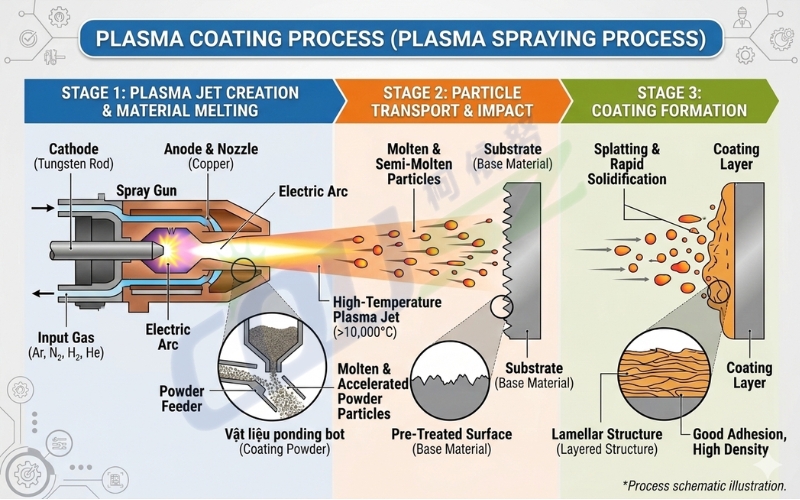
- Enhanced adhesion: Besides cleaning, plasma modification also activates the surface, increasing surface energy and helping paint, glue, or coatings adhere better and last longer.
- Long-term cost savings: Although the initial investment cost is high, minimizing defective products and saving on chemicals and production time significantly reduces operational costs.
6. Comparison of plasma surface treatment with traditional methods
To see the differences more clearly, let’s compare plasma technology with two other popular methods:
| Criteria | Plasma surface treatment | Chemical cleaning | Mechanical cleaning (sanding) |
|---|---|---|---|
| Efficiency | Very high, at the molecular level | Medium to high | Depends on skill |
| Safety | Very high, non-toxic | Can be harmful to humans and the environment | Can damage the surface |
| Impact on surface | Does not alter structure | Can cause corrosion, leave residue | Can cause scratches, deformation |
| Cost | High initial, low long-term | High operating and waste disposal costs | Low cost |
| Flexibility | Broad, for many types of materials | Depends on the type of chemical | Limited, only applies to certain materials |
7. Practical applications of Plasma Surface Treatment technology
Thanks to its outstanding advantages, this technology is widely applied in many key industries:
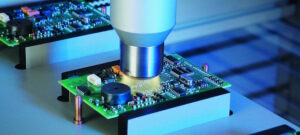
- Electronics & Semiconductor Industry: Cleaning circuit boards (PCBs), microchips, and screens before soldering or packaging, ensuring good electrical connection and high durability.
- Medical Industry: Sterilizing surgical instruments, cleaning implant surfaces to increase biocompatibility with the body.
- Automotive Industry: Surface preparation of plastic and metal parts before painting or gluing, keeping the coating durable and preventing peeling.
- Aerospace Industry: Cleaning composite and lightweight metal parts before applying special protective coatings, ensuring material integrity in extreme conditions.
- Textile Industry: Activating fabric fiber surfaces to increase dye adhesion, improving dyeing and finishing efficiency.
8. Why choose COUSZ brand Plasma Surface Treatment machines?
The COUSZ brand has affirmed its position in the market with high-quality Plasma machines, optimal designs, and competitive prices. Some highlights include:
- Stable quality, high durability
- Free consultation on machine selection, tailored to actual production needs
- Clear warranty, fast technical support
Do not hesitate to contact us today to receive a free technical consultation and a special quote from our team of experts.
 Hotline: 0965 535 348 – 0964 039 248 (Ms. Yuna / Ms. Hina)
 Email: sales03@cousz.com
 Website: https://cousz-vn.com/
 Nationwide Delivery – Genuine Warranty!