中文 (中国)
 Tiếng Việt
 한국어
한국어
1. How to utilize this UV Meter Buying Guide to optimize your investment?
In today’s highly competitive manufacturing market, equipment prices vary drastically, ranging from a few hundred to several thousand dollars. This massive discrepancy does not stem from external appearances, but rather from optical spectral precision, thermal endurance, and integrated sensor technology.
1.1. Analyzing common price segments
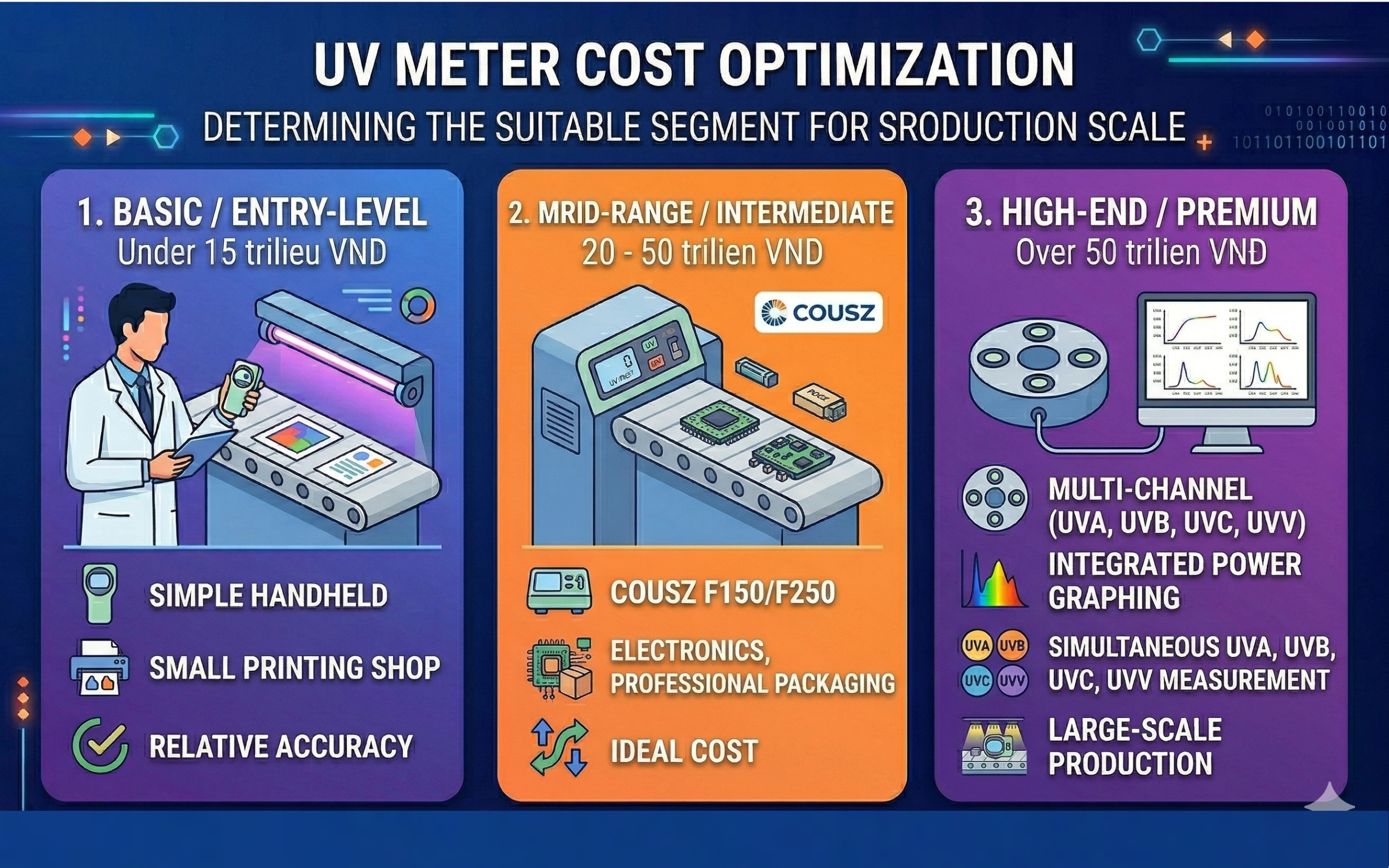
To effectively manage UV measurement system costs, enterprises must clearly identify the equipment tier that perfectly matches their production scale. A crucial part of this UV Meter Buying Guide is understanding the three main categories:
| Market Segment | Estimated Budget | Typical Industrial Application |
|---|---|---|
| Entry-Level | Under $600 | Basic handheld devices with relative accuracy. Suitable for quick spot-checks in very small print shops. |
| Mid-Range | $800 – $2,000 | Models like the COUSZ F150 or F250. This is the ideal tier for professional electronics manufacturing and packaging. |
| High-End | Over $2,000 | Multi-channel radiometers (e.g., UV Power Puck II) measuring UVA, UVB, UVC, and UVV simultaneously with data graphing. |
1.2. Secrets to optimizing your capital expenditure
Optimizing your investment does not mean purchasing the absolute cheapest device available; it means acquiring the most suitable one. According to rigorous metrology research from the Rochester Institute of Technology (RIT), utilizing a measurement device with a high error margin can artificially increase product defect rates by up to 12%. If your daily production batch is worth hundreds of thousands of dollars, “saving” a few hundred dollars on an inferior tool will quickly transform into a massive financial loss.
Therefore, understanding UV meter pricing is vital. Our expert advice: Always select a device whose spectral response band perfectly matches your light source (Mercury or LED). Purchasing the wrong wavelength band will force you to buy a second device, doubling your expenses unnecessarily.
2. Where to find a reliable UV meter supplier?
Navigating through the complex “matrix” of counterfeit goods, unauthorized resellers, and gray-market imports can be overwhelming. Finding a legitimate address to optimize your long-term costs is critically important. A reputable unit does not merely sell you a machine; they sell you absolute peace of mind.
For more detailed strategies on managing these expenses, please read our dedicated article: UV Meter Pricing: How to Optimize UV Measurement System Costs for Your Business.
2.1. Crucial supplier selection criteria
A truly reliable UV meter supplier must easily meet the following rigorous industrial standards:
- In-depth technical support: They must possess the engineering capability to advise you on proper measurement techniques and correct sensor placement to prevent thermal damage to the optics.
- Local calibration services: Shipping a device overseas for annual calibration is slow and expensive. Choose an entity connected with certified laboratories within your country.
- Readily available spare parts: Prevent the disaster of replacing an entire machine just because a single LCD screen or connection cable was damaged.
2.2. Cousz vietnam – your trusted measurement partner
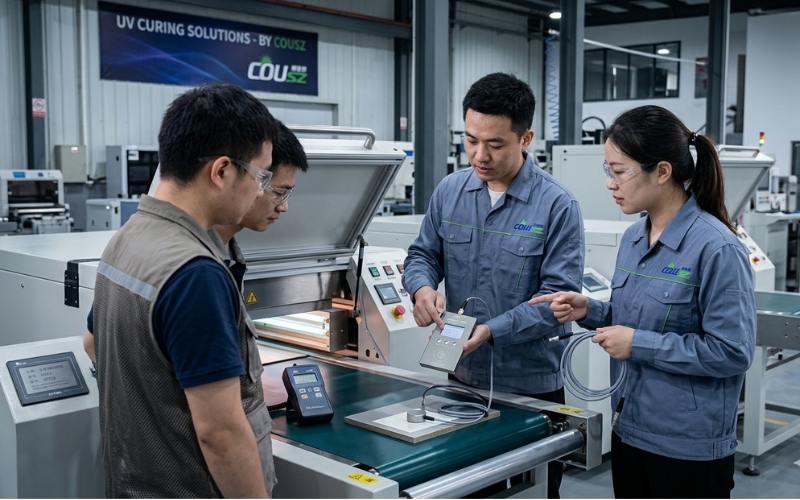
In the Vietnamese market, COUSZ is proud to be the pioneer in providing comprehensive metrology solutions. We help clients optimize their budgets through highly competitive pricing policies, professional maintenance services, and a team of engineers with profound knowledge of curing technology. When you choose COUSZ, you are not just getting a great price; you are securing lifelong technical companionship.
3. What is the cost analysis of initial investment vs operational expenses?
Many purchasing managers only look at the initial quotation number and completely forget about “hidden costs.” A comprehensive financial overview must include long-term maintenance.
3.1. Annual calibration fees
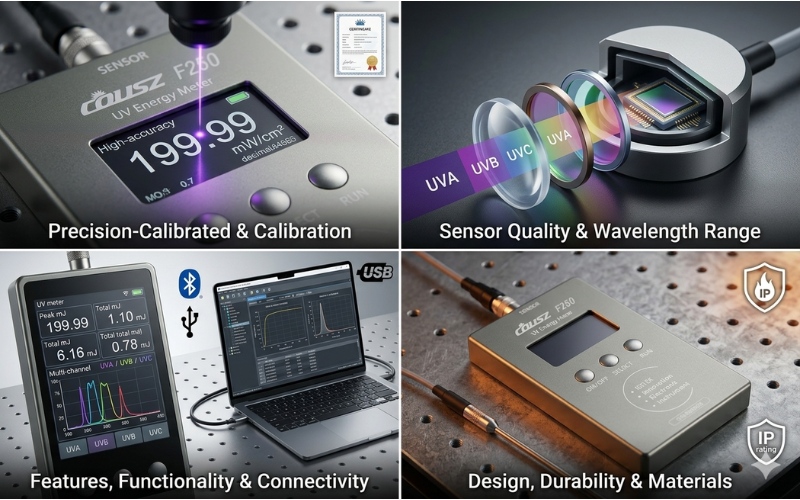
Every optical measurement device undergoes sensor “aging” (solarization) due to direct exposure to high-intensity ultraviolet rays. According to strict ISO 9001 quality management standards, equipment must be formally calibrated every 12 months. A hidden factor in UV meter pricing is the recurring annual calibration fee. Genuine COUSZ devices feature streamlined calibration procedures, saving you significant operational funds year after year. Following a solid UV Meter Buying Guide means always factoring this into your 3-year budget.
3.2. Repair and sensor replacement costs
Ultraviolet sensors are fundamentally consumable components. After approximately 2 to 3 years of high-power usage, their optical sensitivity will inevitably decrease. Selecting a provider that offers individual sensor replacements—rather than forcing you to buy a completely new main unit—will cost you only about 30% of the price of a brand-new machine.
4. What is the financial impact of lacking measurement tools?
To truly understand why the initial investment is worthwhile, we must examine the severe risks of operating “blind” without metrology equipment.
Hidden losses in your production line
Operating without a meter can escalate your overall UV measurement system costs immensely in ways you might not immediately notice:
- Electrical energy waste: You might be running your lamps at 100% power when only 70% is actually required to cure the adhesive. The electricity saved over a single year can easily pay for a high-end radiometer.
- Shortened bulb lifespan: Forcing lamps to run at maximum overload because you do not know the actual output parameters will burn out expensive bulbs much faster.
- Destroyed brand reputation: A single shipped batch that gets rejected due to “peeling adhesive” or “uncured ink” will cause financial damages hundreds of times greater than the cost of a meter.
Professor R.W. Stowe, an eminent expert in photochemical technology, famously affirmed: “Measurement is not a cost; measurement is a savings.” As highlighted in every professional UV Meter Buying Guide, measuring your process empowers you to master your profit margins.
5. How to follow a 5-step UV Meter Buying Guide for the best price?
If you are still hesitant about procurement, strictly apply this systematic workflow to guarantee success.
The professional procurement workflow
- Determine the exact spectrum: Are your lamps Mercury (broadband UVA/B/C) or LED (narrowband 395nm)? Choose the exact matching waveband to avoid wasting capital.
- Assess the measuring environment: If you measure inside a high-temperature conveyor oven, the machine absolutely must have thermal resistance (a puck design). Do not buy a cheap plastic handheld unit that will melt on the first pass.
- Request an on-site demo: Reputable companies are always willing to let you test the equipment on your actual factory floor to prove its accuracy.
- Compare total ownership costs: Compare the 3-year total cost (Purchase Price + Annual Calibration Fees + Battery/Sensor Replacements).
- Select a local legal entity: This ensures your warranty rights are protected and verifies you are partnering with a reliable UV meter supplier.
Applying this UV Meter Buying Guide step-by-step eliminates guesswork and protects your corporate budget.
6. Contact our experts for technical consultation
Do not let vague numbers affect your critical investment decisions. For an essential addition to your UV Meter Buying Guide, consult our detailed distributor list: Where to Buy Reliable UV Meters? Recommended Authorized Suppliers in Vietnam.
Contact the COUSZ engineering experts immediately to receive a highly detailed, customized cost analysis tailored to your factory:
👤 Ms. Yuna
✨ Technical Specialist – COUSZ Vietnam
📞 Tel/Whatsapp/Wechat/Zalo: (84) 965 535 348
📧 Email: sales03@cousz.com
🌐 Website: www.cousz-vn.com
7. Faqs – common questions about costs and models
1. Why is LED UV meter pricing usually higher than mercury lamp meters?
LED technology emits a very narrow band with incredibly high peak irradiance. This requires the sensor to have highly sophisticated optical interference filters and much faster electronic sampling rates to capture the data accurately. Consequently, manufacturing these sensors costs about 20-30% more than traditional broadband devices.
2. Can I save money by purchasing a second-hand machine?
This carries massive risks. Ultraviolet sensors have a finite “photon lifespan.” A used machine might still turn on and display numbers, but the values could be completely skewed due to severe sensor solarization. The cost to repair and recalibrate a heavily degraded used machine often equals the price of a brand-new unit, significantly increasing your long-term UV measurement system costs.
3. Does the initial price include a calibration certificate?
At COUSZ, all genuine quotations include the factory exit certificate and the initial accuracy test results. However, subsequent annual periodic calibration fees are typically billed as a separate maintenance service.
4. What is the cost difference between single-channel and multi-channel models?
Single-channel machines (e.g., measuring only UVA) have a simpler structural design. Multi-channel machines (like the Power Puck II) integrate four distinct sensors into one body, allowing comprehensive system monitoring. Multi-channel devices can cost 3 to 4 times more, but they provide incredibly deep analytical data for R&D departments.
5. Does COUSZ offer rental programs to reduce upfront costs?
Yes. We offer flexible project-based rental packages for our metrology equipment. This helps enterprises minimize upfront capital expenditure while ensuring their production control quality remains uncompromised, proving once again that we are a reliable UV meter supplier.
Conclusion: Investing in high-precision measurement equipment is the smartest move a visionary production manager can make. By deeply understanding the factors that constitute optical hardware costs, you will select the most durable “companion” for your manufacturing line. Thank you for reading our complete UV Meter Buying Guide.