中文 (中国)
 Tiếng Việt
 한국어
한국어
In the highly competitive landscape of smart manufacturing in 2026, procuring photopolymerization equipment is no longer merely about buying a lamp; it is a critical strategic decision that dictates the efficiency, yield rate, and stability of your entire assembly line. Enterprise managers frequently face a complex dilemma: How do you perfectly balance the initial capital expenditure with long-term cross-linking reliability? This comprehensive UV curing systems buying guide is engineered to dissect the absolute truth regarding equipment pricing, operational expenses, and the “golden criteria” required to identify a legitimate partner.
1. How much does a UV curing system actually cost?
When factory directors initiate the procurement process, the very first question is inevitably about the sticker price. However, successfully navigating an industrial UV equipment investment requires looking far beyond the initial invoice. According to a profound longitudinal study conducted by the Rochester Institute of Technology (RIT), the initial purchase price constitutes a mere 30% of the Total Cost of Ownership (TCO) over the machine’s operational lifecycle. The remaining 70% is heavily dominated by electrical consumption, routine maintenance, and replacing degraded optical components.
1.1 What technical factors directly influence the price?
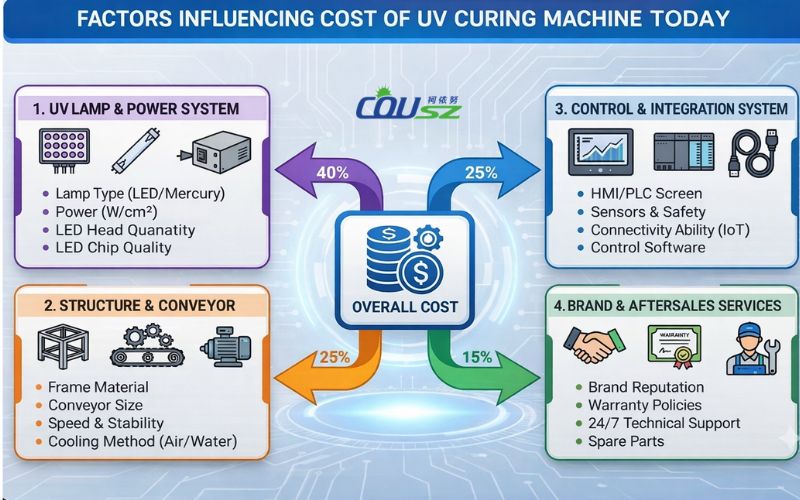
The baseline cost of a professional drying array is strictly governed by three core engineering elements:
- Light source technology: A modern UV LED setup is generally priced 1.5 to 2 times higher than a legacy mercury arc lamp. This price premium is directly attributed to the complex manufacturing process of high-purity semiconductor LED chips. However, this upfront UV LED curing cost is rapidly recovered through massive energy savings.
- Peak irradiance requirements: Machines engineered to deliver extreme radiant intensities (for example, exceeding 20W/cm²) require vastly superior internal components. Handling this immense optical power necessitates highly expensive, ultra-pure quartz lenses and heavy-duty thermodynamic cooling systems (such as industrial water chillers) to prevent the diodes from melting.
- Intelligent control systems: High-end models feature integrated PLCs with real-time radiometric sensors and closed-loop feedback mechanisms. While these advanced digital brains increase the initial price, they guarantee that the Defect Rate (NG) remains effectively at zero by instantly alerting operators to any drop in photon output.
1.2 What are the popular price segments available at cousz?
To help procurement officers easily visualize the market, this UV curing systems buying guide categorizes the standard industrial segments available in 2026:
- Spot curing series: Typically ranging from 15,000,000 to 45,000,000 VND, depending heavily on the number of emitting heads and the complexity of the optical fiber guides. This is the ultimate choice for microscopic medical device assembly and smartphone camera modules.
- Automated conveyor systems: Ranging from 80,000,000 to 300,000,000 VND. The UV LED curing cost in this segment fluctuates based on the physical width of the Teflon belt and the total wattage of the massive overhead flood arrays.
- Customized integrations: Pricing is strictly provided via a bespoke quotation. This applies to highly specific requests involving multi-axis robotic arm integration or heavily shielded, inert-gas curing chambers.
How Much Does UV Curing System Cost? Comparing Costs and Investment Returns
1.3 How do operational expenses compare between technologies?
Many factories tragically opt for the cheapest initial machine, only to be financially devastated by hidden operational expenses. A highly controlled empirical study from 2025 highlights the brutal reality:
Traditional Mercury Lamps: The financial bleeding is continuous. You face the exorbitant recurring cost of replacing shattered, degraded bulbs every 1,000 hours. Furthermore, because these bulbs emit massive amounts of wasted infrared heat, your factory’s air conditioning and ventilation electricity bills will skyrocket.
Modern UV LED Technology: Diodes require absolutely zero warm-up time; they feature “Instant On/Off” capabilities tied directly to conveyor sensors. With an operational lifespan frequently exceeding 30,000 hours, they slash overall electricity consumption by up to 70%. More importantly, this “Cold Curing” technology completely resolves the notorious “H-Heat” problem, preventing thin plastic substrates and delicate electronic films from melting or warping during the industrial UV equipment investment lifecycle.
2. Where can you find a reputable authorized UV curing supplier?
In the fast-paced modern supply chain, purchasing the equipment is only step one. Securing a long-term, highly reliable engineering partner is the true key to manufacturing dominance.
2.1 What is the current market reality in vietnam?
Currently, the Vietnamese industrial equipment market is heavily fragmented into three distinct vendor groups:
- Cheap import traders: These vendors import unbranded, low-grade machinery. They offer tempting prices but absolutely no technical support, no local warranty, and no spare parts when the machine inevitably breaks down.
- Western conglomerates: These brands offer exceptional quality but come with astronomical price tags. Furthermore, waiting for proprietary replacement parts to clear customs from Europe or America can halt your production line for weeks.
- Specialized regional brands like COUSZ: These manufacturers focus entirely on core photopolymerization technology. They maintain massive local warehouses in Vietnam, ensuring rapid part replacement, and offer a price point perfectly optimized for the Southeast Asian industrial market.
Where Can You Buy Reliable UV Curing Systems in Vietnam?
2.2 What are the golden criteria for evaluating an authorized UV curing supplier?
When committing capital to a new assembly line, you must rigorously audit your potential vendor. According to our UV curing systems buying guide, you should evaluate any supplier against these non-negotiable criteria:
- Origins and global certifications: The equipment must be backed by transparent Certificates of Origin and Quality (CO/CQ), alongside strict international safety compliances like CE and RoHS.
- Deep technical consulting capacity: Test their engineers. Can they clearly and mathematically explain the critical difference between Peak Irradiance (mW/cm²) and Accumulated Energy Dose (mJ/cm²)? If they cannot, they do not understand photochemistry.
- Live sampling and demo capabilities: A highly legitimate authorized UV curing supplier will actively encourage you to bring your physical adhesive and substrates to their lab for live empirical testing before you sign a contract.
- Ironclad after-sales service: They must legally commit to providing on-site technical support within 24 hours and guarantee a robust local inventory of replacement LED chips and digital drivers.
- Customization prowess: Can their engineering team redesign the physical optical brackets or focal lenses to perfectly integrate with your factory’s highly specific 6-axis robotic dispensers?
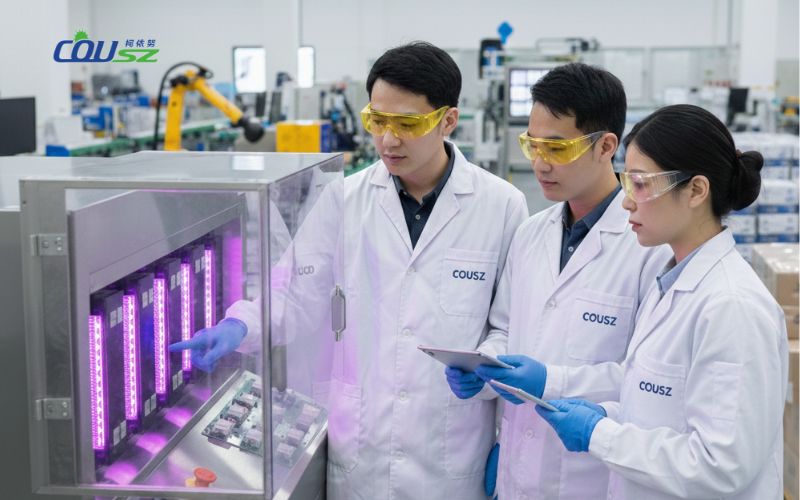
3. Why is COUSZ the leading brand in the market?
The COUSZ brand has rapidly become the gold standard and the ultimate guarantor of quality across major industrial powerhouses like Bac Ninh, Thai Nguyen, and Binh Duong.
What makes the cousz engineering approach different?
We are not merely commercial box-movers. COUSZ specializes in the deep R&D and direct manufacturing of advanced photopolymerization equipment adhering to the strictest international standards.
Our defining competitive advantage lies in our absolute mastery of core semiconductor packaging. Unlike standard vendors who buy generic lamps, COUSZ engineers possess the capability to heavily customize the specific nanometer wavelength and the exact optical focal geometry to perfectly match the chemical absorption rate of your specific adhesive. This bespoke engineering drastically optimizes output power, totally eliminates wasted electrical consumption, and maximizes the operational lifespan of every single diode, fundamentally justifying your UV LED curing cost.
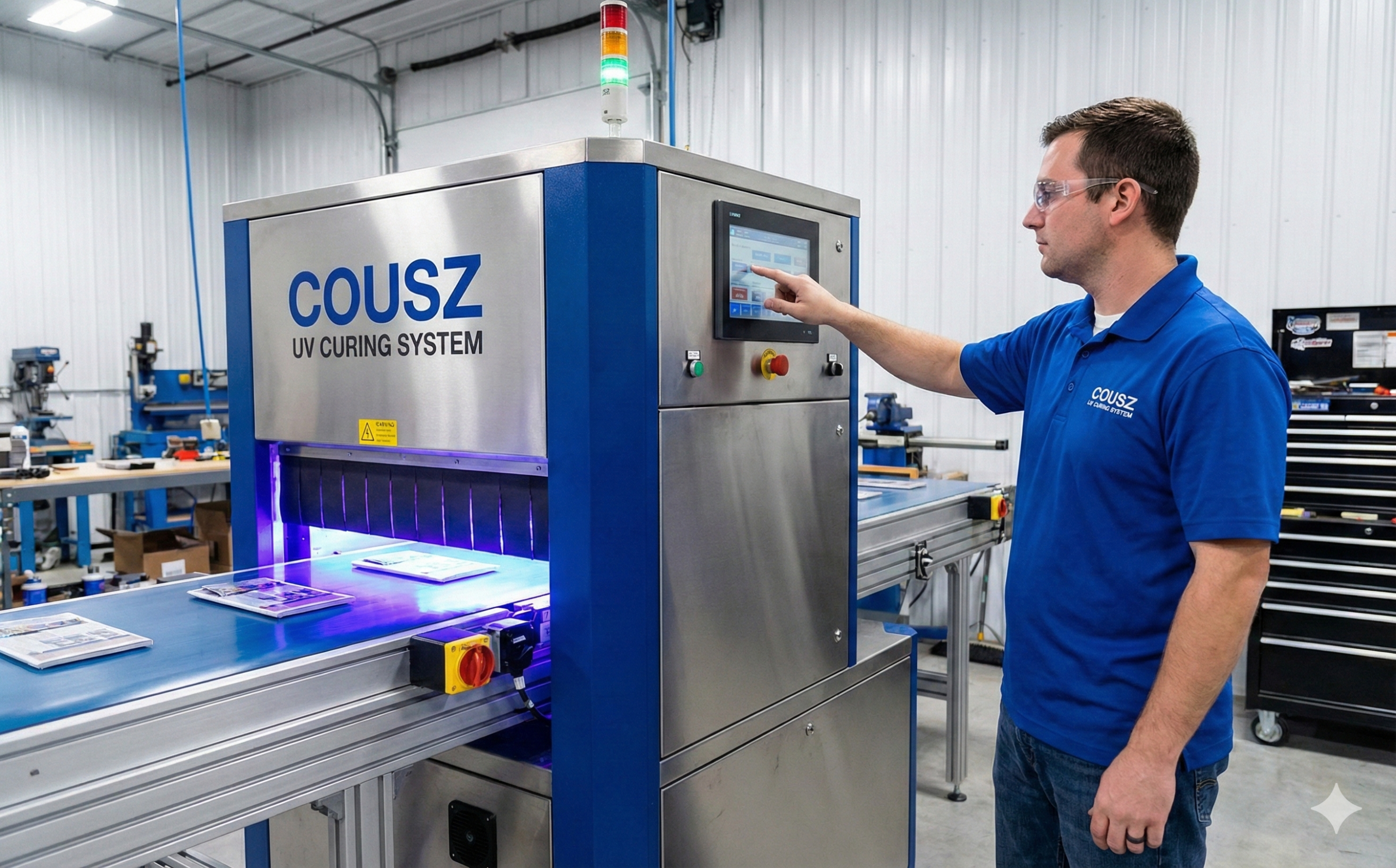
4. Conclusion: making a smart capital investment
Procuring advanced photopolymerization hardware is a critical, long-term industrial UV equipment investment. A superior machine does not merely make your final product look aesthetically better and structurally stronger; it violently asserts your enterprise’s technological superiority in the eyes of stringent international auditors and global partners. By strictly adhering to this UV curing systems buying guide, you empower yourself to be a highly informed investor—choosing the exact right technology and the perfect engineering partner to dominate your manufacturing sector.
5. Faqs about purchasing UV curing equipment
5.1 Why is the UV LED curing cost higher than traditional ovens upfront?
The initial price tag is higher because you are paying for highly advanced, pure semiconductor chips and sophisticated digital thermal management systems. However, because LED systems consume 70% less electricity, require zero warm-up time, and do not need replacement bulbs every few months, the return on investment (ROI) is typically achieved within the first 12 to 18 months of continuous factory operation.
5.2 How do I verify if a vendor is an authorized UV curing supplier?
Always demand to see their official laboratory facilities. An authorized UV curing supplier will have a physical presence, a dedicated team of optical engineers, heavily calibrated radiometers for testing, and a massive local warehouse filled with genuine replacement drivers, quartz lenses, and LED modules.
5.3 Can I use a cheap imported machine for high-precision medical assembly?
Absolutely not. Cheap machines suffer from severe irradiance fluctuations and poor thermal management. In medical device assembly, a drop in optical intensity will result in uncured, biologically hazardous liquid adhesive leaking into the product. This leads to catastrophic product recalls and immense legal liabilities. You must use a highly stable, digitally monitored system.
6. Contact our technical experts for a quote
Do you require a highly detailed, line-item quotation, or do you want to bring your physical products to our laboratory for live, empirical curing tests? Connect instantly with our senior engineering team to receive the most highly optimized photopolymerization solution for your factory line.
👩💼 Senior Technical Consultant: Ms. Yuna 🌟
📞 Tel / Whatsapp / Wechat / Zalo: (84) 965 535 348
📧 Email: sales03@cousz.com
🌐 Website: cousz-vn.com
🏢 Headquarters: Ngo Xa Village, Phat Tich Commune, Bac Ninh Province, Vietnam.